



Regency Mahogany Canterbury Castors
Regency mahogany canterbury castors are practical stands designed for sheet music or newspapers, bringing effortless mobility and classic grain to a room.
Regency Mahogany Canterbury Castors
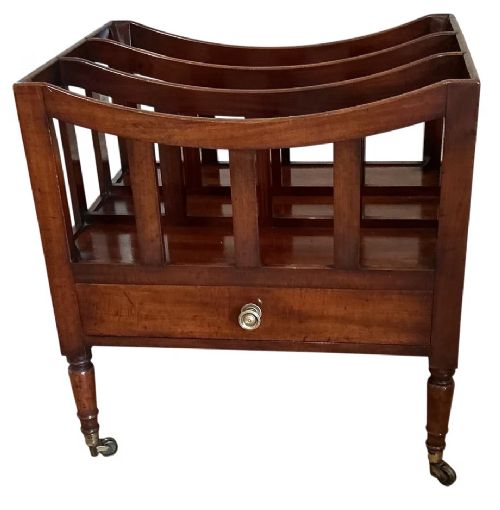
When you search for regency mahogany canterbury castors, you encounter compact standalone stands primarily used for holding newspapers, magazines, and sheet music. These pieces date predominantly from the nineteenth century, including the Regency, Georgian, and William IV periods, alongside examples attributed to around eighteen hundred or eighteen fifty.
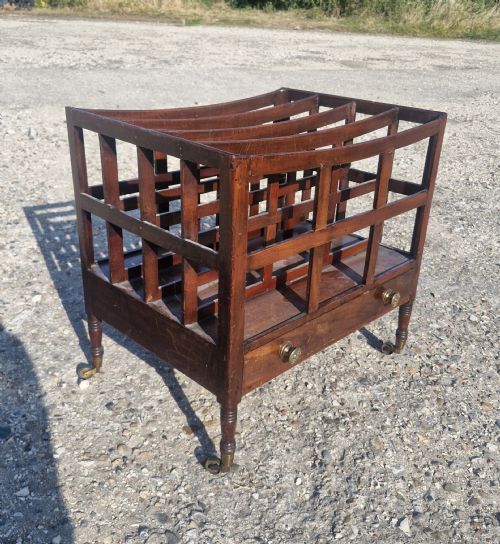
The versions most frequently met on this page take the form of boat-shaped frames or multi-division racks fitted with wooden or metal wheels for easy movement across the floor. They appear in forms described as magazine racks, newspaper stands, and music stands, often structured with four distinct interior divisions.
Originating in English workshops, these items reflect the cabinetry trends of the early nineteenth century. Makers constructed them to sit beside chairs or tables, keeping reading materials close at hand in domestic drawing rooms and libraries.
How they were made
Makers relied heavily on solid mahogany and rich veneers to build the main frames, occasionally incorporating contrasting woods such as ebony banding or rosewood details. This primary timber provided a durable structure with a deep, warm grain that responded well to polishing.
The lower framework typically integrates turned wooden legs finished with metal castors, allowing the stand to roll smoothly. Some variants incorporate decorative elements such as wreath carving or precise joinery to define the individual partitions.
Regency Mahogany Canterbury Castors Retail Price Guide 2026
Typical asking prices for regency mahogany canterbury castors among the pieces listed under this phrase on Sellingantiques today, from the lower quarter to the upper quarter. They describe what is for sale here now, not the wider market.
Some nineteenth-century canterburys were built with built-in cutlery trays or writing slopes, proving that Victorians loved multi-tasking furniture just as much as we do.
What varies in quality
The standard of craftsmanship shows in the crispness of the turned legs, the finesse of any decorative banding or carving, and the structural integrity of the interior divisions. Superior pieces demonstrate meticulous attention to timber selection, displaying cohesive grain patterns across the entire frame rather than mismatched boards.
Hardware and mobility also distinguish finer examples. Original castors that move freely and retain their matching metal components indicate a higher grade of preservation and original manufacture than replaced or sluggish fittings.
Gillows of Lancaster·J.C.Loudon
The Regency Mahogany Canterbury Castors Glossary
- Canterbury
- A low stand with partitions, traditionally used for holding music scores, newspapers, or periodicals. The name is believed to derive from an Archbishop of Canterbury who requested such a piece.
- Castor
- A small wheel fitted to the base of a piece of furniture to allow easy rolling across carpets and floors. They are commonly made of brass and mounted on turned wooden legs.
- Boat-shaped
- A descriptor for canterburys featuring curved, sweeping sides that resemble the hull of a vessel. This silhouette was especially popular during the Regency period.
- Ebony banding
- A thin strip of dark wood inlaid into the primary mahogany surface to create a contrasting border. It highlights the clean geometric lines of the piece.
Regency Mahogany Canterbury Castors: Frequently Asked Questions
What is a canterbury used for?
A canterbury is a low, compartmentalised stand originally designed to hold sheet music, books, or writing materials near a desk or piano. In modern interiors, they function effectively beside a sofa or armchair for storing current magazines and newspapers.
The open partitions keep reading materials upright and organised, preventing clutter while maintaining immediate accessibility. Their compact footprint makes them versatile additions to studies, living rooms, and hallways.
Why do they have castors?
Castors were added to allow the stand to be repositioned easily around a room as needed. In nineteenth-century drawing rooms, furniture was frequently moved to accommodate changing social activities.
Fitted to the base of the turned legs, these small wheels enabled servants or residents to slide the stand across carpets without lifting heavy loads. Today, they preserve that original functionality and mobility.
How do I tell Regency from Victorian?
Regency pieces typically display restrained classical proportions, elegant turned woodwork, and occasionally boat-shaped profiles with clean, architectural lines. They date from the early decades of the nineteenth century.
Victorian examples often introduce heavier ornamentation, different carving techniques, or alternative timber selections like rosewood. Comparing the leg turnings and joinery style helps clarify the period of manufacture.
Are all divisions original?
The interior slats and partitions experience considerable wear from the daily removal and insertion of heavy books and papers. Over generations of use, individual divider slats may have been re-secured or replaced.
Examining the wood species, patina, and fastening methods inside the rack helps determine whether the partitions remain intact from the original period of creation.