
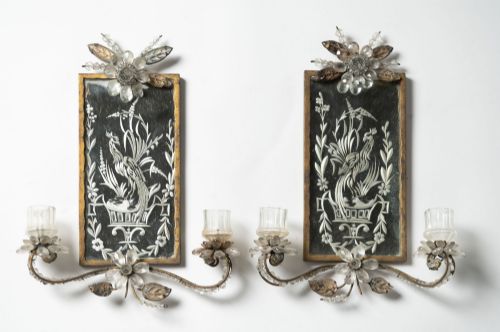


Regency Glass Wall Sconces
Regency glass wall sconces bring brilliant illumination and classical elegance to a room, catching the light through cut crystal and glass.
Regency Glass Wall Sconces
When you search for regency glass wall sconces, you find wall-mounted light fixtures that span multiple eras from the nineteenth century to the twentieth century. These pieces include pairs and sets designed to flank mirrors or fireplaces, often taking the form of tent lights, girandoles, or twin branch fittings.
The items listed on this page showcase a mix of periods, including nineteenth century originals alongside Edwardian and 1920s revivals. You will encounter styles described as Regency, French Regency, Italian Regency, and French Empire, reflecting the enduring popularity of classical symmetry and reflective glass surfaces.
Forms range from simple glass and metal wall lights to elaborate pieces featuring mirror backs and cut crystal drops. These wall sconces and girandole pier mirrors bring distinct character to an interior, functioning as both functional lighting and decorative wall art.
Materials and construction
Makers constructed these wall sconces using combinations of glass, cut crystal, rock crystal, brass, gilt metal, and standard metal frames. Cut glass and crystal components refract the light, while metal structures provide the necessary support for arms and mirror backs.
Techniques relied on precision glass cutting and metal shaping to form the intricate drops, tents, and branches characteristic of the style. Many pieces incorporate mirrored glass backplates to multiply the illumination from candles or early electric bulbs.
Some Edwardian wall lights incorporate hidden mirror backs designed to trick the eye into thinking a room possessed twice its actual window space.
Assessing quality in wall sconces
Quality reveals itself in the clarity and depth of the cut glass or crystal, where sharper facets and heavier metal mounts indicate superior manufacture. The integration of the mirror backplate and the precision of the metalwork set finer examples apart from simpler utilitarian pieces.
The coherence of the design within a pair or set determines desirability, as matched components demonstrate careful original assembly. Finer pieces maintain original metal patination and complete sets of crystal drops without mismatched replacements.
Maison Baguès
The Regency Glass Wall Sconces Glossary
- Girandole
- A branched wall light or sconce, frequently incorporating a mirror backplate to enhance the reflection of light into the room.
- Tent and drop
- A lighting configuration featuring a conical arrangement of crystal beads resembling a tent, suspended above hanging crystal pendants.
- Pier mirror
- A tall, narrow mirror designed to hang on the wall between windows, often fitted with candle branches or sconces.
- Rock crystal
- A naturally occurring colourless quartz, cut and polished by hand for high-end lighting fixtures before synthetic crystal became common.
Regency Glass Wall Sconces: Frequently Asked Questions
What periods do these sconces date from?
The pieces span from the nineteenth century through the Edwardian era and into the 1920s and 1930s. Many follow earlier classical aesthetics while utilising the manufacturing methods of their actual production date.
Distinguishing between original nineteenth-century pieces and later revivals involves examining the metal casting techniques, screw threads, and the composition of the glass elements.
How were regency glass sconces used?
These fixtures hung on walls to provide ambient illumination in reception rooms, hallways, and drawing rooms. Placed strategically near windows or between architectural pillars, they maximised the available light from candles or oil.
Reflective mirror backs and crystal drops served to bounce light around darker corners, functioning as decorative centerpieces even when unlit.
Are these wall lights sold in pairs?
Many of the listed wall sconces appear as matched pairs or sets of three, designed for symmetrical placement on either side of a fireplace, door, or mirror. Single sconces also occur, often originating from larger sets or designed for narrower wall spaces.
Finding matched pairs remains a key consideration for traditional room decoration where symmetry dictates the layout.
How do I live with antique wall sconces?
Integrating these fixtures into modern spaces involves checking the wiring and mounting capacity with a qualified professional to ensure safe operation. Many pieces accommodate standard low-wattage bulbs that preserve the warm glow of the original design.
Positioning them at eye level or flanking a mantelpiece highlights their reflective glass and metal details as focal points in a room.