
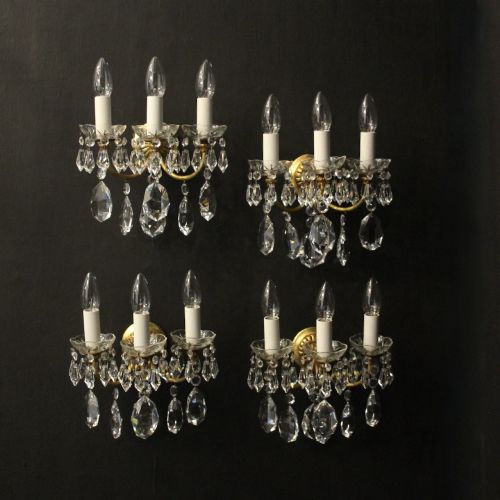
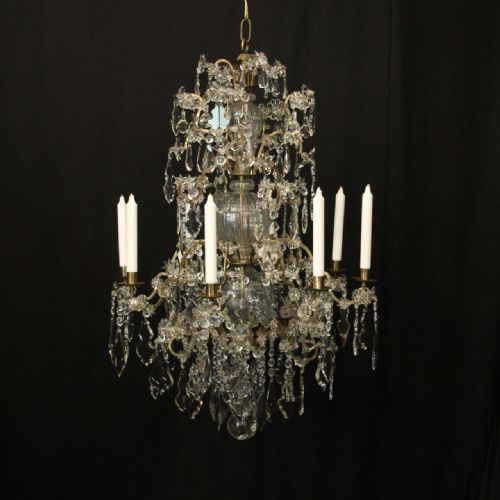


Cut Glass Candle Sconces
Cut glass candle sconces bring remarkable fire and brilliance to a room, catching every flicker of light against brass, gilt bronze, and crystal.
Cut Glass Candle Sconces
When you search for cut glass candle sconces, you enter a domain of wall-mounted illumination that draws heavily on French and English traditions. The selections range from twin branch wall lights to French crystal triple arm fixtures and Swedish glass lustres, spanning the nineteenth century through the art deco era of the nineteen-thirties.
Most examples you meet on this page pair clear glass or crystal components with metal frames of brass, silver, or gilt bronze. Forms vary from rococo revival candlesticks to clean-lined pieces influenced by regency and Edwardian aesthetics, often appearing in balanced pairs or sets of three and four.
How they were made
The makers of these pieces combined heavy lead crystal and cut glass with structural mounts in brass, gilt bronze, and silver. Workers shaped the metal backplates and arms through casting and gilding, providing a sturdy framework to support the refractive glass elements.
Artisans then cut and faceted the glass and crystal components by hand, creating sharp edges and deep prisms designed to multiply the light of candles. Lustres and drops were suspended from the arms to enhance this sparkle, secured with fine wire loops and metal pins.
Some nineteenth century glass lustres were known colloquially as 'invisible servants' because their sparkling prisms distracted dinner guests from smoky room lighting.
What varies in quality
The distinction between ordinary and exceptional pieces lies in the crispness of the glass cutting and the weight of the metal armature. Superior examples display deep, sharp facets that refract light cleanly, alongside substantial brass or gilt bronze backplates with refined surface chasing.
Design cohesion also sets pieces apart, as seen in the harmonious integration of glass drops with matching branches and backplates. Simpler utilitarian designs sit at one end of the scale, while elaborate creations by notable houses like Baccarat or followers of F. & C. Osler represent the other.
F. & C. Osler·Baccarat
The Cut Glass Candle Sconces Glossary
- Lustre
- A glass candlestick or hanging ornament adorned with cut glass pendants, designed to catch and reflect candlelight. These pieces often feature glass bobeches and hanging prisms.
- Bobeche
- A small glass collar or drip pan fitted beneath the candle nozzle to catch melting wax. It frequently supports a ring of dangling crystal prisms.
- Gilt Bronze
- Bronze metal treated with a gold wash or mercury gilding to produce a rich, durable golden finish. It provides a warm contrast to clear cut glass.
- Lead Crystal
- Glass containing lead oxide, which increases its weight, clarity, and refractive index. This material allows for deeper and sharper facet cutting than standard glass.
Cut Glass Candle Sconces: Frequently Asked Questions
Were these originally for candles?
Many wall lights and sconces from the nineteenth and early twentieth centuries were designed specifically to hold wax candles. The reflective glass panels and hanging lustres amplified the limited candlelight available in historic rooms.
Later adaptations often converted these fixtures for electricity while retaining the original glass arms and drip pans. Examining the nozzle interiors helps reveal whether a piece held a traditional candle or an early electrical fitting.
How do I date a sconce?
Dating relies on observing the stylistic cues of the metalwork and the specific cutting techniques used on the glass. Pieces from the mid nineteenth century often display ornate rococo or regency motifs, whereas nineteen-thirties examples favor cleaner lines.
Construction details such as screw types, metal casting quality, and wiring channels also provide clear clues. Comparing the piece against documented designs from makers like Baccarat helps narrow down the period.
Where should I hang a sconce?
Mount these wall lights in spaces where artificial illumination can interact directly with the cut glass facets. Hallways, dining rooms, and flanking a fireplace mirror are traditional locations that maximise their reflective qualities.
Ensure the wall structure can support the combined weight of the metal armature and heavy lead crystal. Positioning them at eye level allows the detailed casting and glasswork to be appreciated up close.