



Red Upholstery Chair
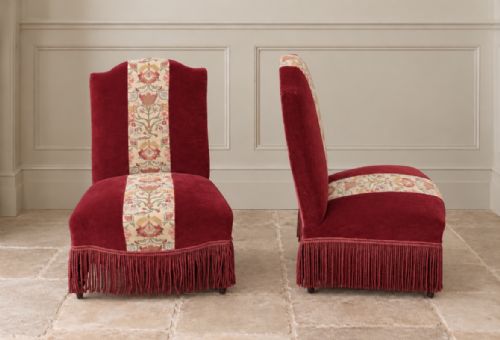
These red upholstery chair options bring rich colour and classic seating to a room, spanning periods from the eighteenth century to the early twentieth.
Red Upholstery Chair
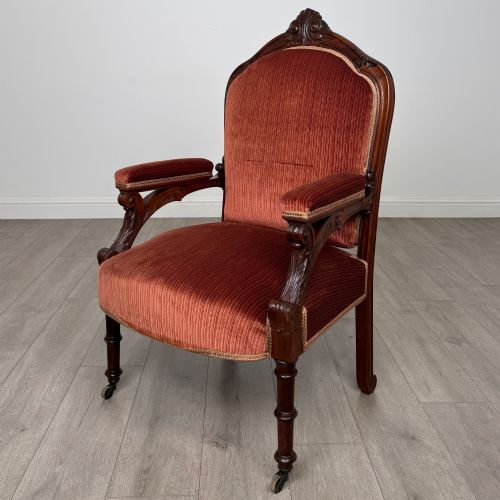
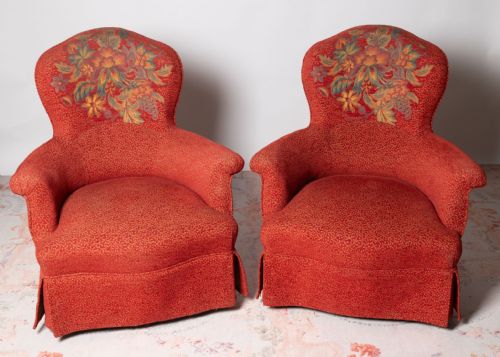
A red upholstery chair is a practical and striking seating choice found across multiple periods, including the Victorian era and the eighteenth century. Buyers seeking this style will encounter diverse forms ranging from large armchairs and open armchairs to sets of dining chairs and bedroom chairs.
The pieces available on this page highlight distinct regional and stylistic variations, such as French Napoleon III designs, Renaissance Revival, and Jacobean Revival. Armchairs often feature deep button backs or supportive padded backs, while dining chairs offer straightforward padded construction.
Materials and construction
Makers utilised solid timbers such as mahogany, walnut, oak, rosewood, and general wood to build sturdy frames that support the upholstered upper sections. Carved details frequently appear on the wooden frameworks of armchairs and side chairs, showcasing traditional joinery.
The soft coverings rely on textiles, fabric, velvet, and occasionally kilim, paired with brass details where appropriate. Button-back padding techniques provide both structural depth and a tailored finish to the textile surfaces.
Red Upholstery Chair Retail Price Guide 2026
Typical asking prices for red upholstery chair among the pieces listed under this phrase on Sellingantiques today, from the lower quarter to the upper quarter. They describe what is for sale here now, not the wider market.
Listings feature periods spanning from the eighteenth century through the Victorian era up to nineteen-ten, utilising walnut, mahogany, oak, and rosewood.
Assessing quality and craftsmanship
Superior examples distinguish themselves through the precision of the carved woodwork and the choice of durable frame timbers like walnut and mahogany. The integrity of the original or renewed upholstery work and the symmetry of button-backed padding dictate the overall refinement of the seating.
Sets maintain greater consistency when the frames and textile selections match closely across multiple dining or bedroom chairs. Single armchairs achieve distinction through notable proportions, such as large armchair dimensions or sculptural open arm designs.
Howard & Sons
The Red Upholstery Chair Glossary
- Armchair
- A comfortable seat with side supports for the arms. These include large lounge chairs and open reception seating.
- Button back
- An upholstery technique where indentations are formed by pulling stitches tightly through the padding and securing them with buttons. This creates a distinctive padded pattern.
- Renaissance Revival
- A nineteenth-century architectural and decorative style inspired by Renaissance motifs. Pieces in this style display classical carved ornamentation.
Red Upholstery Chair: Frequently Asked Questions
What periods do these chairs come from?
The selection spans several eras, running from the eighteenth century through the nineteenth century and into the early twentieth century. Victorian examples are particularly common.
Specific dates within listings sometimes point to specific decades, such as the eighteen-seventies, or broader periods like late Victorian.
Are these chairs suitable for daily use?
Most pieces are built from sturdy hardwoods like mahogany, walnut, and oak, providing reliable structural support for regular seating. Many feature comfortable padded or button backs.
Some dining chairs and armchairs are designed for formal reception rooms, while others suit bedroom or casual living spaces.
How do I identify a French armchair?
French chairs often carry specific stylistic labels such as Napoleon III or farmhouse fauteuil. They typically showcase carved wooden frames and open arm designs.
Materials used in these continental pieces frequently include walnut paired with textile or velvet upholstery.
What frame woods are most common?
Makers relied heavily on traditional cabinet timbers, with walnut, mahogany, oak, and rosewood appearing frequently across the inventory. General wood frames also support simpler or later pieces.
These timbers often feature visible carved details, particularly on Victorian and revival styles.