



Red Marble Lamps
Red marble lamps bring striking colour and classical weight to a room, cast from rich stone and detailed metalwork.
Red Marble Lamps
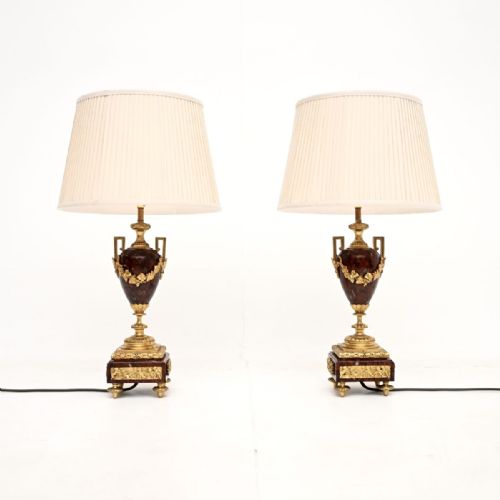
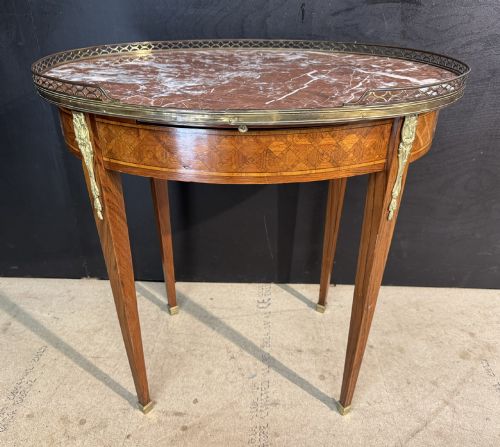
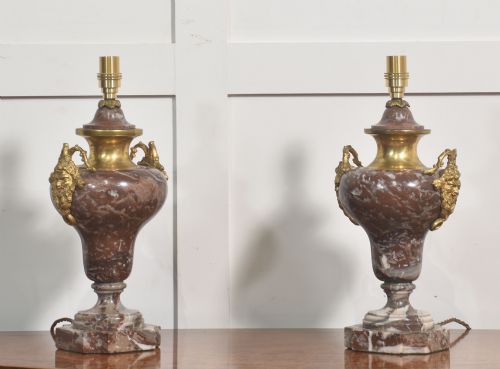
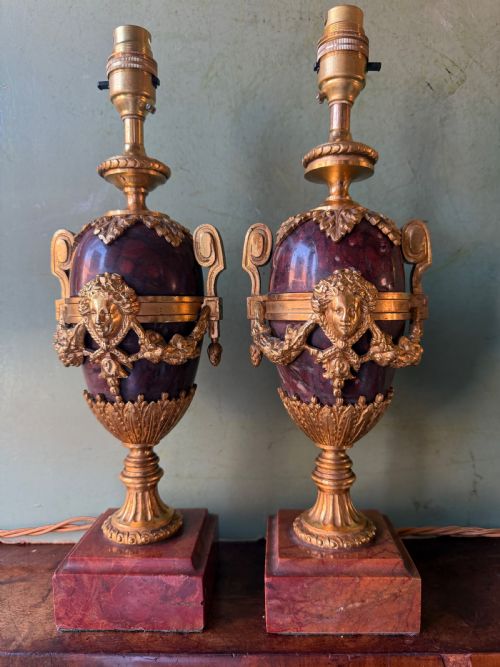
Red marble lamps combine turned or polished stone bodies with metal mounts, primarily taking the form of table lamps alongside occasional furniture with inset tops. These decorative objects draw heavily on French Neoclassical, Louis XVI, and Empire design vocabularies developed during the nineteenth century.
The materials span rouge marble, red and grey marble, and two-tone polished stone, often paired with brass, ormolu, gilt bronze, patinated bronze, and standard brass or giltwork. Most examples originate from nineteenth-century French workshops or English Victorian production, while related table forms include rosewood and burr walnut occasional tables.
Buyers seeking red marble lamps encounter matching pairs and individual standard or table lamps featuring classical proportions, columnar shafts, or figural supports. The selection also includes converted candlesticks and pieces incorporating giltwood, bronze, and classical brass mountings.
How they were made
Makers shaped the heavy stone bodies by turning and polishing solid blocks of rouge and multi-toned marble to achieve smooth, reflective cylindrical, urn, or column forms. Natural variations in the mineral veining meant each stone base possessed a distinct visual character.
Metal components, such as ormolu, gilt bronze, and patinated bronze, were cast and chased separately before being mounted onto the marble. Craftsmen secured these brass and bronze mounts using threaded rods or pins that passed directly through the stone cores.
Red Marble Lamps Retail Price Guide 2026
Typical asking prices for red marble lamps among the pieces listed under this phrase on Sellingantiques today, from the lower quarter to the upper quarter. They describe what is for sale here now, not the wider market.
Materials recur across the archive in various combinations of rouge marble, gilt brass, patinated bronze, and carved rosewood.
What varies in quality
Quality rests significantly in the crispness and weight of the cast metal mounts, where finely chased ormolu displays sharp architectural detail and deep fire-gilt colour. Lesser examples utilise simpler brass castings with softer definition and minimal hand finishing.
The selection of the marble itself distinguishes standard production from exhibition pieces, as dense stone with dramatic, unbroken veining commands greater visual authority. Precision in the lathe work and tight joints between stone and metal further separate workshop standards.
The Red Marble Lamps Glossary
- Ormolu
- A technique of applying finely ground high-carat gold to a bronze base using a mercury amalgam, creating a rich golden surface. This finish appears frequently on nineteenth-century French lamp mounts.
- Rouge marble
- A deep red ornamental limestone characterised by varied white, grey, or dark veining. It was widely utilised in French decorative arts for architectural elements and lamp bodies.
- Neoclassical
- A revival style drawing inspiration from the classical art and architecture of ancient Greece and Rome. It prioritises symmetry, proportion, and restrained classical ornament.
- Patinated bronze
- Bronze that has been chemically treated to produce a darkened or aged surface tone. This contrast highlights the brighter gilt bronze and marble components.
Red Marble Lamps: Frequently Asked Questions
Are these lamps usually sold in pairs?
Many nineteenth-century French lighting pieces survive as symmetrical pairs designed for sideboards or mantelpieces. Single examples also appear frequently across both table and standard lamp formats.
Matching sets often originate from grand domestic interiors where balanced lighting arrangements were standard practice.
How do I identify French nineteenth-century styling?
French pieces from this era typically exhibit precise ormolu mounts, classical column or urn forms, and Louis XVI or Empire design motifs. The integration of rouge marble with gilt bronze serves as a primary indicator of this origin.
Craftsmanship in the chasing of the metalwork provides further evidence of Parisian workshop production during the period.
Can these antique lamps be rewired safely?
Most antique lamps are adapted for modern electrical standards by running internal flex through the original central core. This process preserves the exterior stone and metal components without altering the antique structure.
Professional rewiring ensures compliance with current safety regulations while maintaining the visual integrity of the piece.
What is the difference between ormolu and brass?
Ormolu consists of cast bronze finished with a mercury gold gilding process, producing a warm, deep lustre that resists tarnish. Brass is an alloy of copper and zinc that generally presents a brighter, yellower metallic tone.
On high-end nineteenth-century pieces, gilded bronze mounts were meticulously hand-chased after casting, unlike simpler stamped brass elements.