



Reconstituted Stone Lion Statues
Reconstituted stone lion statues command attention beside a driveway or upon a terrace, bringing classical symmetry and enduring presence to an outdoor space.
Reconstituted Stone Lion Statues
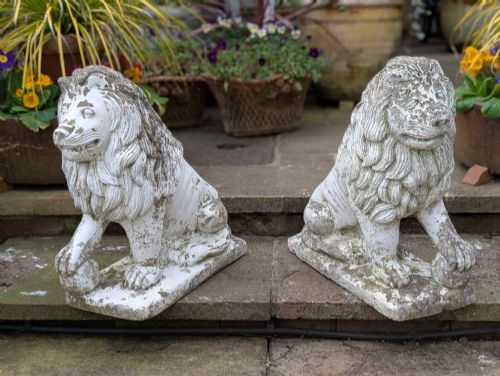
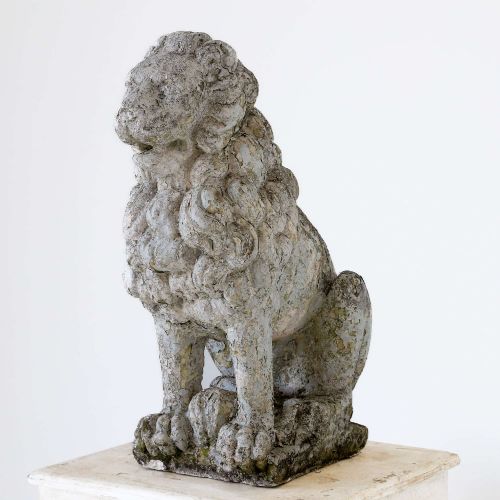
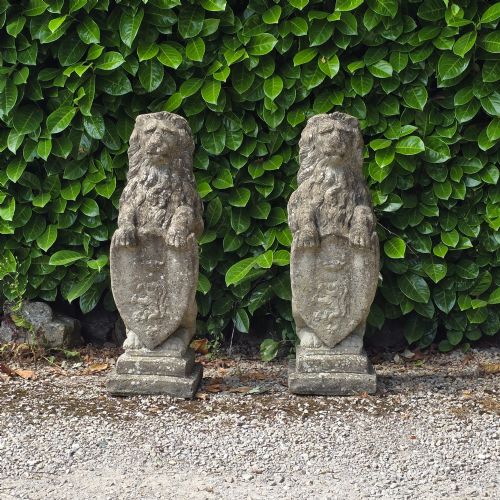
Reconstituted stone lion statues arrive in pairs or solitary forms, standing guard or seated upon integral plinths and gate piers. These figures draw upon neoclassical, classical revival and grand regency traditions to anchor an english garden or architectural entrance with formal dignity.
You are most likely to meet mid-century pairs dated around 1950 alongside weathered 1920s examples, while grander Victorian and nineteenth-century French Medici designs appear less frequently. Makers cast these guardians to serve as gate finials, pier caps or substantial lawn ornaments.
The sculptural postures vary from alert standing guardians to restful seated beasts, often retaining traces of original old paint or weathering naturally through decades outdoors. Such versatility makes them a staple of english country house design, equally at home flanking a modest garden path or a sweeping carriage drive.
Materials and construction methods
Foundries and stone-masons manufactured these pieces using composite stone, cast stone and reconstituted stone, blending crushed aggregates with cement binders to replicate natural sandstone. This liquid or semi-dry mix was tamped into intricate moulds taken from carved originals, capturing the muscular detail and formal manes of neoclassical sculpture.
Many survivors carry layers of historical paint applied to mimic aged masonry or to protect the porous matrix from frost heave. Over decades in the elements, the cast surfaces weather organically, developing moss patinas and surface pitting that distinguish genuine garden statuary from modern reproductions.
Reconstituted Stone Lion Statues Retail Price Guide 2026
Typical asking prices for reconstituted stone lion statues among the pieces listed under this phrase on Sellingantiques today, from the lower quarter to the upper quarter. They describe what is for sale here now, not the wider market.
One persistent nineteen-thirty guardian wears layers of authentic old paint, proving that even fierce stone beasts appreciated a seasonal wardrobe change.
Markers of sculptural quality
Proportion and scale separate imposing architectural gate finials from domestic garden ornaments, with well-balanced pairs commanding a heavier presence. The integrity of the original surface, whether bare weathered composite or remnants of authentic old paint, preserves the historical character of the piece.
The Reconstituted Stone Lion Statues Glossary
- Reconstituted stone
- A durable building material manufactured from crushed stone aggregates bound with cement, cast into moulds to imitate natural masonry. It allows intricate sculptural forms to be produced with consistency.
- Gate finial
- An ornamental architectural carving mounted upon the top of a gatepost or pier. These pieces often take the form of heraldic beasts or lions acting as guardians.
- Medici lion
- A classical sculptural type depicting a powerful alert lion with one paw resting upon a sphere, originating from Roman antiquity and famously copied during the Renaissance. French interpretations of this form remain particularly sought after.
- Composite stone
- A modern synonym for reconstituted stone, denoting a mixture of natural stone dust and binding agents. It weathers similarly to quarried sandstone over time.
- Plinth
- A heavy architectural base or block upon which a statue or urn is elevated. Many garden lions are cast with integral plinths to provide stability on lawns and gravel.
Reconstituted Stone Lion Statues: Frequently Asked Questions
How do I clean my stone lion?
Gentle brushing with warm water removes surface dirt without stripping the historic patina or damaging the cast surface. Avoid harsh chemical cleaners and high-pressure washers, which scour away the outer crust of reconstituted stone.
Allow the weathering process to continue naturally, as lichens and gentle staining enhance the antique appearance of nineteenth-century and mid-century garden ornaments.
Can these statues stay outside in winter?
Cast and composite stone figures endure winter frosts well provided they are raised slightly off damp ground on bricks or timber battens. Trapped moisture freezing beneath a heavy plinth can cause cracking, so proper winter positioning matters.
Covering them tightly in plastic traps condensation and accelerates surface damage; leaving them open to the air is generally safer.
How do I date a stone lion?
Stylistic clues, mounting types and surface patination help indicate the age of garden statuary. Nineteenth-century French pieces often display sharper classical detailing, whilst mid-century examples from the nineteen-fifties utilise heavier, simpler composite mixes.
Traces of original old paintwork provide further clues to the decade of manufacture, matching the decorative preferences of English country house gardens from the interwar period onward.
Where should I place a pair?
Pairs of seated or standing lions suit symmetrical settings such as flanking entrance gates, anchoring the base of a terrace stairway, or framing a primary garden view. Their original purpose as gate finials means they look most natural when terminating a wall or path.
Ensure the ground beneath is level and firm, as the substantial weight of reconstituted stone requires stable foundations to prevent shifting over time.