

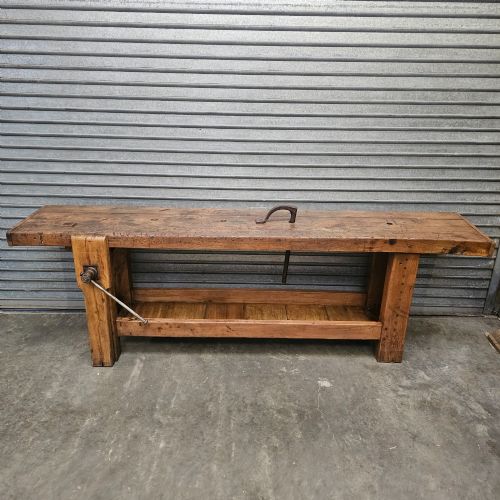
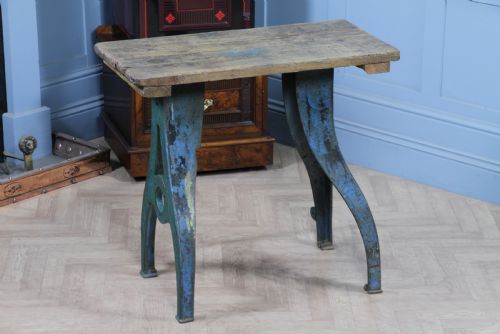


Reclaimed Workbench Table
These heavy-duty reclaimed workbench table pieces bring honest utility and robust character into modern rooms.
Reclaimed Workbench Table
A reclaimed workbench table merges the robust utility of historical workshops with domestic dining and hallway use. Buyers tracking down a reclaimed workbench table encounter forms adapted from carpenter's benches, cheese presses, and industrial machinery bases.
The objects span the nineteenth century and the early twentieth century, reflecting industrial and rustic farmhouse styles. Common manifestations include console tables, trestle tables, and large dining surfaces fitted with original vices or iron supports.
Origins stretch across English and French workshops, utilising existing timbers rather than newly felled lumber. These items serve equally well as central kitchen islands, dining tables, or commanding hallway consoles.
Materials and construction
Construction relies heavily on thick solid pine and oak planks joined to robust structural supports. Iron and cast iron feature prominently in the legs, bases, and functional hardware such as vices and winding screws.
Surfaces often display the scars of heavy manual labour, retaining original paint, stains, and tool marks. Trestle frames and metal bases provide the rigidity necessary to support dense timber tops without movement.
Reclaimed Workbench Table Retail Price Guide 2026
Typical asking prices for reclaimed workbench table among the pieces listed under this phrase on Sellingantiques today, from the lower quarter to the upper quarter. They describe what is for sale here now, not the wider market.
Current listings showcase pieces spanning from eighteen-fifty through the nineteen-twenties, incorporating pine, oak, cast iron, and steel.
Judging quality in industrial work tables
Quality rests in the integrity of the original mechanism and the thickness of the timber top. Tables retaining functional wooden vices or heavy cast-iron bases demonstrate higher manufacturing ambition than domestic adaptations.
The balance between patinated age and structural soundness dictates desirability. Pieces that preserve authentic workshop wear without compromising daily usability command greater respect from discerning buyers.
The Reclaimed Workbench Table Glossary
- Trestle table
- A table structure featuring two or more horizontal beams supported by diverging legs. This design provides exceptional legroom and stability.
- Cast iron
- An iron-carbon alloy poured into moulds to create heavy, rigid machine bases and decorative brackets. It forms the indestructible foundation of many industrial tables.
- Pine
- A softwood commonly utilised for historical work surfaces due to its availability and resilience. Over decades of use, it develops a deep, honeyed patina.
- Vice
- A mechanical screw apparatus attached to a workbench to hold timber securely during shaping. On salvaged tables, this serves as a striking sculptural feature.
Reclaimed Workbench Table: Frequently Asked Questions
How do I clean a wooden work table?
Maintain the timber by wiping surfaces with a slightly damp cloth and drying them immediately. Avoid harsh chemical cleaners that strip the historic patination accumulated over generations of workshop use.
Periodically nourish dry pine or oak with natural beeswax to preserve the grain. This guards against moisture while maintaining the honest, matte finish characteristic of industrial furniture.
Can I use an old workbench for dining?
These pieces function wonderfully as dining surfaces due to their generous proportions and stable frames. Ensure the height matches standard seating before pairing chairs with deep wooden skirts.
Many designs incorporate trestle legs or indented bases that comfortably accommodate diners along the full length. The thick timber tops easily withstand the demands of daily family meals.
What defines industrial utilitarian style?
Industrial utilitarian furniture prioritises function above ornamentation, reflecting the practical needs of nineteenth and early twentieth-century factories. Every structural element serves a distinct mechanical purpose.
Raw metals, exposed fixings, and unadorned timber define the aesthetic. This uncompromising focus on utility creates a striking contrast in modern residential interiors.
How do I date a nineteenth-century table?
Dating relies on observing construction methods, tool marks, and the specific composition of the iron hardware. Hand-sawn timber and forged iron components generally indicate earlier nineteenth-century manufacture.
Later pieces from the early twentieth century often integrate rolled steel and standardised machine bolts. Comparing these physical clues against known workshop styles clarifies the timeline.