




Portable Table Clock
A portable table clock travels easily, combining mechanical precision with brass housing and glass panels to tell time anywhere.
Portable Table Clock
A portable table clock offers mechanical timekeeping in a compact format designed for movement rather than permanent placement on a mantelpiece.
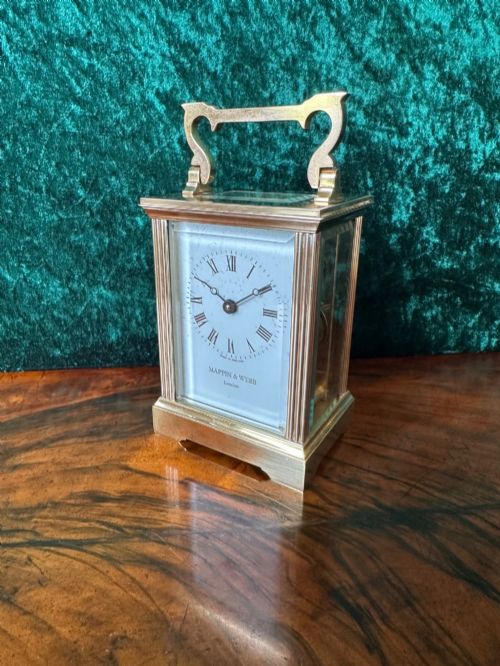
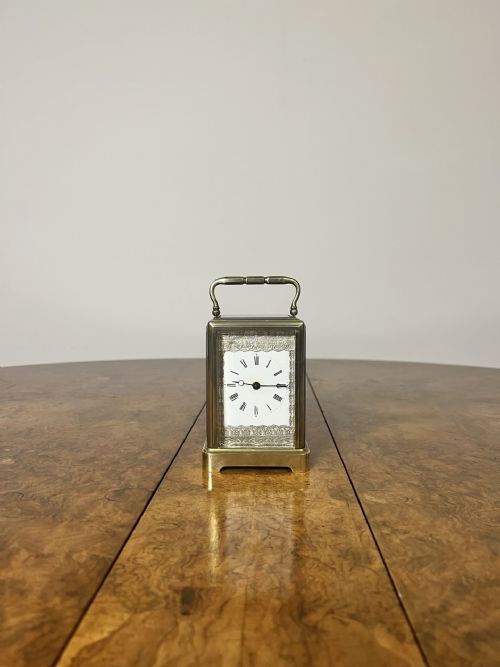
The portable table clock on this page appears most frequently as a carriage clock housed in brass and glass, alongside related forms like writing desks and exhibition clocks.
These pieces emerge across the nineteenth and twentieth centuries, spanning Victorian, Edwardian, and Art Deco periods with French and British origins.
Materials and construction
Makers construct these clocks using heavy brass frames inset with clear glass panels that reveal the internal mechanical movement.
Dials frequently feature enamel or silvered metal surfaces, whilst protective leather travelling cases accompany various examples.
Cabinetmakers utilise timber such as mahogany, fruitwood, and satinwood for associated pieces like writing desks.
Portable Table Clock Retail Price Guide 2026
Typical asking prices for portable table clock among the pieces listed under this phrase on Sellingantiques today, from the lower quarter to the upper quarter. They describe what is for sale here now, not the wider market.
Several clocks come with their original leather travelling cases, proving that nineteenth-century gear also needed a good suitcase.
Judging quality in timepieces
Quality rests in the sophistication of the movement, such as the inclusion of strike repeat functions or eight-day duration, rather than simple exterior decoration.
The refinement of the brass casting and the clarity of the enamel dial distinguish superior examples from standard production pieces.
Provenance adds distinction when signed by known makers like Henri Jacot or retailers such as Mappin and Web.
Mappin and Web·Latshea and Sons Edinburgh·J.C Vickery of London·Paul Garnier·Henri Jacot
The Portable Table Clock Glossary
- Strike repeat function
- A mechanical complication allowing the clock to repeat the last hour or quarter-hour struck when a button or cord is pressed. This feature required skilled watchmaking.
- Eight day
- A movement capable of running for eight days on a single winding. This reduced the frequency of maintenance for the owner.
- Enamel
- A glassy substance fused to a metal dial substrate through high-fired kilns. It provides a durable, smooth surface for painted numerals.
Portable Table Clock: Frequently Asked Questions
What is a portable table clock?
A portable table clock is a mechanical timepiece built into a sturdy case with a handle, designed to be moved between rooms or taken on journeys. Most examples feature glass panels that display the moving gears.
These pieces developed from the needs of nineteenth-century travellers who required reliable timekeeping away from large domestic clocks.
How do I wind these clocks?
Most pieces use a dedicated winding key inserted into arbors located on the backplate or underneath the movement. Care must be taken not to overwind the mainspring.
Eight-day movements require winding less frequently than standard thirty-hour versions, maintaining consistent tension on the gear train.
Were these clocks meant for travel?
Carriage clocks were specifically engineered for mobility, often accompanied by fitted leather travelling cases to absorb jolts during transit. The platform escapement allowed them to keep accurate time while moving.
Owners packed them into luggage alongside other personal effects when undertaking long journeys by coach or rail.
How do I date an antique clock?
Dating relies on stylistic markers, such as the heavy classical brass cases of the Victorian era versus the streamlined geometric lines of Art Deco pieces. Maker signatures and engraved movement serial numbers also help establish the period of manufacture.
Examining the escapement type and dial materials provides further clues to the decade of production.