

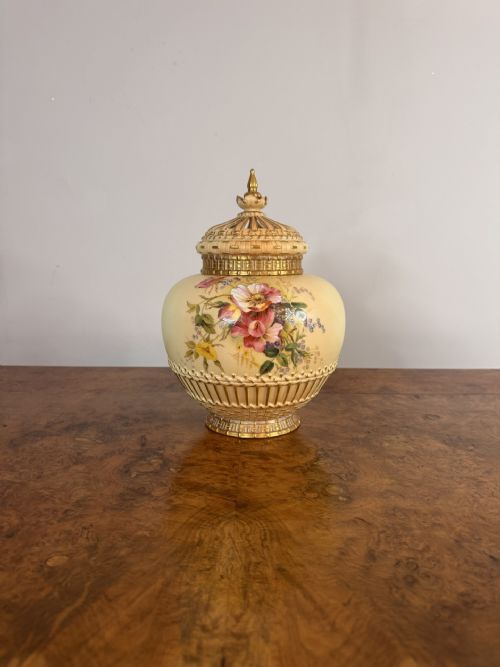
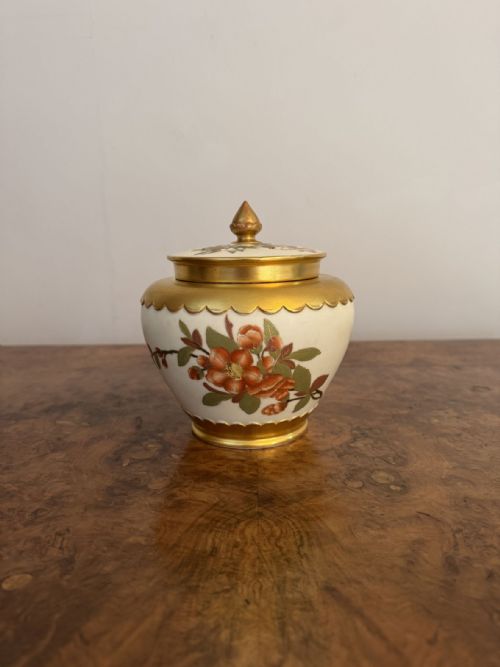


Porcelain Potpourri Urn
A porcelain potpourri urn brings scent and colour into a room through pierced lids designed to release dried petals.
Porcelain Potpourri Urn
A porcelain potpourri urn functions primarily as a decorative vessel designed with a pierced or perforated cover to release the fragrance of dried herbs and flower petals stored inside. When searching for a porcelain potpourri urn, collectors encounter forms ranging from lidded jars to twin-handled vases spanning the Georgian, Victorian, and Edwardian eras.
The material composition relies heavily on fine ceramics, including English bone china, ironstone, and Continental porcelain bodies. Many examples take the form of lidded ginger jars, bulbous pots, and pedestal vases equipped with inner lids beneath the main pierced cover to contain the botanical mixture.
Victorian factories such as Royal Worcester dominate the selection alongside earlier Georgian makers, frequently employing classical urn silhouettes. These pieces combine utility with ornamental display, serving as centrepieces on mantelpieces and side tables since the eighteenth century.
Materials and production methods
Potters shaped these vessels using traditional ceramic bodies like porcelain and ironstone, fired at high temperatures to achieve a dense and durable structure. Artisans then applied intricate hand-painted motifs, enamel paint, and transfer printing, often incorporating cobalt blue grounds or blush ivory finishes.
Gilding and gold leaf highlights were meticulously applied to rims, handles, and finials before a final secondary firing to fuse the metallic decoration. Pierced covers required precise hand-cutting of apertures in the wet clay body to ensure symmetrical airflow patterns without compromising the structural integrity of the lid.
Porcelain Potpourri Urn Retail Price Guide 2026
Typical asking prices for porcelain potpourri urn among the pieces listed under this phrase on Sellingantiques today, from the lower quarter to the upper quarter. They describe what is for sale here now, not the wider market.
Listings span the eighteenth, nineteenth, and twentieth centuries, featuring porcelain, ironstone, and gilt bronze materials.
Assessing craftsmanship and finish
The distinction between standard production and top-tier execution lies in the crispness of the moulded details and the precision of the pierced lid apertures. Finer examples exhibit hand-painted botanical or figurative panels executed by named artists, whereas lesser pieces rely on uniform transfer prints.
The application of gilding and enamel work reveals the skill of the decorator, with superior specimens showing burnished gold leaf and rich, layered enamel paint rather than flat, machine-applied metallic paint. Preservation of the original inner and outer covers intact also elevates the standing of an individual vessel.
Royal Worcester·Spode·Masons Ironstone·Wolfsohn Dresden·Sitzendorf Porcelain·Herend
The Porcelain Potpourri Urn Glossary
- Potpourri
- A mixture of dried flower petals and spices placed inside a vessel to perfume a room. The practice dates back centuries and required specialised lidded containers to house the aromatics.
- Blush Ivory
- A specific ceramic finish developed by Victorian potteries to create a soft, matte cream background. This technique mimics the tone of unglazed ivory and provides a subtle base for floral decoration.
- Ironstone
- A heavy, durable type of earthenware patented in the nineteenth century. It resists chipping better than soft-paste porcelain while offering a sturdy surface for blue transfer printing and Imari patterns.
- Crown Cover
- An ornate secondary lid configuration resembling a crown, featuring pierced cut-outs. This structure allows maximum scent dispersion from the potpourri contents within the vase.
Porcelain Potpourri Urn: Frequently Asked Questions
How do I use a potpourri urn today?
Place dried scented botanicals inside the main chamber and position the pierced lid on top to allow the fragrance to disperse gently into the room. Keep the vessel away from direct sunlight and damp environments to preserve both the ceramic body and the botanical contents.
Ensure you remove the contents periodically for cleaning the interior with a dry cloth to prevent dust accumulation within the pierced apertures of the cover.
How do I distinguish Victorian from Georgian pieces?
Georgian examples often feature classical shapes with hand-painted floral motifs or early transfer printing techniques, reflecting neoclassical design influences. Victorian specimens tend to show more exuberant moulding styles, including Rococo revival scrolls and blush ivory finishes.
Examining the paste body, glaze characteristics, and any factory marks on the underside will further clarify the manufacturing period.
What causes the different glaze colours?
Makers achieved various background tones through specific chemical formulations added to the ceramic body or glaze before firing. Cobalt blue ground required metallic oxides applied under the glaze, while blush ivory relied on specialised opacity agents.
Enamel paint and gold leaf were added in subsequent low-temperature firing stages to sit on top of the primary glaze.
Are inner lids necessary for these urns?
Many traditional potpourri vessels included a secondary inner lid to directly contain the loose plant material beneath the decorative outer cover. This dual-lid system prevented small particles from falling out and helped regulate the release of the scent.
While many surviving pieces retain their complete set of covers, finding them without the inner lid remains common due to centuries of handling.