






Period Wood Whatnot
A period wood whatnot brings tiered display and practical shelving into a room, offering the clean lines of mahogany, rosewood, oak, and brass.
Period Wood Whatnot
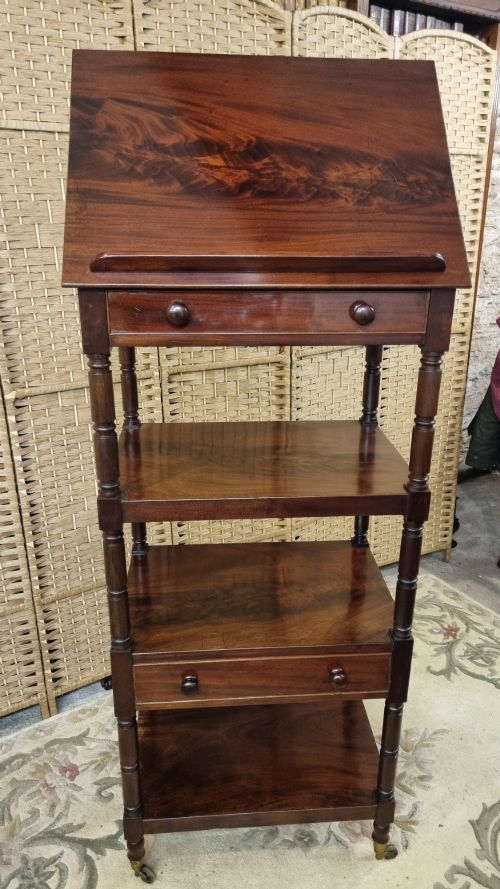
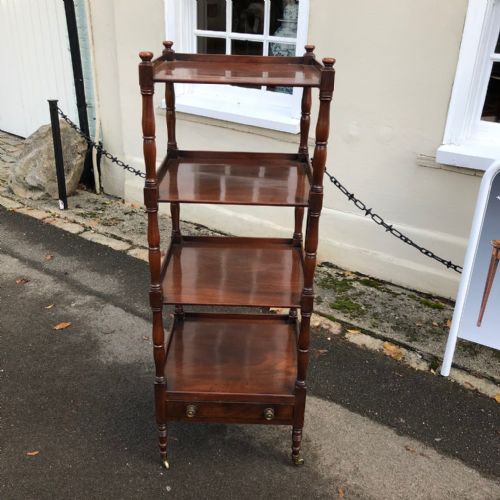
A period wood whatnot is a tiered shelving unit or etagere designed for holding books, ornaments, and display items. These pieces span the Georgian, Regency, William IV, and Victorian eras, originating from the early nineteenth century.
The versions met most frequently on this page are mahogany and rosewood three-tier what-nots from the Regency and George III periods. Compact scales, octagonal forms, and pairs appear alongside standard freestanding shelving units.
Makers and craftsmen of these eras utilised fine timbers to construct sturdy multi-level furniture that suited domestic sitting rooms and drawing rooms. The evidence shows surviving examples in oak, mahogany, and rosewood, often accented with brass details.
How they were made
Cabinet makers constructed these etageres and whatnots using dense tropical hardwoods such as mahogany and rosewood, alongside native oak. Timbers were selected for grain pattern and rich colour before being shaped into upright supports and tier boards.
Joinery involved precise fitting of shelves to uprights, sometimes incorporating turned columns and brass castors for mobility. Surface finishing emphasised the natural lustre of the wood through polishing rather than heavy ornamentation.
Period Wood Whatnot Retail Price Guide 2026
Typical asking prices for period wood whatnot among the pieces listed under this phrase on Sellingantiques today, from the lower quarter to the upper quarter. They describe what is for sale here now, not the wider market.
Some nineteenth-century makers could not decide between two names, labelling their creations as whatnot or etagere just to be safe.
What varies in quality
Quality in a period wood whatnot rests upon the choice of timber and the crispness of the turning on the upright supports. Dense, well-figured mahogany or richly grained rosewood elevates a piece above standard utility items.
Proportion and scale distinguish finer examples, particularly where compact dimensions or unusual tiered configurations are executed with balanced harmony. Subtle details such as brass mounts and refined edge moulding separate standard joinery from superior cabinet work.
The Period Wood Whatnot Glossary
- Etagere
- A piece of furniture consisting of a set of open shelves for holding ornaments, synonymous with the whatnot. The term derives from French and often describes lighter display pieces.
- Regency
- An architectural and decorative style spanning the early nineteenth century, characterised by classical restraint and refined proportions. Pieces from this period frequently employ dark hardwoods and subtle brass accents.
- Georgian
- The period covering the reigns of the first four Georges, known for classical symmetry and expert cabinet making. Mahogany was the primary timber utilised during this era.
- Tier
- An individual level of shelving within a multi-level structure like a whatnot. Multiple tiers allow for graded display of books and decorative objects.
Period Wood Whatnot: Frequently Asked Questions
What is a period wood whatnot used for?
A period wood whatnot serves as an open shelving unit for displaying books, ceramics, and ornaments in a reception room. Its multiple tiers provide vertical storage without bulk.
Historically, these pieces held prized possessions and writing materials within easy reach of a seating area. Today, they function similarly in modern interiors for accent display.
How do I identify a Regency whatnot?
Regency whatnots date from the early nineteenth century and typically feature dark timbers like mahogany or rosewood, sometimes with turned columns. They often incorporate brass castors and display classical proportions.
Comparing the turning style and timber grain against documented examples helps confirm the period. The absence of heavy Victorian carving is also a key indicator.
What is the difference between a whatnot and an etagere?
In British furniture terminology, whatnot and etagere refer to the same form of multi-tiered open shelving. Etagere is a French term sometimes used interchangeably in nineteenth-century trade descriptions.
Both types were designed for display and storage in drawing rooms. Listings often combine the two terms to describe the same object category.
Are mahogany and rosewood common in these pieces?
Mahogany and rosewood are the dominant timbers found across nineteenth-century whatnots. Their density and rich natural colour made them the preferred choice for high-quality cabinet work.
Oak also appears in specific regional or matched pieces, offering a different grain texture. Each timber responds distinctively to period polishing techniques.