

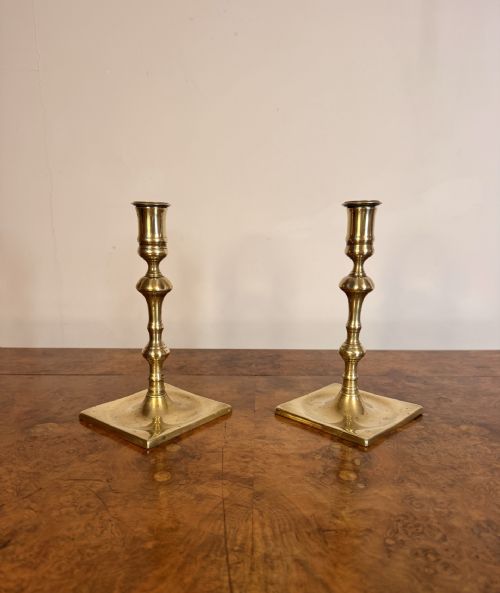
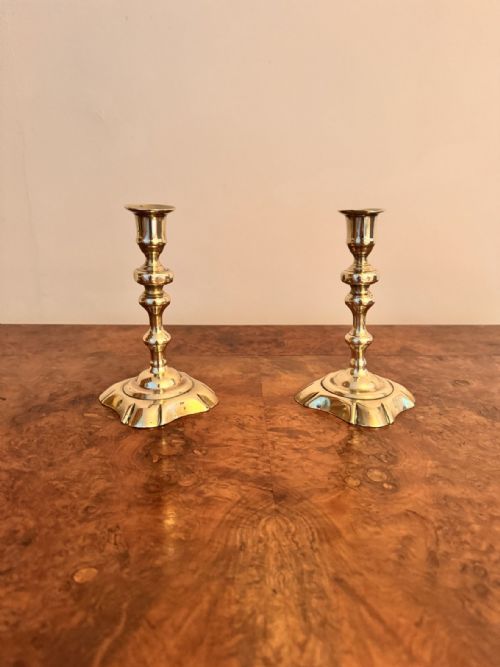
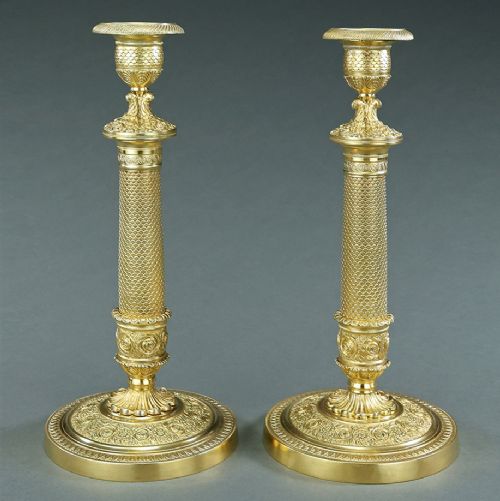

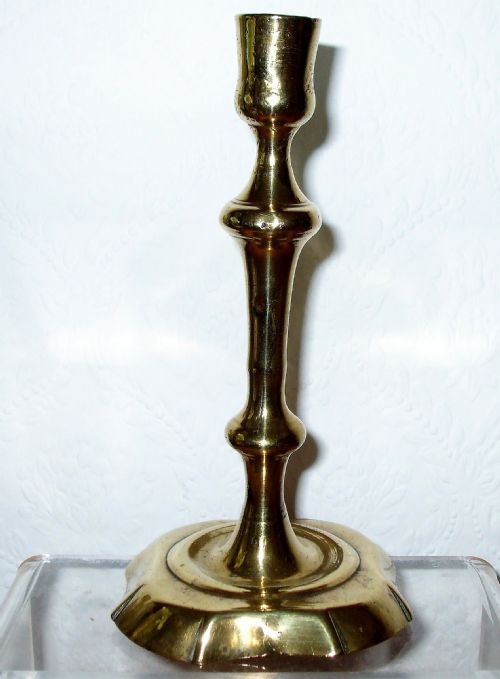
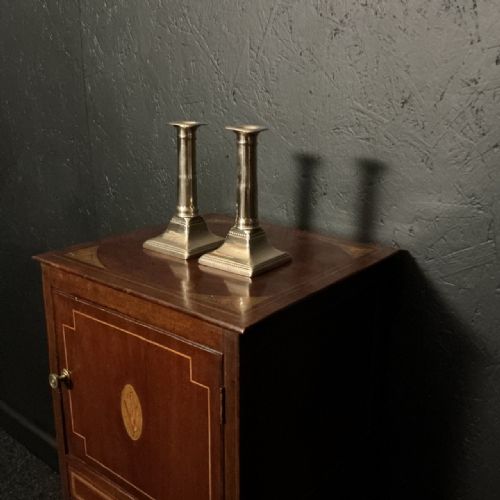


Period Metal Candlesticks
These period metal candlesticks bring weight and steady light to a room, drawn from centuries of domestic metalwork.
Period Metal Candlesticks
Period metal candlesticks span the seventeenth, eighteenth, and nineteenth centuries, taking the form of ejector sticks, chamber sticks, prickets, and candelabra. Brass forms the backbone of these pieces, alongside patinated bronze, gunmetal, ormolu, and occasional slate bases.
English and French examples predominate, moving from the plain turnings of the Queen Anne and Georgian eras to the heavy gilding of the French Empire and Charles X periods. Pairs appear frequently, offering symmetrical balance for mantelpieces and side tables.
The heavier structural forms include Japanese bronze dragon pieces alongside domestic English brass, demonstrating how varied the medium proves across different workshops.
How they were made
Foundry work relies on casting, where molten brass or bronze is poured into moulds to create the stems and bases. Seamed brass construction shows visible joins from sheet metal rolled and soldered together, particularly on eighteenth-century ejector models designed to push out spent wax stubs.
Finishing involves turning on a lathe to sharpen details, followed by patination or gilding with ormolu to achieve the gold-toned surfaces seen on French Empire and Charles X pieces. Cast brass requires hand-chasing to crisp up the moulded foliage and fluting after the metal cools.
Period Metal Candlesticks Retail Price Guide 2026
Typical asking prices for period metal candlesticks among the pieces listed under this phrase on Sellingantiques today, from the lower quarter to the upper quarter. They describe what is for sale here now, not the wider market.
Japanese dragons coiled around bronze stems share the shelf with stern Georgian brass.
What varies in quality
The crispness of the casting marks the difference between standard production and superior work, as hand-chasing after the mould stage defines sharp leaf-tips and clean mouldings. Weight also separates the grades, with heavier gauge brass and substantial bronze feeling solid in the hand rather than thin or hollow.
Surface preservation dictates value, particularly on gilt bronze and ormolu where original fire-gilding retains its warm lustre against worn alternatives. Matching components within a pair matter deeply, since mismatched bases or replaced ejector mechanisms alter the integrity of the piece.
The Period Metal Candlesticks Glossary
- Ejector candlestick
- A domestic stick fitted with an internal mechanism to push out remaining candle stubs. This device operates via a small slide on the stem.
- Ormolu
- Finely ground high-carat gold applied to a bronze base through a mercury amalgamation process. This technique creates a deep, lasting golden surface common in French pieces.
- Pricket
- A candlestick featuring an upright spike that pushes directly into the base of the candle rather than sitting inside a socket. These often appear on altar-style or large decorative pairs.
- Chamber stick
- A low-profile candle holder fitted with a saucer base and a loop handle for carrying room to room. They often include a small conical snuffer resting in the tray.
- Gunmetal
- A dark alloy of copper, tin, and zinc prized for its industrial strength and dark metallic colour. It yields a heavy, dense candlestick with a distinctive sombre tone.
Period Metal Candlesticks: Frequently Asked Questions
How do I clean old brass candlesticks?
Dust them gently with a soft dry cloth to remove surface grime.
Avoid abrasive metal polishes that strip away age-acquired patination and soften crisp cast details.
What is the difference between an ejector and a standard stick?
An ejector stick contains an internal sliding rod designed to push out stubborn wax remnants.
Standard sockets require manual scraping from the top once the candle burns down.
Are French and English candlesticks constructed differently?
French pieces frequently employ ormolu, patinated bronze, and slate combinations with elaborate cast ornament.
English work relies more heavily on turned brass, showing simpler geometric lines and functional engineering.
How can I tell a pricket from a socket candlestick?
A pricket uses a sharp metal spike protruding upward to impale the candle base.
A socket candlestick holds the candle inside a cylindrical cup or nozzle.
What does chamber stick mean?
A chamber stick is a portable candle holder featuring a wide drip pan and a loop handle.
People carried them through darkened hallways before the advent of gas and electric lighting.