


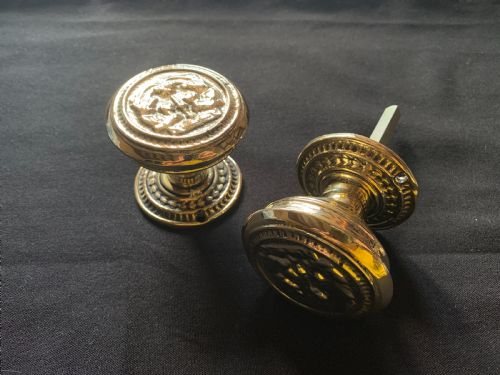


Period Brass Door Knobs
Period brass door knobs bring weight and tactile character to an interior, offering a distinct upgrade from modern hardware.
Period Brass Door Knobs
Period brass door knobs encompass door hardware spanning the Georgian, Regency, Victorian, and Edwardian eras, alongside pieces from the nineteenth century. Buyers searching for period brass door knobs typically encounter centre door knobs, pairs for mortice locks, and complete sets that include matching finger plates or locks. These items range from simple domestic hardware to ornate designs reflecting Arts and Crafts and Art Nouveau aesthetics.
The most common variants on this page are Victorian and Regency pieces, particularly single brass centre door knobs and pairs featuring beehive or octagonal turnings. Materials extend beyond standard brass to incorporate bronze, steel, iron, oak, ebony wood, and amber glass elements. Each style corresponds to the architectural demands of its era, from restrained Georgian ovular forms to decorative late nineteenth-century hardware.
Materials and construction
Alternative materials such as ebony wood, oak, and amber glass appear inset into brass mounts or formed as the gripping surface itself. Surface finishing relied on hand-turning on lathes and detailed casting, producing crisp octagonal facets, ribbed beehive profiles, and smooth ovular contours.
Victorian occupants apparently loved striped beehives so much they turned brass into rows of miniature stairs for their fingers.
Assessing quality and manufacture
The distinction between standard domestic hardware and finer examples rests upon the weight of the metal and the precision of the casting. Heavier brass and bronze castings retain sharper detail in their moulding, whereas mass-produced utilitarian pieces often show softer edges and thinner walls.
Integration of secondary materials also signals quality, such as tightly fitted wooden or glass inserts within solid brass collars. Superior examples demonstrate smooth turning action in movable spindle assemblies and substantial backplates that distribute wear evenly across the door surface.
The Period Brass Door Knobs Glossary
- Centre door knob
- A stationary or operating knob mounted directly in the middle of a primary entrance door rather than on the edge for latching.
- Beehive door knob
- A turned design featuring a series of concentric stepped ridges resembling a traditional skep, popular during the Victorian era.
- Finger plate
- A flat decorative metal plate screwed to the door face adjacent to the knob to protect the timber from hand marks.
- Mortice lock
- A locking mechanism housed entirely within a rectangular pocket cut into the edge of the door.
- Regency
- An architectural and decorative style spanning the early nineteenth century, characterised by classical restraint and neat geometric profiles.
Period Brass Door Knobs: Frequently Asked Questions
How do I install vintage door knobs?
Many period knobs require spindles and threaded fixings that match imperial dimensions rather than modern metric standards. You may need to source an appropriate reducer sleeve or adjust the follower in an existing mortice lock.
Care should be taken not to force mismatched threads, as older brass components strip easily under excessive torque.
Are these door knobs suitable for exterior doors?
Solid brass and bronze pieces withstand external weathering well and develop a deeper natural patina over decades of exposure. However, pieces incorporating wood or glass inserts require sheltered external conditions or interior placement to prevent moisture damage.
Checking the internal mechanism for iron components will help determine vulnerability to rust in damp environments.
How do I date a brass door knob?
Dating relies on matching the silhouette, manufacturing marks, and material combinations to specific design periods like Georgian, Regency, or Arts and Crafts. For instance, heavy geometric facets point towards Victorian production, while flowing organic lines suggest Art Nouveau.
Screws and interior spindles, if original, also provide clues based on early thread-cutting techniques.
Can I polish antique brass door knobs?
Polishing is a matter of personal preference, though many collectors prefer to leave an accumulated aged patina intact. If you choose to clean the metal, use a mild non-abrasive brass cleaner to preserve the underlying crispness of the cast details.
Avoid harsh chemical dips that strip away historical surface character entirely.