



Peridot and Seed Pearl
Peridot and seed pearl jewellery brings together vibrant green olivine and tiny lustrous spheres in gold settings designed to catch the light.
Peridot and Seed Pearl
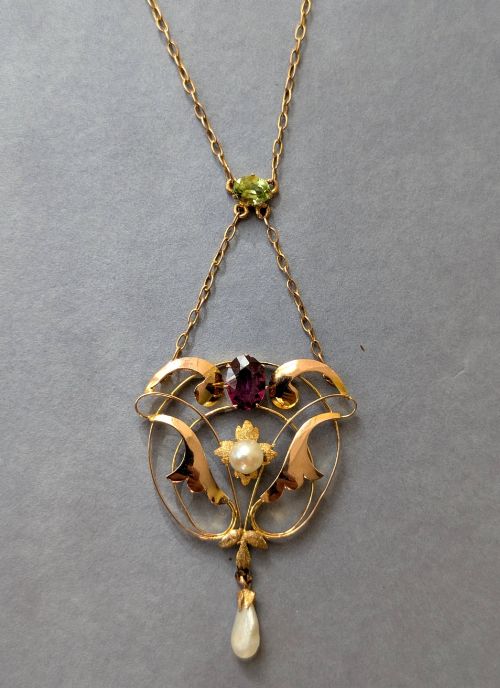
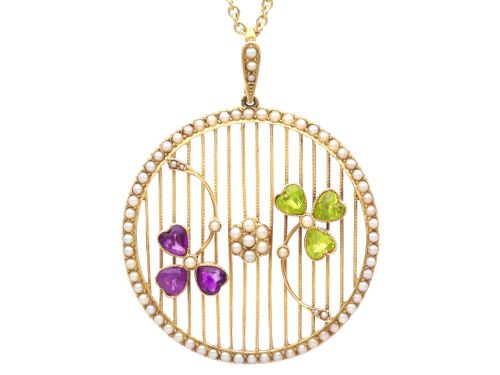
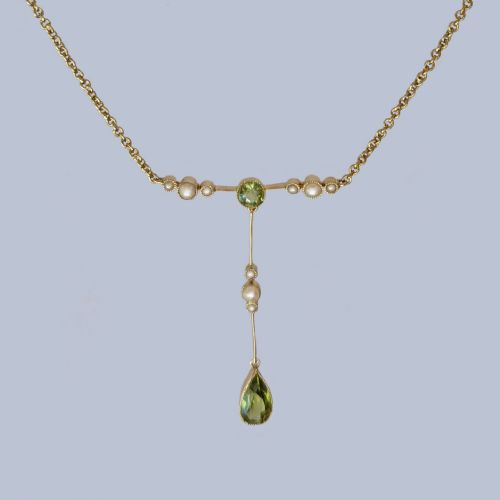
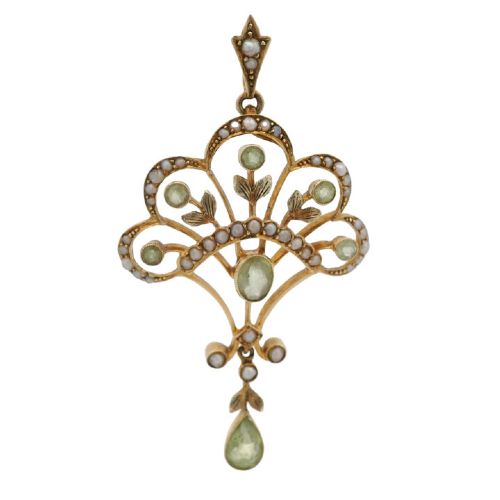
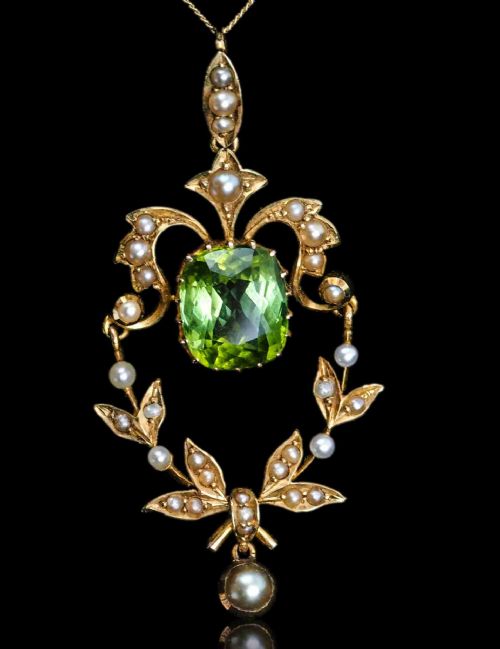
Peridot and seed pearl items on this page primarily take the form of pendants, necklaces, brooches, and rings dating from the Victorian and Edwardian eras. You are most likely to meet Edwardian gold pendants and necklaces featuring bright green peridot stones accented by delicate seed pearls. These works span the late nineteenth century through to the early twentieth century, capturing the stylistic shifts toward Art Nouveau and garland designs.
The distinct visual character relies on the pairing of transparent lime-green peridots with tiny, evenly matched seed pearls. Many examples incorporate convertible elements, functioning as both pendants and brooches depending on how the piece is worn. Formats range from simple cluster rings to elaborate drop pendants set in yellow gold.
Materials and construction
Goldsmiths of the period utilised varying purities of gold, including 9ct, 15ct, and 18ct yellow gold, alongside occasional platinum mounts and 14K gold. Stones were hand-set into open-backed settings to allow light to pass through the peridot facets, intensifying the green colour. Seed pearls were meticulously drilled and threaded or pegged onto wire frameworks.
Enamelling techniques such as plique-à-jour appear in select pieces, creating translucent stained-glass effects behind the metalwork. Master jewellers balanced structural durability with the airy, botanical motifs characteristic of the Edwardian period.
Peridot and Seed Pearl Retail Price Guide 2026
Typical asking prices for peridot and seed pearl among the pieces listed under this phrase on Sellingantiques today, from the lower quarter to the upper quarter. They describe what is for sale here now, not the wider market.
Some Edwardian pendants doubled as clandestine brooches, ready to abandon the neckline at a moment's notice to climb up onto a lapel.
Factors of quality
Quality in peridot and seed pearl jewellery rests upon the saturation and clarity of the peridot crystal alongside the uniformity of the seed pearls. Superior examples feature well-matched, lustrous pearls that retain their original orient and securely closed settings without replacement stones. The finesse of the goldwork, whether through delicate wire-twist garlands or precise openwork frames, distinguishes finer workshop production from standard commercial output.
The architectural complexity of the mount also dictates distinction, as seen in multi-tiered drop pendants or pieces combining white sapphire and pink tourmaline with the core peridot and pearl elements. Preservation of original components, such as integrated pin stems and pendant loops, maintains the integrity of the piece.
The Peridot and Seed Pearl Glossary
- Seed pearl
- A very small natural or saltwater pearl, typically under two grains, used in clusters or borders around larger gemstones. They provide a soft, creamy contrast to faceted stones.
- Peridot
- A gem-grade variety of olivine valued for its distinctive yellowish-green hue. It has been utilised in jewellery since ancient times.
- Plique-à-jour
- An enamelling technique where enamel is applied within a wire framework without a backing, resembling miniature stained glass. This method allows light to shine directly through the translucent enamel.
- Garland style
- A decorative aesthetic popular in the Edwardian era characterised by swags, bows, ribbons, and floral wreaths rendered in precious metals. It draws heavily on eighteenth-century French motifs.
Peridot and Seed Pearl: Frequently Asked Questions
How do I care for peridot jewellery?
Peridot is a softer gemstone compared to diamond or sapphire, rating around six and a half to seven on the Mohs scale. Clean your pieces gently using warm soapy water and a soft cloth, avoiding ultrasonic cleaners and harsh chemicals.
Seed pearls are similarly delicate and sensitive to acids, cosmetics, and perfumes. Store your jewellery separately in a lined box to prevent scratching from harder metals and stones.
Were these pendants originally brooches?
Many Edwardian and Victorian pieces were designed with dual functionality in mind, featuring both a hidden loop for a chain and a pin mechanism on the reverse. This versatility allowed the wearer to pin the jewel to clothing or suspend it from a neck chain.
Conversion was common as fashion shifted from brooches to necklaces during the early twentieth century. Examining the reverse will usually reveal the original hinged pin and catch alongside the suspension ring.
What does 15ct gold indicate?
The 15ct gold standard denotes an alloy containing fifteen parts pure gold out of twenty-four, representing approximately sixty-two point five percent purity. This specific grade was widely used in British jewellery manufacturing during the Victorian and Edwardian periods.
British makers abandoned this standard in nineteen hundred and thirty-one in favour of nine carat and eighteen carat alloys. Finding fifteen carat gold helps confirm a nineteenth or early twentieth-century date of origin.