




Pastoral Farmyard Canvas
These pastoral farmyard canvas works capture rural life through oil paint, offering a glimpse into nineteenth-century agricultural scenes.
Pastoral Farmyard Canvas
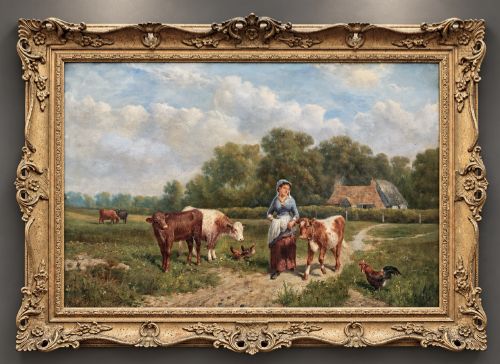
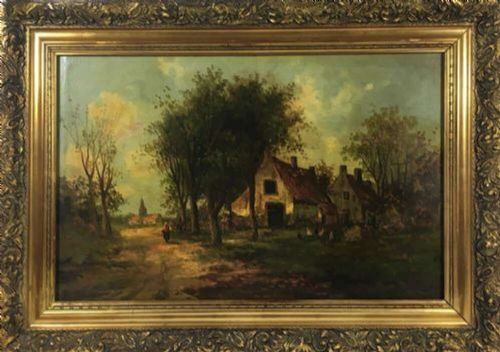
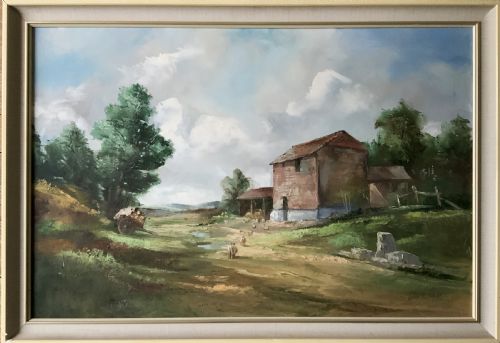
A pastoral farmyard canvas brings rural scenes into domestic spaces, depicting agricultural life, livestock, and laborers. These oil paintings span from the eighteenth century through to the twentieth century, reflecting various regional British and European landscapes.
The works on this page include framed oil paintings on canvas, often housed in giltwood and gesso frames with gold leaf detailing. Buyers frequently encounter nineteenth-century realism, British Impressionism, and Barbizon School influences across these rural subjects.
Subjects range from quiet farmyards with shire horses and carthorses to poultry, cattle, and milking scenes. Artists render these rural moments on canvas using traditional oil paint and wooden stretcher supports.
Materials and construction methods
Artists painted these works using oil paint applied to woven canvas supports, stretched over wooden frames. This combination allowed for rich colour blending and textured brushwork that defined rural subjects.
Many of these canvases sit within decorative frames constructed from wood, finished with gesso layers and highlighted in gold leaf. These giltwood surrounds provided both structural protection and visual weight to the landscape compositions.
Represented movements include British Impressionism, the Barbizon School, and various forms of nineteenth-century realism.
Factors influencing the standard of the work
Quality rests in the handling of light, shadow, and anatomical precision in both animal and human figures. Master painters captured natural movement and atmospheric depth with confident brushwork rather than rigid outlines.
Frederick W. Jackson·John Linnell·Pierre Emmanuel Dielmans·Julius Caesar Ibbetson·Arthur Charles Dodd·Claude Cardon·J L VAN Leemputten·John Percy Cooke·Arthur Walker Redgate·Jack R Mould·Georgina Lara·Owen Bowen
The Pastoral Farmyard Canvas Glossary
- Oil on Canvas
- A painting medium where pigments are bound with drying oils, applied to a woven fabric support. This technique allowed artists to achieve rich textures and subtle tonal gradations.
- Giltwood
- Wood that has been coated with a thin layer of gold leaf or gold paint. This material was standard for framing significant nineteenth-century paintings.
- Gesso
- A plaster-like mixture applied to wooden frames as a base before gilding. It provides a smooth surface for detailed decorative carving.
- Barbizon School
- A French art movement focusing on realism in landscape painting. It emphasised direct observation of nature and rural life.
- Genre Painting
- The pictorial representation of scenes from everyday life. These works depict ordinary people engaged in common activities.
Pastoral Farmyard Canvas: Frequently Asked Questions
What periods do these paintings cover?
The works span from the eighteenth century through the nineteenth century and into the mid-twentieth century. This timeline covers shifting styles from Georgian rural scenes to British Impressionism and later twentieth-century interpretations.
Most pieces date from the nineteenth century, reflecting a strong period interest in agrarian subjects and realist landscape traditions.
How were these artworks framed?
Many paintings are housed in wooden frames featuring gesso layers and gold leaf finishes. These giltwood surrounds complement the oil on canvas compositions.
Original frames often provide context regarding the period and the status given to the artwork by its initial owners.
What subjects appear in these scenes?
Common subjects include farmyards, agricultural laborers, shire horses, carthorses, and livestock such as cattle, poultry, and geese. Artists also recorded specific rural tasks like milking and feeding.
These depictions offer historical records of rural labour, farm architecture, and countryside life across Britain and Europe.
How do I identify different artistic styles?
Styles range from eighteenth-century topographical realism to the looser brushwork of the Barbizon School and British Impressionism. Examining how the artist applies oil paint helps distinguish between meticulous nineteenth-century realism and later expressive techniques.
Signatures, framing materials, and recorded exhibition histories further assist in placing a work within its proper artistic movement.