









Paired Entryway Tables
Paired entryway tables are matching console furniture designed to anchor a hall, drawing strength from Georgian symmetry and Italian Baroque revival grandeur.
Paired Entryway Tables
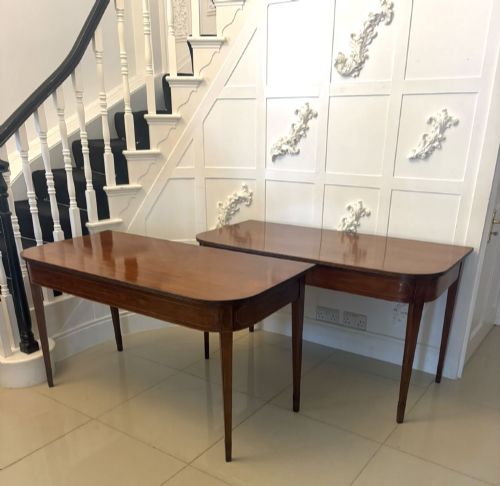
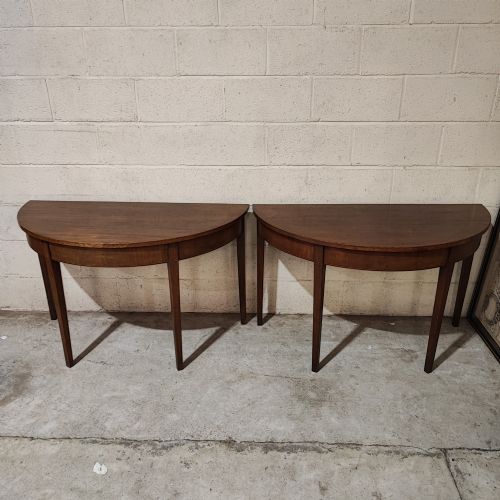
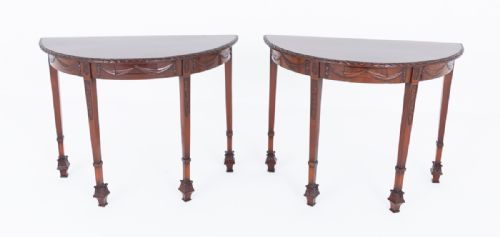
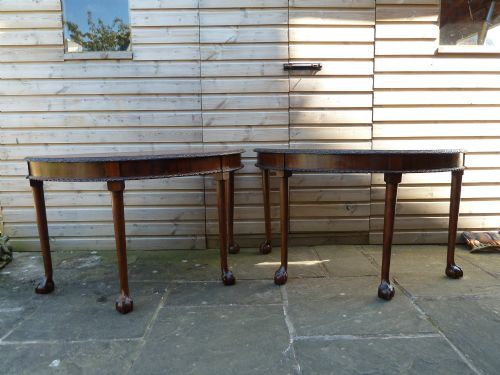
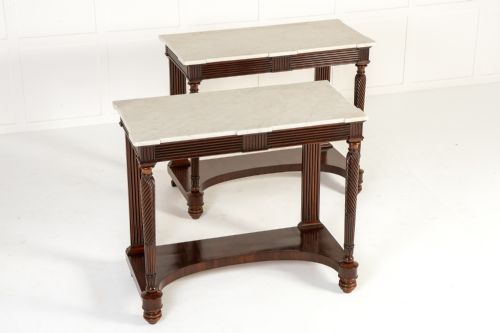
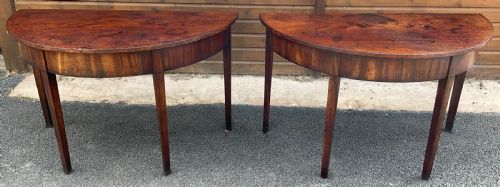
Paired entryway tables consist of matching console tables designed to sit against a wall in a hallway or reception room, frequently taking the form of demi-lune shapes or D-end configurations. These items appear across periods spanning the eighteenth century through to the Edwardian era, encompassing Italian Neoclassical, Scandinavian country, and William IV aesthetics.
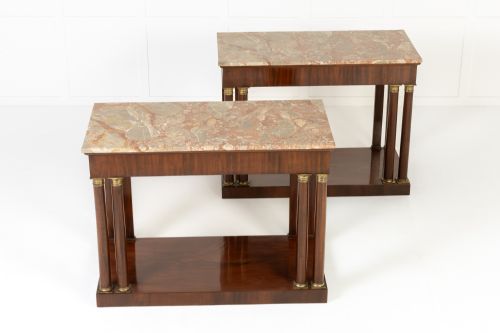
The selections encountered here rely heavily on mahogany timber, alongside painted wood, pine, and walnut, frequently topped with marble or fitted with boxwood inlay. Console tables of this nature provide a formal surface for an entryway, balancing decorative presence with practical placement against a wall.
How they were made
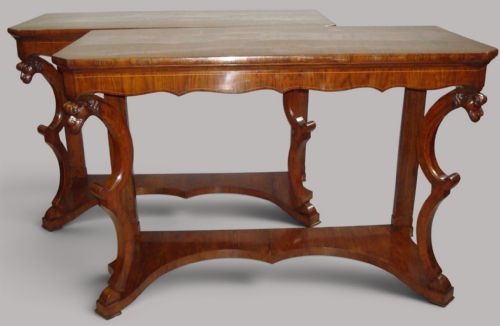
Cabinetmakers constructed these tables using dense timbers such as mahogany and walnut, shaping them into semi-circular demi-lune profiles or straight fronts with boxwood inlay details. Giltwood carving appears on more exuberant Italian Baroque revival pieces, which incorporate lion's paw supports and heavy marble surfaces.
Surfaces were finished with polished wood grains or painted treatments on pine and light woods, reflecting regional preferences from English workshops to Scandinavian country environments and Italian studios.
Paired Entryway Tables Retail Price Guide 2026
Typical asking prices for paired entryway tables among the pieces listed under this phrase on Sellingantiques today, from the lower quarter to the upper quarter. They describe what is for sale here now, not the wider market.
Listings span from the eighteenth century to the early twentieth century, incorporating English mahogany pieces, Italian marble-topped giltwood items, and Scandinavian country furniture.
What varies in quality
Quality rests in the selection of timber and the crispness of carved details, such as the distinction between simple side tables in pine and monumental giltwood consoles with breccia marble tops. The integration of boxwood inlay and the structural integrity of D-end joints dictate the refinement of the piece.
Italian Baroque revival works demonstrate sculptural ambition through elaborate supports, whereas Georgian and Regency examples rely on proportion, figured mahogany veneers, and restrained classical lines.
The Paired Entryway Tables Glossary
- Console table
- A table designed to be fixed against a wall, frequently supported by brackets or ornamental legs rather than standing independently on four full posts. These form the core of the entryway selection.
- Demi-lune
- A half-moon shape used for table tops and frames, allowing the furniture to sit flush against a wall while projecting into the room. This profile is common among Georgian and nineteenth-century examples.
- Breccia marble
- A type of stone composed of broken fragments cemented together in a fine-grained matrix, providing a variegated surface for high-status table tops. It appears on Italian revival console tables.
- Boxwood inlay
- Contrasting light wood inserted into the surface of a darker timber to create geometric or floral patterns. This decorative technique defines several mahogany console tables.
- Giltwood
- Timber that has been coated with gold leaf or gold paint to simulate solid gold enrichment. This finish characterises Italian Baroque revival items.
Paired Entryway Tables: Frequently Asked Questions
Where should paired console tables be placed?
These tables are traditionally positioned symmetrically in a hallway, entryway, or reception room against a blank wall. They often sit beneath a mirror or flanking a doorway to establish architectural balance.
Because they feature flat backs meant to adjoin the wall, they occupy minimal floor space while creating a formal focal point upon entering a interior space.
How do I identify a Georgian console table?
Georgian pieces typically exhibit solid mahogany construction, restrained classical proportions, and occasionally D-end shapes or demi-lune formats. Boxwood inlay and subtle edge moulding are frequent decorative elements from this period.
Later revivals emulate these proportions, but eighteenth-century pieces display specific timber ageing and hand-cut joinery consistent with the period.
What is the difference between side tables and consoles?
Console tables are specifically designed to rely on a wall for complete stability, historically fixed with brackets or designed with a flat rear edge for wall placement. Side tables can often stand independently in the centre of a room.
In historical listings, these terms sometimes overlap, but console tables generally emphasise wall-anchored architectural presentation.
How do I care for marble top tables?
Marble surfaces require gentle cleaning with mild soap and water, avoiding acidic substances that can etch the polished stone. Regular dusting preserves the natural finish of breccia and plain marble slabs.
The wooden bases benefit from standard furniture wax applied sparingly to maintain the mahogany or walnut grain without buildup.