
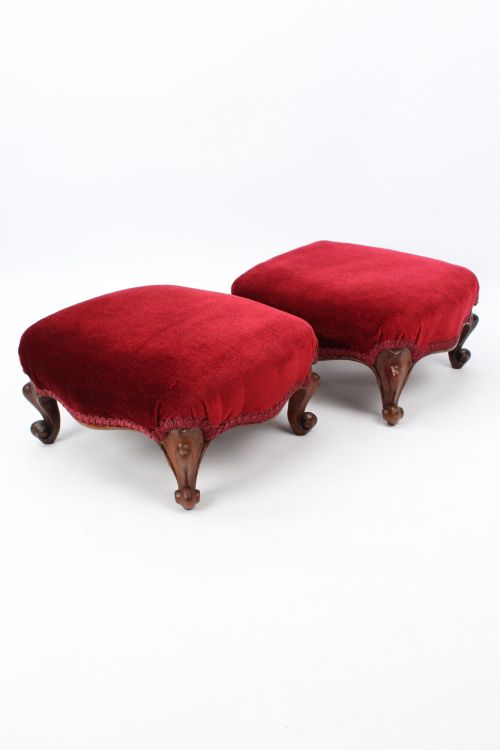
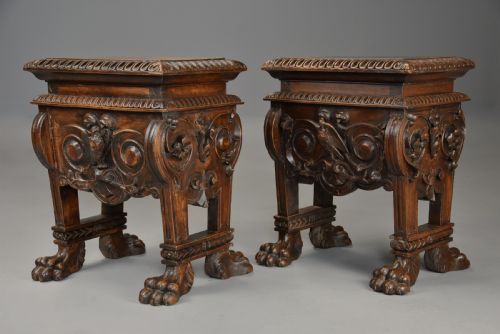
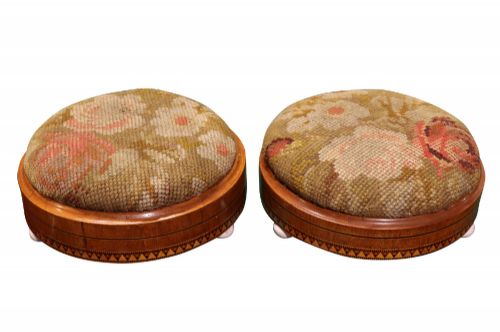


Pair of Walnut Stools
A pair of walnut stools brings warmth and utility to a room, spanning periods from the eighteenth century to the art deco era.
Pair of Walnut Stools
A pair of walnut stools encompasses various forms designed for seating, resting feet, or placing by windows, appearing most frequently in nineteenth-century Victorian variants and French revival styles.
The selection ranges from small circular footstools and upholstered window seats to larger library stools, armchairs with matching footrests, and bar stools.
These items originate across different European traditions, reflecting shifts in taste from Italian Renaissance and Louis XIV revivals to twentieth-century art deco designs.
How they were made
Makers shaped the frames from solid walnut, employing carved woodwork, inlaid patterns, and parcel gilding to decorate the timber structure.
Upholstery completed the pieces, utilising materials such as velvet, leather, wool, textile fabrics, needlepoint, and tapestry, occasionally accented with brass or ormolu mounts.
Some tiny Victorian footstools were specifically built as gout stools to ease aching feet.
What varies in quality
Quality differentiates by the crispness of the wood carving and the precision of inlaid details on the walnut frames.
The grade of the upholstery materials, from simple woven textiles to hand-stitched petit point tapestry or buttoned leather, determines the refinement of the finished item.
Liberty and Co
The Pair of Walnut Stools Glossary
- Walnut
- A hard, dark timber prized for furniture frames, offering rich grain patterns and durability for carved details.
- Prie-Dieu
- A devotional chair or low stool equipped with a padded shelf for kneeling and prayer.
- Petit point
- A fine, count-thread needlepoint embroidery used for intricate upholstery on small footstools.
- Ormolu
- Gilded bronze mounts applied to furniture for decorative effect, seen on select French examples.
- Revival style
- A design movement drawing inspiration from earlier periods such as the Louis XIV, Renaissance, or Queen Anne eras.
Pair of Walnut Stools: Frequently Asked Questions
Where should I place a pair of walnut stools?
These pieces fit well at the foot of a bed, beside a fireplace, or positioned in front of low windows as seats.
Smaller footstools suit placement beneath armchairs or desks to provide support.
How do I care for the leather and fabric upholstery?
Dust textile and tapestry surfaces regularly with a soft brush to prevent dirt accumulation within the weave.
Condition leather sections periodically using specialised creams to maintain flexibility and prevent drying.
How do I distinguish Victorian pieces from earlier examples?
Victorian items often display heavy buttoning, machine-assisted turning, or characteristic revival motifs influenced by earlier centuries.
Eighteenth-century counterparts tend to feature simpler, hand-carved structural lines specific to periods like the reign of Queen Anne.
Are these items suitable for daily seating?
Solid wood frames and robust upholstery construction allow for regular use in domestic settings.
Periodic checks on the internal frame and joints ensure stability over time.