




Pair of Empire Fauteuils
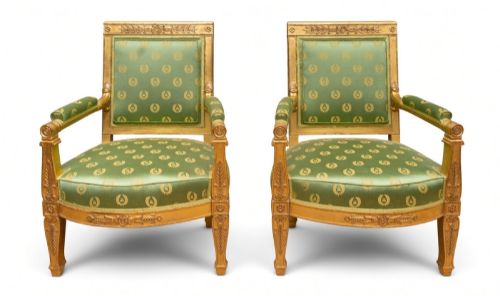
A pair of empire fauteuils brings monumental neoclassical design and architectural presence to a room, offering both historic authority and commanding seating.
Pair of Empire Fauteuils
A pair of empire fauteuils represents formal seating rooted in nineteenth-century neoclassical design, featuring open arms and upright backs. Buyers browsing this selection encounter nineteenth-century examples alongside later revival pieces produced into the early twentieth century.
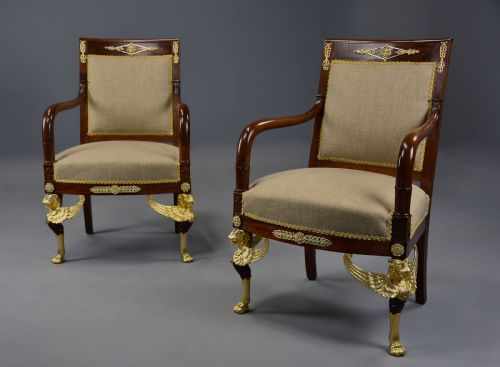
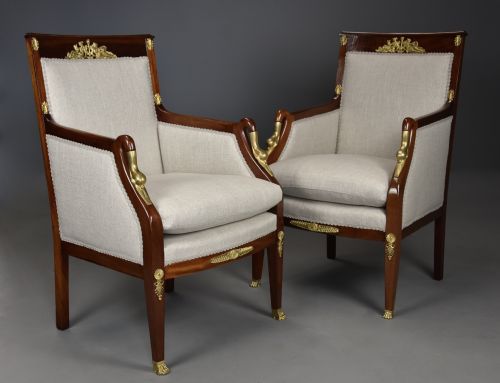
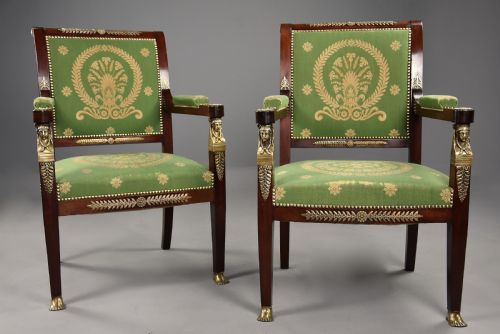
The dominant forms on this page pair rich mahogany timbers with giltwood accents, reflecting French and Italian workshops. Makers draw upon Empire, Consulate, and Restauration idioms, creating matching seating designed for formal salons and libraries.
How they were made
Cabinetmakers constructed the structural frames primarily from dense mahogany and carved gessoed wood, applying fire-gilt or cast ormolu mounts for metallic contrast. These classical bronzes delineate structural junctions and highlight figurative motifs along the arm supports and rails.
Upholstery techniques involved traditional webbing and stuffing secured beneath layered textiles including silk, linen, and decorative woven fabrics. Woodcarvers shaped the giltwood frames with characteristic swans, palmettes, and classical trophies before gilding the surfaces.
Pair of Empire Fauteuils Retail Price Guide 2026
Typical asking prices for pair of empire fauteuils among the pieces listed under this phrase on Sellingantiques today, from the lower quarter to the upper quarter. They describe what is for sale here now, not the wider market.
Some nineteenth-century French cabinetmakers doubled as military contractors, which explains why certain armchair frames feel sturdy enough to withstand a cavalry charge.
What varies in quality
Quality rests in the crispness of the wood carving and the precision of the cast ormolu mounts, where finer pieces display deep chisel work rather than soft, blurred casting. The weight and grain of the mahogany timber further separate standard workshop production from elite cabinetmaking.
Original period execution from the early nineteenth century differs from later revival interpretations through the depth of joinery and material integrity. Superior pairs maintain proportional harmony across both chairs, ensuring identical carving and gilding standards within the set.
Jacob-Desmalter
The Pair of Empire Fauteuils Glossary
- Fauteuil
- An open-armed upholstered armchair originating in France, traditionally designed for formal reception rooms. The wooden frame remains visible around the padded back and seat.
- Ormolu
- Gilt bronze mounted onto furniture surfaces as decorative hardware. This technique involves applying a mercury-gold amalgam to cast bronze.
- Giltwood
- Timber coated with a thin layer of gold leaf over a prepared gesso ground. This finish provides a bright metallic sheen characteristic of neoclassical seat furniture.
- Directoire
- A transitional design style bridging Louis XVI and the French Empire period, characterised by simplified classical geometry. Pieces from this phase exhibit restrained ornamentation compared to later imperial excess.
- Restauration
- A French decorative style spanning the Bourbon Restoration, favouring lighter timbers and refined neoclassical proportions. Seating from this era bridges strict Empire austerity and later Victorian comfort.
Pair of Empire Fauteuils: Frequently Asked Questions
Where should I place a pair?
These armchairs demand space to display their architectural frames and carved arms properly, making them well suited for formal drawing rooms or grand libraries. Position them flanking a fireplace or beneath a large mirror to anchor the neoclassical symmetry.
Because they offer upright seating rather than deep lounging comfort, they function best as conversational chairs or focal seating groups rather than everyday reading loungers.
How do I spot revival pieces?
Revival examples, typically dating from the late nineteenth or early twentieth century, often employ heavier proportions and machine-assisted carving details alongside traditional joinery. Examining the timber shrinkage and the construction of the seat rails helps clarify the actual age of the frame.
Makers working during the revival periods drew heavily upon earlier vocabulary, meaning stylistic indicators alone do not confirm an early nineteenth-century origin.
Are these chairs comfortable?
Empire seating prioritises upright posture and formal deportment over relaxed lounging, reflecting the social etiquette of the nineteenth-century salon. The open arms and straight padded backs provide firm support for structured seating during extended gatherings.
Modern comfort depends entirely on the internal webbing and stuffing condition restored by previous owners, which can be adjusted during reupholstery.
How do I care for the wood?
Maintain mahogany and giltwood surfaces by dusting gently with a dry, soft cloth, avoiding commercial aerosol polishes that leave chemical buildups. Protect ormolu mounts and gold leaf from abrasive cleaning agents to preserve the original metallic patination.
Keep matching pairs away from direct sunlight and steady heat sources to prevent timber splitting and fabric fading across the upholstery.