

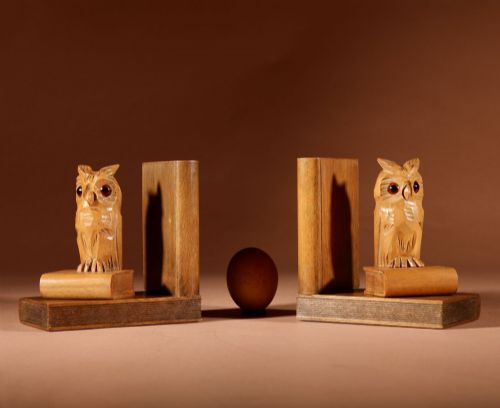
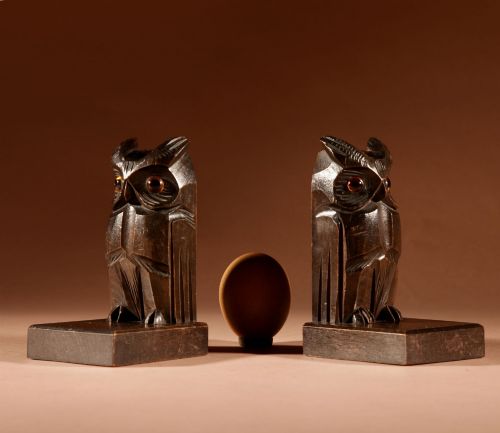


Pair Carved Wood Bookends
Pair carved wood bookends hold volumes upright through the natural weight of carved animal and human forms.
Pair Carved Wood Bookends
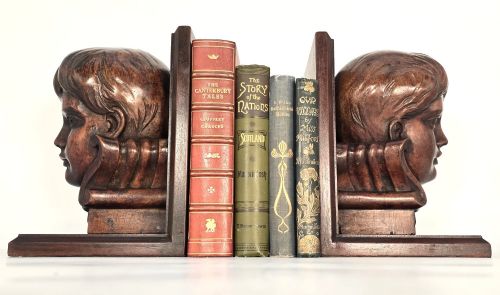
When you search for pair carved wood bookends, you encounter heavy shelf supports shaped from timber, ranging from Victorian Gothic Revival library terminals to playful Black Forest animal carvings. These objects secure books on shelves while introducing sculptural interest to domestic and institutional interiors.
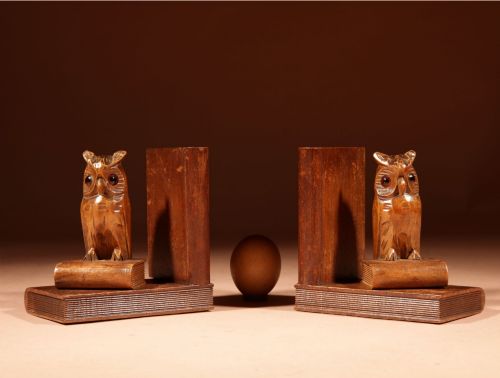
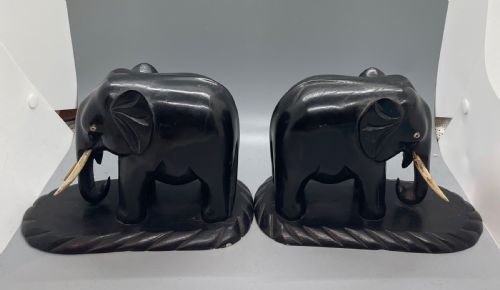
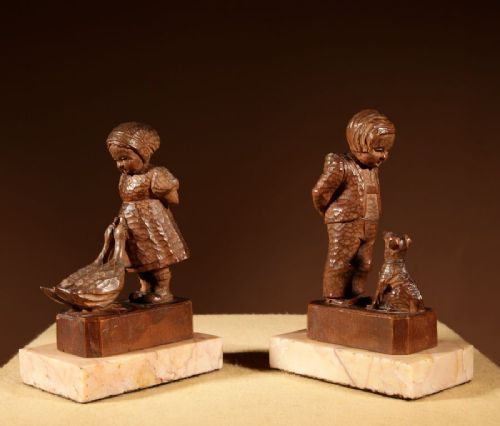
The selection here draws heavily from the early twentieth century and the nineteenth century, featuring domestic woods alongside exotic hardwoods. Animal subjects dominate the forms, particularly elephants, owls, dogs, lions, and bears carved with varying degrees of realism and caricature.
How they were made
Carvers shaped these pieces from timber such as oak, mahogany, linden wood, ebony, pine, and beech using hand chisels and gouges. Artisans selected dense hardwoods to provide the physical mass necessary to support rows of heavy books without tipping.
Surface treatments vary from the pale, untreated grain of linden wood to polished ebony, dark oak, and painted highlights. Some workshops applied detailed penwork or integrated bone and glass elements into the wooden structures.
Design styles span Black Forest, Art Deco, Gothic Revival, Anglo-Indian, and folk art traditions.
What varies in quality
Quality rests upon the anatomical precision and expressive depth of the carving, distinguishing stiff, mechanical duplication from lively, observant hand-chiselling. Superior examples show confident handling of fur, feathers, and muscular form across both matching pieces.
The selection of the timber dictates the finish and durability, with dense tropical hardwoods and finely grained European timbers allowing for crisper detail than softer or more brittle woods. Integrated plinths and balanced weighting also determine how effectively the pair performs its practical task.
V Ramirez Bolivia
The Pair Carved Wood Bookends Glossary
- Black Forest
- A style of wood carving originating in the mountainous region of Central Europe, characterised by realistic depictions of wildlife such as bears, owls, and deer. These carvings often combine naturalistic textures with humorous or anthropomorphic details.
- Foo Dog
- A traditional guardian lion depicted in Asian art, frequently rendered in pairs with one animal holding a ball and the other a cub. These figures appear frequently in carved wooden decorative objects and shelf supports.
- Gothic Revival
- An architectural and decorative style drawing inspiration from medieval forms, featuring pointed arches, tracery, and mythical beasts like griffins. Pieces from this movement often utilise dark oak or mahogany.
- Coromandel
- A dense, heavy dark timber imported from India and Southeast Asia, prized for its rich grain and suitability for intricate carving. Victorian makers utilised this material for high-status desktop accessories and book supports.
- Linden wood
- A pale, fine-grained timber favored by European carvers for its uniform texture and lack of pronounced grain. This wood allows for exceptionally sharp, shallow detailing without splitting.
Pair Carved Wood Bookends: Frequently Asked Questions
How heavy are wooden bookends usually?
The weight depends entirely on the density of the timber used by the carver. Dense tropical hardwoods provide substantial mass for holding large volumes, while lighter pine or linden pairs rely more on broad bases.
Larger sculptural pieces often incorporate internal weighting or heavy wooden plinths to increase stability on the shelf.
What periods do these bookends date from?
The pieces span the nineteenth and twentieth centuries, encompassing Victorian, Edwardian, and Art Deco eras. Styles shift from ornate Gothic Revival architectural terminals to whimsical Black Forest wildlife.
Mid-century and earlier twentieth-century pieces often reflect modernist streamlining or regional folk traditions from international workshops.
Are these bookends always sold as matching pairs?
Most listings feature symmetrical pairs designed to anchor both ends of a book row securely. Carvers typically sculpted these sets together to ensure matching proportions and mirrored poses.
Individual items occasionally appear, but complete pairs remain the standard format for practical shelf use.
How should I clean carved wooden bookends?
Dust surfaces gently with a soft, dry brush to prevent dirt from settling into the carved recesses of the wood. Avoid applying water or chemical polishes, which can darken the grain or damage delicate finishes.
Occasional application of appropriate furniture wax helps preserve dry or untreated timber surfaces over time.