




Painted French Hallway Table
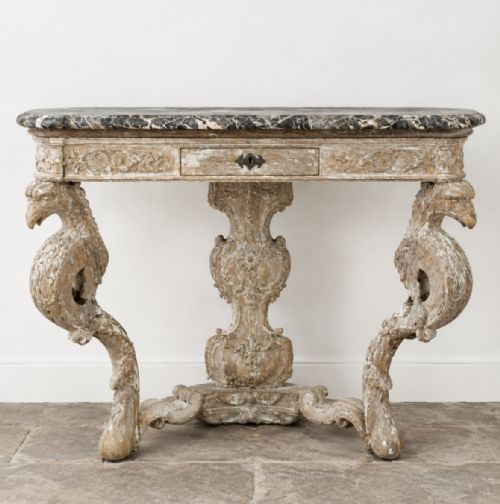
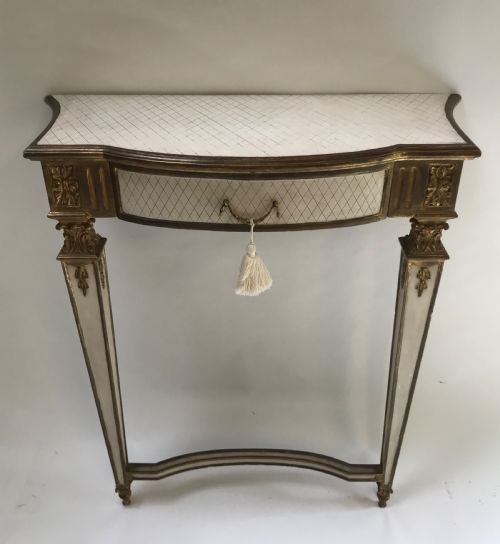
These painted french hallway table pieces bring regional charm and classical proportion to a narrow entrance.
Painted French Hallway Table
A painted french hallway table offers a practical surface for a narrow space while introducing distinct continental character. You will encounter console tables and centre tables spanning from the eighteenth century through to the early twentieth century.
The selections here showcase French Provincial, French Rococo, and Louis XVI influences alongside Georgian style interpretations. Many examples feature demi-lune shapes or elongated proportions designed specifically for corridors and halls.
Surviving pieces frequently combine painted timber frames with decorative tops, ranging from carved wood to contrasting marble. These forms provide both historical substance and functional utility for modern interiors.
Construction and materials
Carpenters typically utilised pine and timber as the foundational base for these tables, applying layers of paint to achieve desired finishes. Parcel gilt accents and carved wood details frequently highlight structural profiles such as cabriole legs or friezes.
Many nineteenth and early twentieth century examples incorporate heavy marble tops, including rouge and sienna varieties, requiring robust joinery to support the stone. Original paint surfaces often show subtle craquelure and patination developed over decades.
Several tables arrive with stories of narrow Parisian hallways built long before modern moving vans existed.
Assessing quality and craftsmanship
The distinction between standard and superior pieces rests in the handling of carved details and the integrity of the painted surface. Hand-carved flourishes on solid timber demonstrate greater artisan investment than applied composition ornaments.
The integration of heavy marble inserts and the preservation of original paint layers significantly influence the desirability of a piece. Finer examples maintain crisp architectural mouldings and balanced proportions across demi-lune and rectangular formats.
The Painted French Hallway Table Glossary
- Console table
- A table designed to be placed against a wall, frequently secured with brackets. These pieces suit hallways and reception rooms where floor space is limited.
- Demi-lune
- A half-moon shape characteristic of many period console tables. This silhouette allows the furniture to sit flush against a wall while projecting minimally into a corridor.
- Giltwood
- Timber treated with gold leaf or gold paint to create a decorative metallic finish. It often highlights carved details on Neoclassical and Rococo furniture.
- Trumeau
- A decorative wall mirror or panel designed to sit above a mantelpiece or console table. Some period arrangements pair the table directly with a matching mirror style.
- Centre table
- A freestanding table intended to be viewed from all sides rather than placed against a wall. They occasionally share stylistic traits with hallway console designs.
Painted French Hallway Table: Frequently Asked Questions
Where should I place a console table?
These tables are traditionally positioned in entrance halls, corridors, or narrow reception rooms. Their shallow depth allows them to sit against a wall without obstructing walkways.
They provide a convenient surface for lighting, correspondence, or decorative objects upon entering a home.
How do I care for a painted wooden surface?
Dust the painted wood regularly with a soft, dry cloth to prevent dirt accumulation. Avoid harsh chemical cleaners that can strip or damage historical paint layers.
Keep the furniture away from direct sunlight and steady moisture to protect the timber and finish over time.
What is the difference between a console and a centre table?
A console table is built specifically to stand flat against a wall, frequently featuring a flat back edge and decorative front supports. They are ideal for narrow hallways.
Centre tables are finished on all four sides and meant to stand freely in the middle of a room, though their decorative styling often overlaps.
How do I identify a marble-topped table?
Inspect the upper surface for natural stone veining, weight, and cool temperature to the touch. These marble slabs, including rouge and sienna varieties, rest directly within the wooden frame.
Care should be taken to use coasters and avoid acidic liquids that can etch polished stone surfaces.
Are these tables suitable for daily use?
Period tables constructed from solid timber and pine remain robust enough for everyday placement in modern hallways. Their original purpose was practical as well as decorative.
Placing felt pads beneath heavy objects and handling marble tops with care will ensure the furniture endures for years to come.