


Padded Leather Ottoman
These padded leather ottoman examples span from Regency to Art Deco, offering sturdy seats and footrests upholstered in rich hides.
Padded Leather Ottoman
A padded leather ottoman combines a supportive upholstered top with a solid wood frame, functioning as a seat, footrest or low table. When searching for a padded leather ottoman, you encounter versatile forms ranging from long Victorian benches to compact Edwardian and Art Deco stools.
Makers shaped these pieces in various regional and historical idioms, including Chippendale, Queen Anne, and Carolean styles. The primary forms recorded on this page include ottomans, footstools, long hall seats, and blanket boxes.
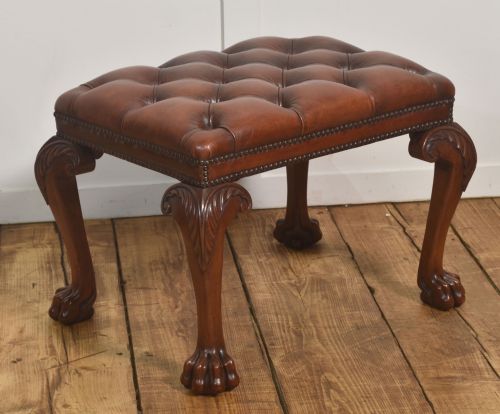
Proportions vary from small square stools to large country house centre pieces and waisted window seats. The unifying feature remains the combination of a leather surface with timber framing, reflecting periods from the nineteenth century into the 1930s.
Materials and construction methods
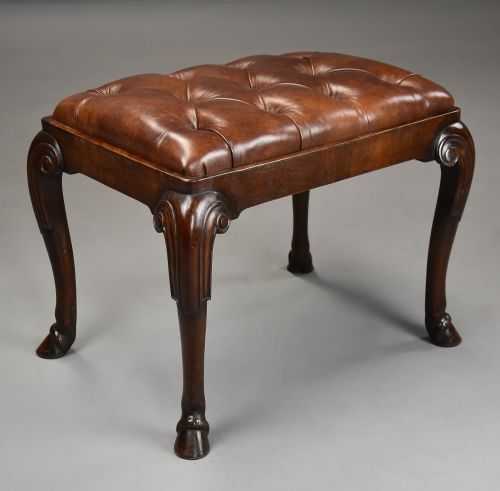
Frames rely upon dense cabinet timbers such as mahogany, walnut, burr walnut, oak, birch, and rosewood. Craftsmen shaped these woods into cabriole legs, turned supports, and box frames, sometimes adding painted finishes or brass details.
Upholstery centres on hand-dyed or buttoned leather stretched over padding. Makers integrated these hides with wooden bases, joining structural elements with traditional cabinetmaking techniques suited to each period.
Assessing quality in construction and material
Quality rests upon the selection of timber and the execution of the woodwork. Dense hardwoods like burr walnut and figured mahogany indicate superior cabinet work compared to standard painted or secondary woods.
The refinement of the frame carving, such as cabriole legs or detailed leg profiles, separates standard workshop production from finer pieces. The integration of the leather upholstery and the crispness of buttoning further distinguish the execution.
The Padded Leather Ottoman Glossary
- Cabriole leg
- A furniture leg that curves outward at the knee and tapers inward toward the foot, often seen on walnut and mahogany stools. This form draws inspiration from seventeenth and eighteenth-century design traditions.
- Burr walnut
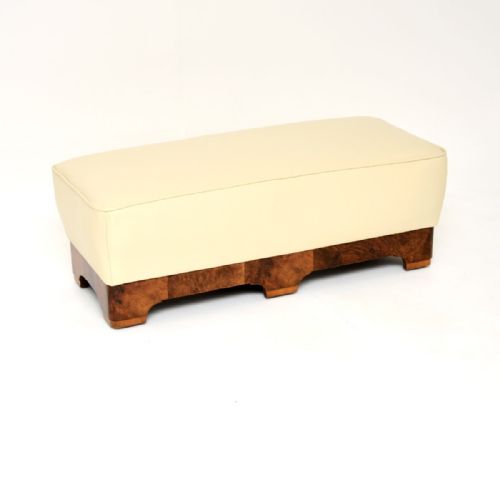
- A veneer taken from the knotted growth of a walnut tree, prized for its swirling, highly figured grain patterns. Makers applied this material to decorative surfaces on Art Deco and earlier stools.
- Buttoned leather
- An upholstery technique where leather is pulled deep into the padding and secured with pleats, creating a tufted surface. This method provides texture and durability to long foot stools and centre seats.
- Centre stool
- A large, substantial stool designed to stand in the middle of a room rather than against a wall. These pieces often feature generous proportions and padded leather tops.
- Window stool
- A low seat specifically designed to sit beneath a window, sometimes featuring a waisted profile. These items combine timber frames with upholstered tops for domestic utility.
Padded Leather Ottoman: Frequently Asked Questions
How were padded leather ottomans used originally?
These pieces served multiple domestic functions in period interiors, acting as footrests, extra seating in drawing rooms, or low tables. Large examples positioned in the middle of rooms provided flexible seating.
Smaller variants suited private chambers or window recesses, while box forms concealed storage for blankets and household items.
Where should I place an ottoman in my home?
A long stool or centre piece fits well in a living room as a coffee table alternative or bench seating. Compact footstools complement armchairs in studies or libraries.
Matching pairs can anchor the foot of a bed or sit beneath a large window to provide practical, low-profile seating.
How do I care for antique leather upholstery?
Leather surfaces benefit from regular dusting with a soft, dry cloth to prevent dirt accumulation. Avoid placing antique pieces in direct sunlight or near heat sources, which can dry out the hide.
Applying suitable leather conditioners periodically helps maintain suppleness and preserves the hand-dyed finish.
How do I distinguish between Victorian and Art Deco pieces?
Victorian examples frequently utilise dark mahogany or walnut with turned legs, heavy frames, and deep buttoning. They reflect traditional English country house aesthetics and revival styles.
Art Deco items from the 1930s often showcase burr walnut veneers, streamlined geometries, and simpler silhouettes that depart from nineteenth-century ornamentation.