






Padded Bed End Stool
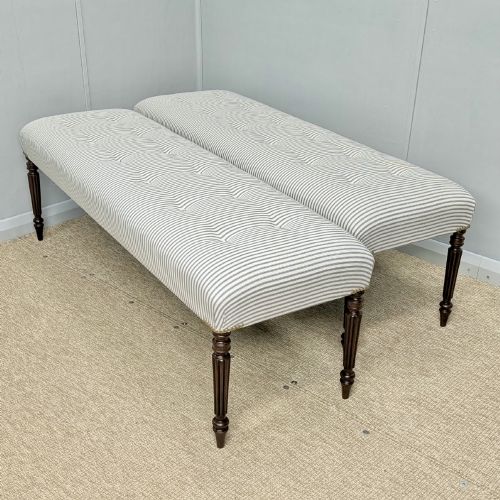
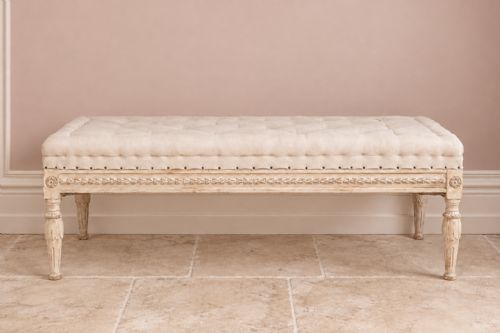
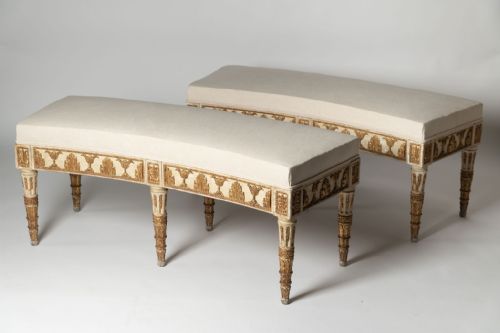
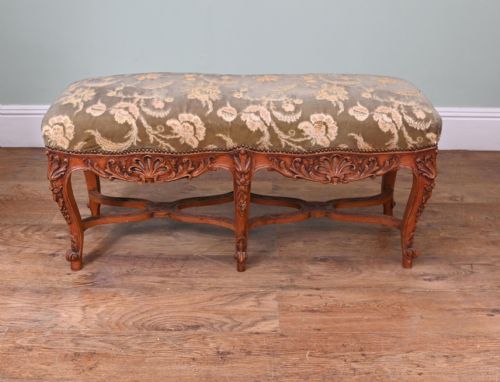
These padded bed end stool examples provide traditional seating and foot rests at the foot of a bed, crafted in walnut, mahogany, and giltwood.
Padded Bed End Stool
A padded bed end stool brings long benches, window seats, and ottomans into a bedroom scheme to provide practical seating at the foot of a bed. When searching for a padded bed end stool, buyers encounter formats ranging from Victorian walnut window seats to Edwardian and early twentieth century long stools.
The pieces listed on this page span the nineteenth century through the early twentieth century, taking the form of window seats, duet benches, and long stools. These items serve functional roles in dressing areas and corridors as well as at the foot of the bed.
Stylistic influences vary widely across the selection, including Regency, Victorian, Italian Neoclassical, Aesthetic Movement, and English Country House traditions. Walnut and mahogany frame woods appear frequently alongside upholstered surfaces in linen, velvet, and textile.
Materials and construction
Frames are constructed predominantly from solid timbers such as walnut, mahogany, oak, and rosewood, shaped with carved details and cabriole or fluted legs. Giltwood and brass accents also appear on specific pieces reflecting Adams style and nineteenth century designs.
Upholstery relies on traditional fabrics including linen, velvet, and patterned textiles, often utilising named designs from makers such as Liberty, William Morris, and Robert Kime. Professional recovering preserves the structural integrity of the antique frames while updating the surface textiles.
Padded Bed End Stool Retail Price Guide 2026
Typical asking prices for padded bed end stool among the pieces listed under this phrase on Sellingantiques today, from the lower quarter to the upper quarter. They describe what is for sale here now, not the wider market.
Some stools hide a secret talent for impersonating a very polite dog waiting patiently at the foot of the mattress.
Assessing quality and craftsmanship
Quality rests in the execution of the timber frame carving, the stability of joints in woods like walnut and mahogany, and the precision of the upholstery work. Pieces featuring substantial hardwoods and refined classical proportions demonstrate superior workshop standards.
The distinction between standard utility items and finer examples lies in the detailing of the legs, such as claw and ball feet or fluted supports, and the selection of high grade covering fabrics. Original or sympathetic restoration of the timber frame elevates the overall integrity of the piece.
The Padded Bed End Stool Glossary
- Window seat
- A long narrow bench designed to sit within a window recess or at the foot of a bed. These typically feature upholstered tops and open or framed sides.
- Duet bench
- An extended stool or bench built to accommodate more than one person sitting side by side. They share the long proportions common in bed end seating.
- Cabriole leg
- A furniture leg that curves out and then in, mimicking animal limbs. This form appears frequently on eighteenth and nineteenth century seating.
- Claw and ball
- A foot motif carved to resemble an animal talon grasping a spherical ball. It is commonly found on the legs of fine antique walnut seating.
Padded Bed End Stool: Frequently Asked Questions
Where should I place a padded bed end stool?
These long seats sit naturally at the foot of a bed to provide a surface for sitting while dressing or placing cushions. They also function well placed against a bedroom wall or beneath a window.
Their elongated proportions mean they occupy narrow spaces effectively without blocking walkways in a bedroom or dressing room.
How do I identify a Victorian bed end stool?
Victorian examples frequently utilise dark hardwoods like walnut and mahogany, often featuring rich carved details and heavy upholstery. Styles from this era draw on earlier revivals including Georgian and Rococo influences.
The use of textiles from the Aesthetic Movement or traditional tufting also points towards nineteenth century manufacturing dates.
Can I use modern fabric on an antique stool?
Many antique benches and stools are professionally reupholstered in contemporary or traditional textiles to suit modern interiors. Using quality linen or velvet maintains the character of the piece while ensuring the upholstery is clean and durable.
Re-covering historic frames is a standard practice that preserves the functional utility of antique seating.