

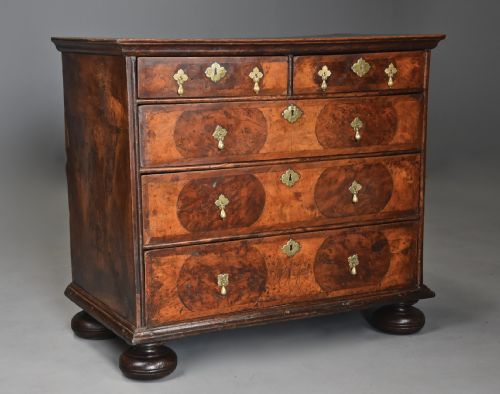


Oyster Veneered Commode
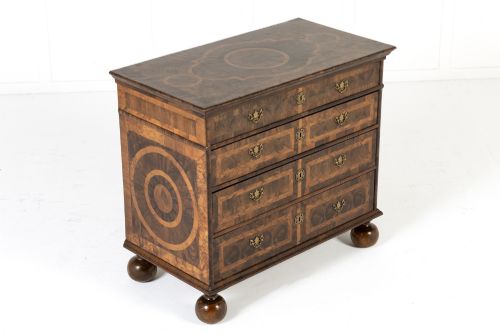
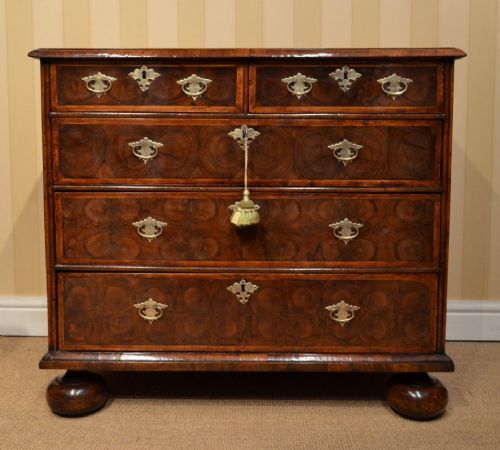
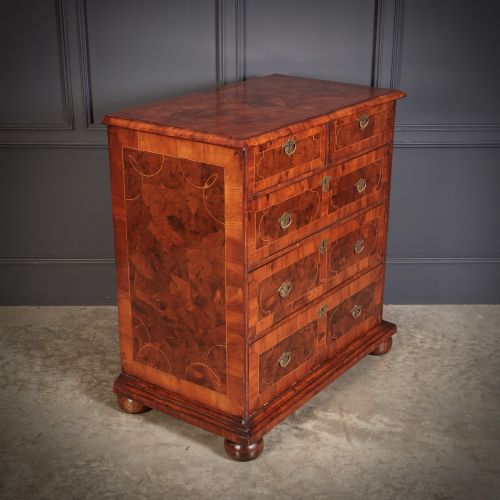
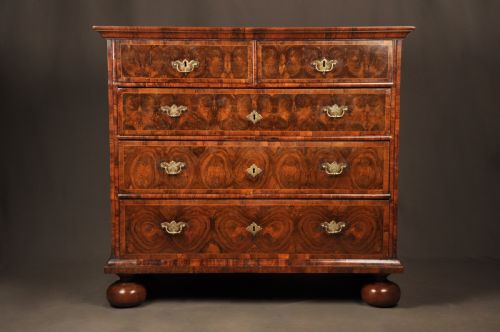
An oyster veneered commode offers a mesmerising surface of circular cross-sections sliced from branches, bringing unmatched texture to any room.
Oyster Veneered Commode
An oyster veneered commode is represented here by seventeenth-century and eighteenth-century chests of drawers executed in styles such as William and Mary and Jacobean. These pieces combine practical storage with dense wooden patterning derived from smaller timber branches.
Buyers will most frequently encounter walnut, olivewood, and laburnum examples dating to the seventeenth century. Oak and yew also appear frequently as primary structural woods or secondary veneers.
The standard form takes shape as a multi-drawer chest rather than a serpentine French commode. Makers utilised the natural grain structure of branches to create geometric patterns across the entire front and top.
Materials and construction
Cabinetmakers sliced young branches across the grain to produce small, circular or oval disks known as oysters. These delicate sections were laid down in complex geometric arrangements over a sturdy oak or pine carcase.
Secondary timbers such as boxwood and maple often provided contrasting stringing or inlay to frame the main oyster panels. Brass handles and escutcheons completed the construction, fastened securely to the drawer fronts.
Oyster Veneered Commode Retail Price Guide 2026
Typical asking prices for oyster veneered commode among the pieces listed under this phrase on Sellingantiques today, from the lower quarter to the upper quarter. They describe what is for sale here now, not the wider market.
The listings span the seventeenth and eighteenth centuries, incorporating styles like William and Mary and Jacobean across walnut, olivewood, laburnum, and yew.
Judging the quality
The highest quality pieces display a disciplined harmony in the selection and matching of the timber rounds. Olivewood and laburnum examples with intricate marquetry or rich colour variation sit firmly at the top of the range.
Superior execution is visible in how tightly the individual disks are fitted together across the surface. Poorer examples show wider gaps between the veneers or careless alignment that disrupts the rhythmic pattern.
The Oyster Veneered Commode Glossary
- Oyster veneer
- A method of slicing branches obliquely to produce oval or circular wooden disks with concentric growth rings. This technique creates a distinctive patterned surface across furniture fronts.
- William and Mary
- A style spanning the late seventeenth and early turn of the century. It is characterised by architectural proportions, geometric veneers, and disciplined use of contrasting timbers.
- Marquetry
- The art of applying pieces of veneer to a structure to form decorative patterns and pictures. Craftsmen used various woods to achieve tonal contrast.
- Escutcheon
- A protective plate surrounding the keyhole of a drawer or door. On these pieces, they are typically cast from brass to complement the dark wood.
Oyster Veneered Commode: Frequently Asked Questions
What is an oyster veneered commode?
An oyster veneered commode is a seventeenth-century or eighteenth-century chest of drawers covered in circular branch-wood slices. These pieces showcase the intricate natural rings of timbers like olive, laburnum, and walnut.
They function primarily as storage chests while serving as visual centrepieces due to their dense, patterned surfaces.
How do I date an oyster veneered chest?
Dating relies heavily on observing the overarching style, such as William and Mary characteristics, alongside the choice of secondary woods like oak. Seventeenth-century examples often feature specific drawer configurations and hand-cut construction joints.
Examining the underside and drawer linings provides further clues regarding the period of manufacture and subsequent conservation work.
How should I care for oyster veneer?
Maintenance requires keeping the timber away from direct sunlight and sudden temperature shifts to prevent the small veneer sections from lifting. Regular dusting with a dry, soft cloth preserves the natural finish without introducing moisture.
Applying microcrystalline wax occasionally helps nourish the historic wood surfaces safely.
Where does the term oyster come from?
The term derives from the visual resemblance of the sliced branch sections to the opened shell of an oyster. Each piece displays concentric growth rings that mimic the mollusc's formation.
Cabinetmakers adopted this descriptor to highlight the decorative nature of the cross-cut timber.