
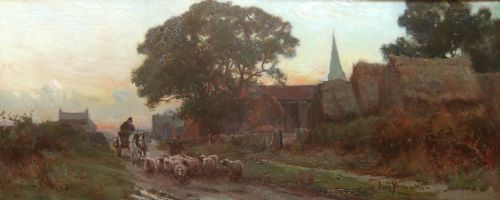


Owen Bowen Landscape
An owen bowen landscape captures the pastoral quiet of Yorkshire and northern rivers through textured brushwork that collectors prize for its authentic country atmosphere.
Owen Bowen Landscape
An owen bowen landscape typically portrays rural scenes across Yorkshire, Wharfedale, and Scottish or Manx coastal views. These artworks capture farmyards, rivers, cottages, and pastures from the early twentieth century.
The most common examples encountered on this page are oil paintings on canvas or board, alongside occasional watercolours on paper. Subjects frequently feature sheep, cattle, and rural workers integrated into natural settings.
Dated pieces span several decades from the nineteen-hundreds through the nineteen-forties, showing consistent engagement with British Impressionism and English Impressionism. The paintings document regional topography from Wharfedale to Brittany and the Scottish Borders.
How they were made
Artists painted primarily with oil paint on stretched canvas, wooden panels, or canvas boards, building texture with loaded brushes. Watercolours on paper formed a parallel medium for lighter garden and cottage views.
Impressionist techniques rely on broken brushstrokes and layered pigment to render natural light across fields, rivers, and stone bridges. Supports range from traditional woven canvas to sturdy wood panels suited to plein air work.
Cows, sheep, and ducks populate these pastures almost as often as the local stone bridges.
What varies in quality
Quality depends upon the clarity of regional topography, composition strength, and the handling of atmospheric light. Works depicting signature Yorkshire dales and river valleys often display more confident brushwork than lesser studio variants.
The preservation of the original paint surface and the presence of descriptive titling contribute to a piece's standing. Stronger examples balance detailed rural narratives with the loose, painterly execution characteristic of British Impressionism.
Owen Bowen
The Owen Bowen Landscape Glossary
- Canvas board
- A rigid panel made from heavy cardboard surfaced with primed canvas. It provides a stable, flat support for oil paintings executed outdoors.
- Impressionism
- An art movement focusing on accurate depiction of light in its changing qualities. Painters use small, thin yet visible brush strokes to capture the visual impression.
- Panel
- A flat piece of wood used as a support for a painting instead of canvas. Wooden panels offer a smooth, rigid surface popular for smaller landscape works.
- Watercolour
- A painting method in which the paints are made of pigments suspended in a water-based solution. Paper serves as the primary support for these translucent applications.
Owen Bowen Landscape: Frequently Asked Questions
Who was Owen Bowen?
Owen Bowen was a British artist who lived from eighteen seventy-three to nineteen sixty-seven. He painted extensively across Yorkshire and northern England.
Highest recognition came through his association with professional societies like the Royal Institute of Oil Painters. His work remains defined by impressionist treatments of rural life.
Where are the landscapes set?
Most scenes focus on Yorkshire locations including Wharfedale, Collingham, and Leathley. River views feature the Wharfe and local stone bridges.
Other works record travels to Scotland, the Isle of Man, Brittany, and Cumbria. Rural farms, cottages, and pastures dominate the geographical scope.
How do I care for an oil painting?
Keep oil paintings away from direct sunlight and dramatic fluctuations in room temperature. Stable indoor conditions prevent canvas warping and pigment cracking.
Dust surfaces gently with a soft, dry brush without applying pressure. Avoid using liquid cleaners or damp cloths on historical paint layers.
Are these paintings signed?
Many examples bear the artist's signature within the composition, often near a bottom corner. Signatures typically appear in a darker pigment that complements the surrounding tones.
Exhibition labels or handwritten titles on the reverse sometimes provide additional provenance. Unsigned works rely on stylistic attribution and recorded subject matter.