



Ornate Writing Bureau
An ornate writing bureau brings elaborate French revival styling and fine timber work straight into a reception room.
Ornate Writing Bureau
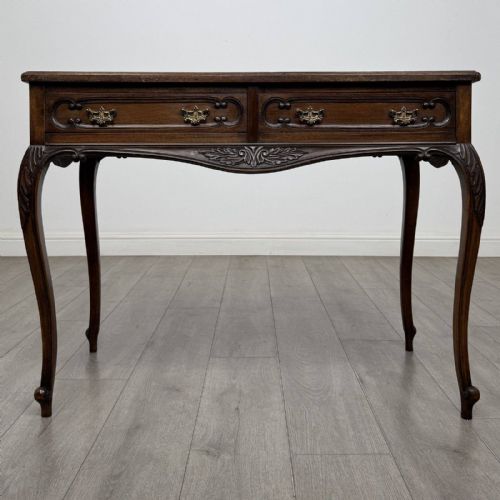
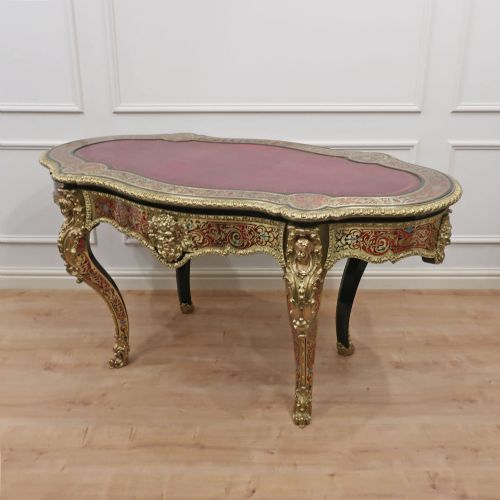
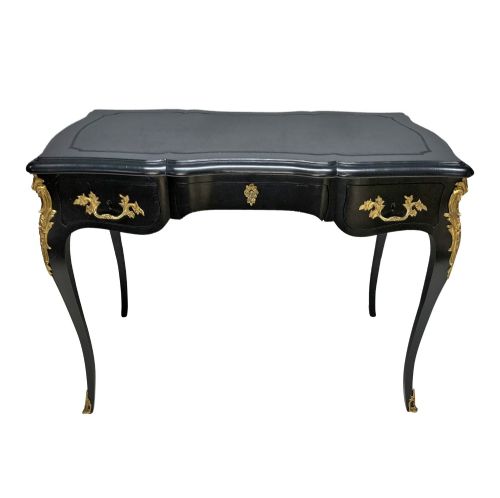
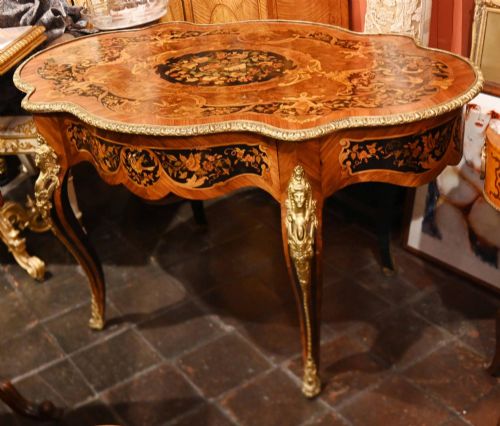
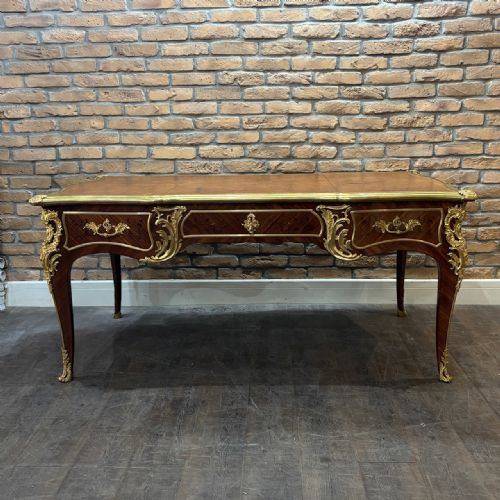
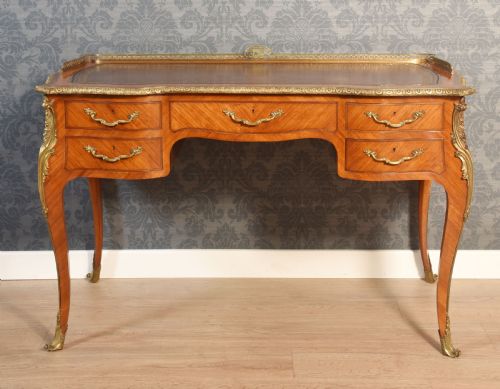
An ornate writing bureau encompasses sophisticated writing desks, bureau plat tables, and secretaires hailing predominantly from the nineteenth century. These forms draw heavily on Louis XV and French Rococo Revival aesthetics, bringing intricate shaping and decorative surfaces to a study.
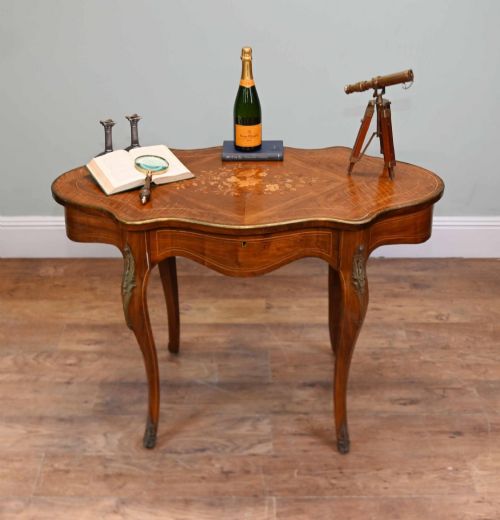
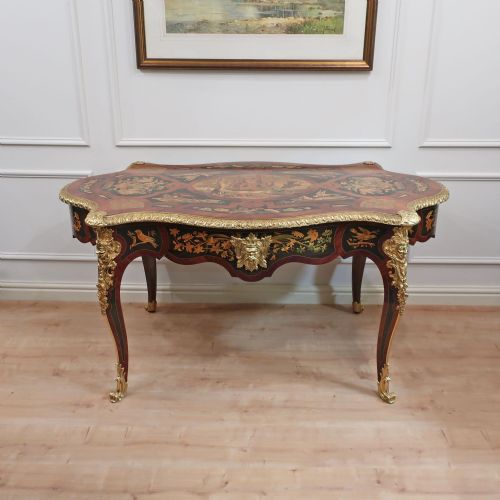
Buyers frequently encounter pieces finished with detailed marquetry inlay, gilt bronze mounts, or contrasting timber veneers. Forms range from compact bureau de dame desks to large centre tables and Davenport writing desks.
Originating largely from continental and British workshops during the Victorian era and late nineteenth century, these desks combine practical writing surfaces with elaborate decorative schemes.
Materials and construction
Cabinet makers utilised dense hardwoods such as walnut, mahogany, rosewood, and kingwood as the structural foundation for these desks. Marquetry panels were created by carefully cutting and fitting contrasting veneer woods to form intricate floral or geometric patterns across the surfaces.
Metal ornamentation played a major role in the construction, featuring cast ormolu and gilt bronze mounts fitted to corners, legs, and aprons. Leather inserts often provided the writing surface, while interior compartments utilised finer secondary timbers.
Ornate Writing Bureau Retail Price Guide 2026
Typical asking prices for ornate writing bureau among the pieces listed under this phrase on Sellingantiques today, from the lower quarter to the upper quarter. They describe what is for sale here now, not the wider market.
Some nineteenth-century writing desks conceal secret internal compartments behind sliding panels, designed to guard confidential correspondence from curious visitors.
Judging quality
Quality rests upon the precision of the marquetry work and the crispness of the cast bronze or ormolu mounts. Finer pieces demonstrate seamless veneer matching and tightly fitted joints across complex curved drawer fronts and cabriole legs.
The choice of secondary timbers inside drawers and the depth of hand-carving separate standard production pieces from exhibition-level examples. Superior surfaces retain subtle hand-rubbed polishes that highlight the natural grain of kingwood or walnut without obscuring the timber.
The Ornate Writing Bureau Glossary
- Bureau plat
- A freestanding writing table, typically with drawers along the frieze, designed to sit in the centre of a room rather than against a wall.
- Marquetry
- The art of applying small pieces of veneer to a structure to form decorative patterns, using various coloured woods.
- Ormolu
- Gilded bronze mounts and decorative hardware applied to furniture, popular in French revival cabinet making.
- Secretaire
- A desk featuring a writing flap or fall-front that conceals internal pigeonholes and small drawers.
- Davenport
- A compact writing desk featuring a sloping top and drawers accessed from the side.
Ornate Writing Bureau: Frequently Asked Questions
Where should an ornate writing bureau be placed?
These desks suit studies, libraries, or spacious living areas where they can be viewed from multiple angles. Freestanding bureau plat designs look particularly striking positioned in the middle of a room.
Ensure the piece sits away from direct heat sources and strong sunlight to protect delicate veneers and leather writing surfaces from drying out.
How do I care for the timber and mounts?
Dust regularly with a soft, dry cloth and avoid silicone-based polishes that can build up over antique finishes. Natural beeswax applied sparingly keeps hardwood veneers nourished.
Clean gilt bronze and ormolu mounts gently with a dry brush to remove dust, avoiding abrasive metal cleaners that damage the fire-gilded surface.
What is the difference between a bureau plat and a Davenport?
A bureau plat is a wide, flat-topped table designed for general correspondence, featuring shallow drawers beneath the writing surface. They usually stand on cabriole legs and display extensive marquetry.
A Davenport is much more compact, combining a sloping desktop with a bank of drawers opening to the side. They originated in nineteenth-century England for smaller drawing rooms.
How can I identify French revival influence?
French revival pieces exhibit characteristic Louis XV motifs such as scrolling acanthus leaves, serpentine curves, and cabriole legs terminating in sabots. The heavy use of floral marquetry and gilt metal mounts also signals this aesthetic.
Cabinet makers in Britain and across Europe adopted these Continental designs heavily during the Victorian period, creating ornate variations on classic French forms.