






Ornate Travel Clock
An ornate travel clock brings precise mechanical movement and heavy metal casing into a portable desk accessory for the discerning collector.
Ornate Travel Clock
An ornate travel clock is principally represented here by nineteenth-century carriage clocks and miniature boudoir timepieces originating from French and English workshops. These pieces combine portable timekeeping with decorative metalwork, glass panels, and specialised repeating mechanisms.
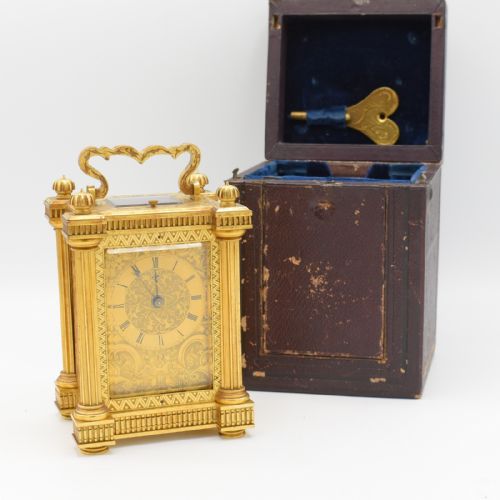
Buyers will most frequently encounter brass and gilt brass examples dating from the Victorian and Edwardian periods, often featuring engraved cases or enamel dials. The selection spans standard carriage clocks to grand sonnerie and repeater complications housed within protective leather travelling cases.
Construction and Materials
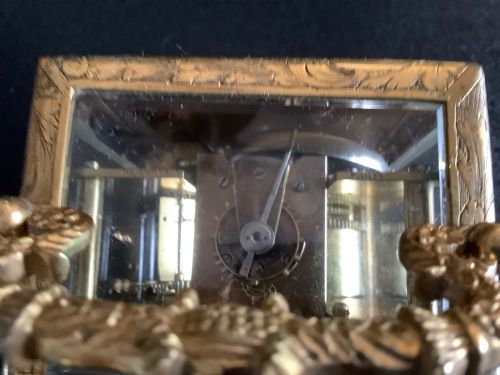
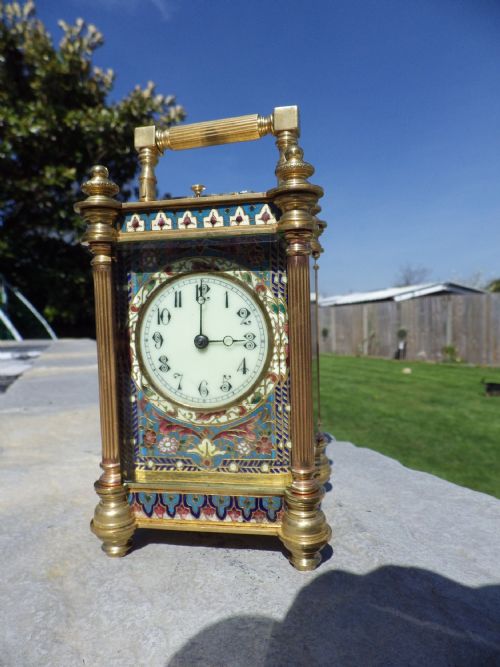
Makers constructed these timepieces primarily using brass and gilt brass frames fitted with bevelled glass windows to display the internal escapement and gear trains. Enamel dials and painted Limoges enamel panels added rich colour and fine detail to the dial faces and side plates.
Cases received extensive surface decoration through hand-chasing, deep engraving, and filigree work, frequently in Rococo Revival or Second Empire styles. Leather outer travelling cases were utilised to protect these delicate metal and glass structures during transit.
Listings feature periods spanning from the 1850s through the Edwardian era, predominantly showcasing French and English brass and gilt metal forms.
Assessing Quality
Quality rests upon the complexity of the movement and the depth of the metalwork, distinguishing standard production from exceptional maker output. Repeater mechanisms, grand sonnerie strikes, and auxiliary complications like compasses and thermometers elevate a piece significantly.
The crispness of the hand engraving across all sides of the case and the presence of signed maker movements or original travelling cases separate fine examples from simpler models. Heavy cast gilt frames and intact enamel panels demonstrate superior workshop execution.
Howell & James London·Brunelot·Gontard & Bolviller Paris·Thomas Cole and James Cole·Hunt And Roskell·Tiffany·E.J.Dent·Paul Garnier
The Ornate Travel Clock Glossary
- Repeater
- A clock mechanism that strikes the hours and quarters upon demand when a lever or button is pressed. This complication required intricate internal gear work.
- Escapement
- The mechanical linkage that controls the unwinding of the mainspring by delivering impulses to the balance wheel. Platform escapements are mounted visibly on top of the movement.
- Grand Sonnerie
- A striking train that automatically sounds both the hours and the passing quarters on bells or gongs. It represents a high level of horological achievement in portable clocks.
- Fusee
- A conical pulley designed to maintain equal force on the gear train as the mainspring unwinds. This device improves timekeeping accuracy across the power reserve.
- Filigree
- Delicate ornamental work consisting of twisted metal threads soldered together into openwork patterns. It appears on select Victorian decorative cases.
Ornate Travel Clock: Frequently Asked Questions
What is a carriage clock?
A carriage clock is a portable spring-driven timepiece developed in the nineteenth century for officers and travellers. They typically feature a rectangular brass frame with glass panels and a handle on top.
These clocks relied on platform escapements rather than pendulums, allowing them to keep time accurately while being moved from place to place.
How do repeater movements work?
Repeater movements allow the owner to hear the current time chimed by pressing a button on the top of the case. The mechanism calculates the hours and quarters independently using internal racks and snails.
This function proved useful during dark nights before reliable artificial lighting became standard in bedrooms and hotel rooms.
How should I clean the glass panels?
The bevelled glass panels should be wiped gently with a soft, lint-free cloth dampened slightly with mild window cleaner. Avoid spraying liquid directly onto the clock to prevent moisture from seeping into the movement.
Take care around engraved brass edges and enamel dials to avoid snagging fabric or spreading cleaning fluids onto delicate painted surfaces.
How do I identify the period?
Dating relies on stylistic clues such as the heaviness of the cast brass case, the depth of the engraving, and the presence of maker signatures on the backplate. Victorian and Edwardian examples often exhibit distinct Rococo Revival motifs or simpler architectural brass framing.
Movements marked by known retailers or Parisian makers help narrow the production window to specific decades within the nineteenth century.