

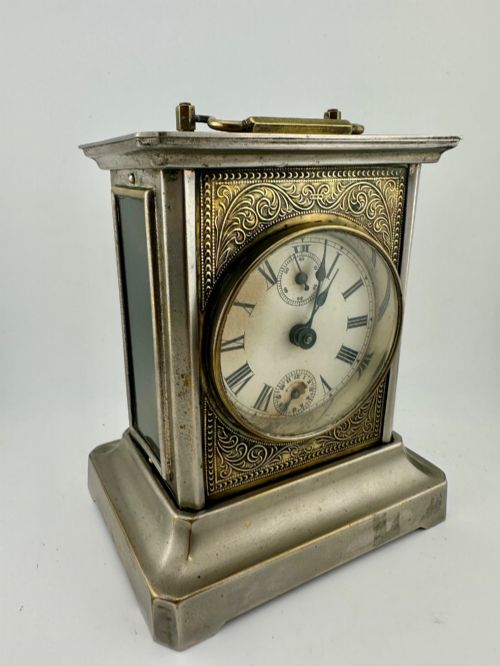
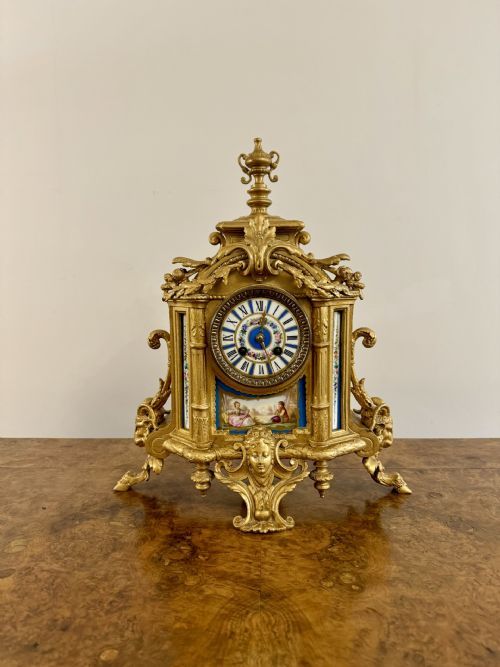


Ornate Metal Table Clock
These ornate metal table clock pieces bring together period brass, gilt metal, and porcelain to sit proudly on any mantel.
Ornate Metal Table Clock
When you search for an ornate metal table clock, you encounter mantel clocks, carriage clocks, boudoir clocks, and clock garniture sets spanning the nineteenth century alongside later twentieth century examples. The selection includes French Rococo Revival, Louis XVI Revival, and Victorian Gothic Revival pieces.
You are most likely to meet French and English mantel clocks housed in gilt metal, brass, or ormolu cases. Many examples incorporate porcelain panels, marble, onyx, or glass panels to frame the dial.
Materials and construction
Cases utilise cast brass, gilt bronze, ormolu, and gilt metal, often combined with hand-painted porcelain or inset enamel dials. Makers mounted these heavy metal housings on marble or onyx bases.
Movements range from standard platform escapements in carriage clocks to fusee movements and signed French mechanisms by makers such as Japy Freres.
Ornate Metal Table Clock Retail Price Guide 2026
Typical asking prices for ornate metal table clock among the pieces listed under this phrase on Sellingantiques today, from the lower quarter to the upper quarter. They describe what is for sale here now, not the wider market.
William Shakespeare gazes out from a bronze mantel clock while time ticks on regardless.
Judging quality
Quality rests upon the crispness of the metal chasing, the depth of the gilding, and whether the porcelain panels or enamel dials remain undamaged. Heavier cast bronze or ormolu mounts display superior hand-finishing compared to lighter stamped metal alternatives.
Signed movements by known makers and complete clock garniture sets command greater attention than unsigned single pieces with plain housings.
Japy Freres·John Barwise·Luxor·Leroy and Fils·Francois Moreau
The Ornate Metal Table Clock Glossary
- Ormolu
- Gilded bronze, where finely ground gold is applied to a bronze base using a mercury amalgam. This technique creates a rich, durable golden surface seen on French nineteenth century clock cases.
- Fusee
- A conical pulley used in clock movements to maintain even driving force as the mainspring unwinds. This mechanism improves timekeeping accuracy across the power reserve.
- Garniture set
- A clock accompanied by matching side ornaments, such as urns or vases, designed to display together on a mantelpiece. These sets unify the decorative scheme of a room.
- Carriage clock
- A small, portable spring-driven clock equipped with a handle, originally designed for travelling. They feature glass panels that reveal the moving escapement.
Ornate Metal Table Clock: Frequently Asked Questions
How do I wind an antique clock?
Most mechanical mantel and carriage clocks require a key to tension the springs via winding arbours on the dial face. Turn the key gently until you feel firm resistance, taking care not to overwind the mechanism.
Consult the specific movement type before making adjustments, as fusee movements and platform escapements each respond differently to handling. Regular gentle winding preserves the tension in the springs over time.
Where should I place a heavy mantel clock?
Position your clock on a stable, level surface such as a wooden mantelpiece, a sturdy sideboard, or a dedicated bracket. Weight distribution matters because heavy bronze, marble, and onyx cases require solid support.
Keep the piece away from direct sunlight and damp environments to protect the gilt finishes, enamel dials, and internal metal components from degradation.
How do I identify a French Rococo clock?
Look for asymmetrical C-scrolls, foliate motifs, naturalistic shell shapes, and cast figures integrated into the gilt metal or ormolu case. These designs reject straight lines in favour of flowing, organic curves.
Many nineteenth century French examples also combine these theatrical metal housings with painted porcelain panels depicting pastoral scenes or floral arrangements.
What is a boudoir clock?
A boudoir clock is a small, decorative timepiece intended for a private sitting room or bedroom rather than a grand reception space. They often feature delicate gilt or ormolu mounts and intimate advertising or presentation inscriptions.
These smaller pieces retain the ornate metal casting and porcelain dial details of larger mantel clocks while fitting into more confined spaces.