

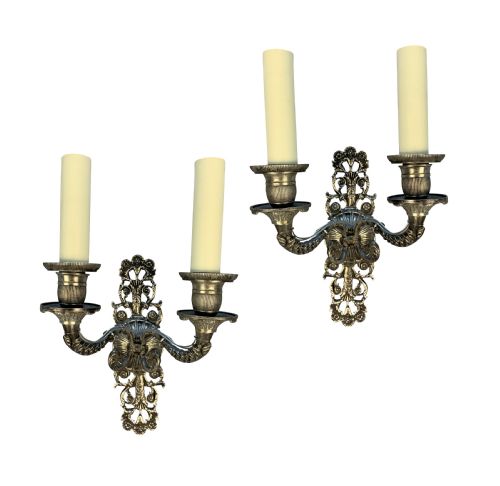
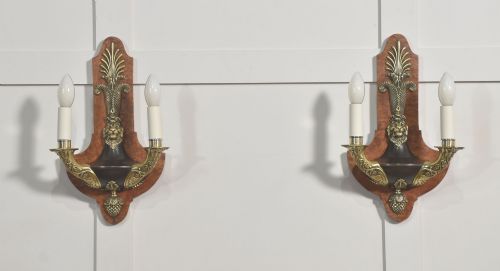

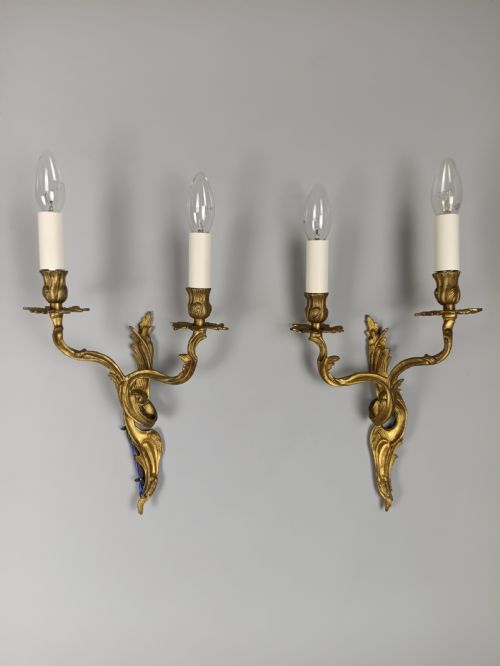

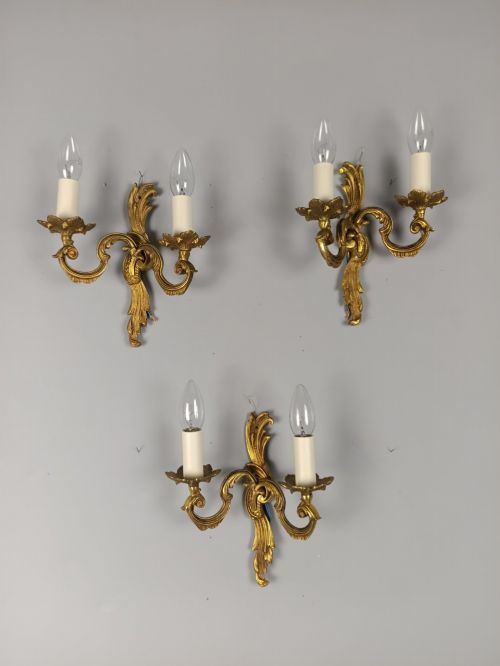


Ornate Double Wall Sconces
These ornate double wall sconces bring layered illumination and period character to a room, cast in heavy metals and styled in revival taste.
Ornate Double Wall Sconces
When buyers search for ornate double wall sconces, they look for twin-branch lighting fixtures designed to mount directly onto a wall and project ambient light from two arms. The examples gathered here span from the late nineteenth century through to nineteen thirty, drawing heavily on continental aesthetics.
French origins dominate the selection, appearing alongside Italian and English pieces that utilise classical vocabulary. Forms range from French Rococo Revival scrollwork to structured Empire style configurations, often configured as pairs or matching sets.
Buyers meet cast brass, gilded bronze and silver-plated constructions repeatedly across these listings. The twin arms branch outward from backplates shaped with ribbons, foliage or geometric moulding.
How they were made
Maker workshops produced these wall lights using metal-casting techniques to shape brass, bronze and base metals into ornate backplates and sweeping twin arms. Gilt finishes were applied through fire-gilding or surface plating to achieve a rich metallic sheen.
Selected pieces incorporate secondary materials such as burr walnut panels set behind the metalwork, combining timber grain with polished brass branches. Surface detailing relies on chasing, embossing and polychrome highlights applied directly to the cast forms.
Ornate Double Wall Sconces Retail Price Guide 2026
Typical asking prices for ornate double wall sconces among the pieces listed under this phrase on Sellingantiques today, from the lower quarter to the upper quarter. They describe what is for sale here now, not the wider market.
Listings span periods from eighteen ninety through to nineteen thirty, capturing late nineteenth-century revivalism and early twentieth-century manufacturing.
What varies in quality
Quality in these lighting fixtures rests on the crispness of the casting and the depth of the metal ornamentation. Superior pieces display finely chased acanthus leaves, sharp ribbon folds and well-defined joints where the twin arms meet the backplate.
The integrity of the surface finish dictates visual success, distinguishing hand-finished fire-gilt bronze from simpler plated alternatives. Weight and rigidity in the backplate construction separate robust structural execution from lighter commercial production.
The Ornate Double Wall Sconces Glossary
- Twin-branch
- A lighting fixture featuring two distinct arms extending from a central mounting plate to hold illumination sources. This configuration provides balanced horizontal light output across a wall surface.
- Gilt bronze
- Metalwork cast from bronze and treated with a gold-coloured surface application or genuine gold leaf. This technique protects the underlying alloy while creating a bright metallic lustre.
- Empire style
- A decorative movement drawing on classical Roman, Greek and Egyptian motifs, characterised by symmetry and martial or imperial symbols. Pieces in this aesthetic often feature restrained geometric lines alongside rich mounts.
- Rococo revival
- A nineteenth-century design movement mimicking the asymmetrical scrolls, shell motifs and naturalistic curves of the eighteenth-century French movement. This style prioritises ornate, flowing contours over rigid geometry.
- Silver plate
- A thin layer of silver bonded to a base metal foundation such as brass or copper. This method offered the appearance of solid silver at a reduced production cost.
Ornate Double Wall Sconces: Frequently Asked Questions
How do I wire antique wall sconces?
Modern electrical wiring must be threaded through the hollow arms and backplates to meet current safety standards. A qualified electrician can adapt old fittings for standard wall circuits.
Insulation sleeves and earth connections should be integrated carefully without compromising the historic metalwork or altering visible exterior surfaces.
How do I clean gilded brass wall lights?
Dust accumulates gently within the recessed scrollwork and chased details of ornate metal surfaces. Use a soft, dry brush to remove particulate matter without disturbing the finish.
Avoid abrasive polishes, chemical dips and vigorous rubbing, as these methods strip away thin layers of gilding and silver plating permanently.
How do I distinguish French Empire from Rococo style?
Empire style wall lights rely on architectural symmetry, classical trophies and disciplined geometric structure. They present a controlled, monumental silhouette.
In contrast, Rococo revival pieces embrace asymmetric C-scrolls, naturalistic foliage and organic shell shapes that twist dynamically across the backplate.