





Ornate Brass Door Hardware
Ornate brass door hardware brings tactile history to a room, offering functional pieces forged in brass, bronze, and steel with striking period detail.

Ornate Brass Door Hardware
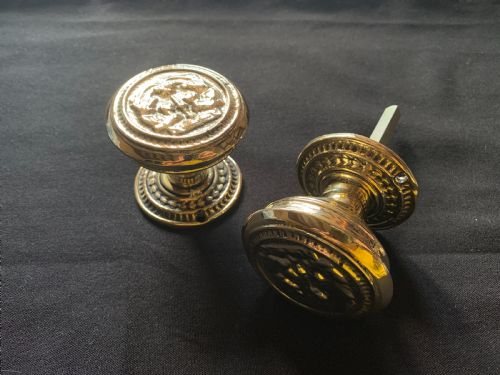
When searching for ornate brass door hardware, buyers encounter functional architectural fittings that span Georgian, Regency, and Victorian eras. These pieces range from heavy lock sets and hinges to decorative finger plates, bell ringers, and door knobs.
The selection on this page leans heavily toward Victorian production, accompanied by select Georgian and Regency examples. Forms include paired crystal and brass handles, solid brass plates, and specialised items incorporating horn or ebony wood.
Origin and style vary from simple British domestic hardware to elaborate French Victorian designs and Gothic Revival motifs. Each item serves both an operational purpose and a decorative function within historic interiors.
Materials and construction methods
The items listed rely primarily on cast brass, solid brass, and polished steel, frequently paired with contrasting materials like crystal glass, blue glass, horn, and ebony wood. Metal components are cast and shaped to achieve the intricate relief work characteristic of Gothic Revival, French Rococo, and French Chateau styles.
Moving parts such as locks, hinges, and bell ringers integrate functional steel mechanisms with decorative brass mounts and backplates. Finishes depend on the interplay between polished metals and inset glass or dark timber elements.
Listings incorporate items spanning the Georgian, Regency, and Victorian periods, alongside specific dated examples from eighteen-hundred and eighteen-ninety.
Assessing quality in period hardware
Quality reveals itself in the crispness of the cast detailing on brass mounts and the weight of the metal used in plates and handles. Pieces that retain their original keys, matching pairs of knobs, and intact crystal or glass inserts demonstrate superior completeness.
Finer examples combine multiple materials successfully, such as horn or ebony incorporated into brass frames, showing careful assembly and robust historical construction.
The Ornate Brass Door Hardware Glossary
- Finger Plate
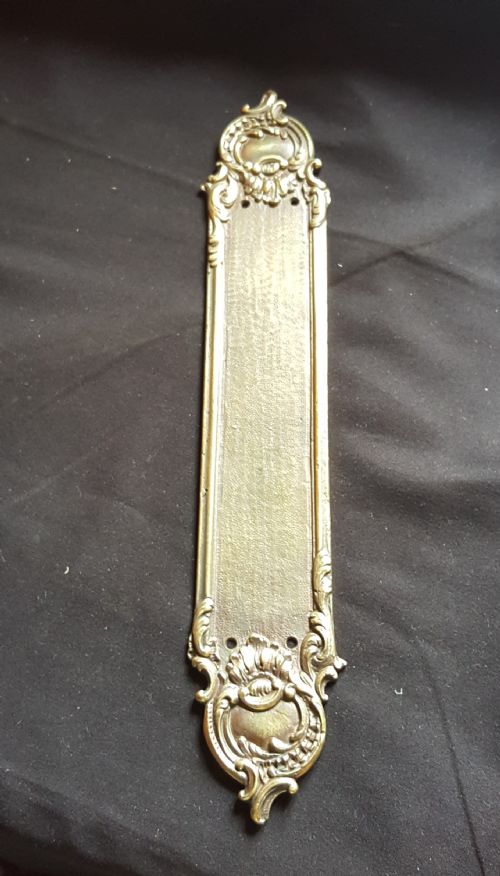
- A protective metal plate mounted on a door around the handle to prevent fingerprints and wear on the wood. These are often decorated with cast patterns.
- Bell Ringer
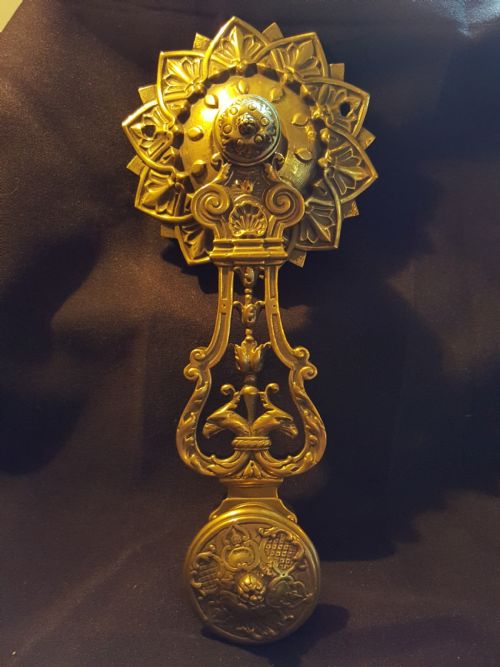
- An operable mechanical door bell mechanism featuring a pull handle and an exterior strike plate. These were common on front doors before electric buzzers.
- Gothic Revival
- An architectural and decorative style drawing inspiration from medieval forms, featuring pointed arches and heavy geometric detailing. This style appears frequently on Victorian hinges and handles.
- Finial
- A decorative terminal ornament attached to the end of a hinge or architectural fitting. They provide a finished sculptural accent to functional hardware.
- Regency
- A design period spanning the early nineteenth century defined by classical restraint and elegance. Hardware from this era displays clean lines combined with refined brass casting.
Ornate Brass Door Hardware: Frequently Asked Questions
How do I clean antique brass hardware?
Clean brass gently using a soft cloth to preserve the historical patina accumulated over the decades.
Avoid harsh chemical dips that strip away the aged surface character entirely.
Can these old door knobs fit modern doors?
Many period spindles and locks differ significantly in sizing and mechanism from modern standard doors.
Check the measurements carefully or consult a specialist joiner before attempting installation.
What is the difference between Georgian and Victorian hardware?
Georgian pieces tend to reflect classical symmetry and restraint, utilising straightforward brass or horn compositions.
Victorian hardware often introduces heavier ornamentation, diverse materials like crystal glass, and revival styles such as Gothic and Rococo.
Are these items supplied with matching keys?
Certain items such as locks retain their period keys, which is noted in the individual descriptions.
Handles and hinges typically function as mechanical pairs or single operational components without locks.