




Ornate Commode
An ornate antique commode brings sculptural presence and French provincial character into a room, offering generous storage topped with fine marble.
Ornate Commode
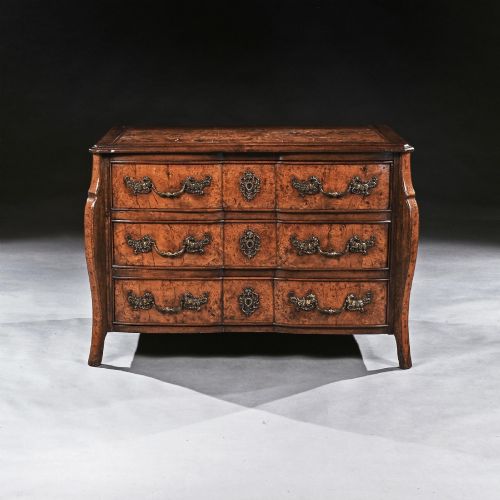
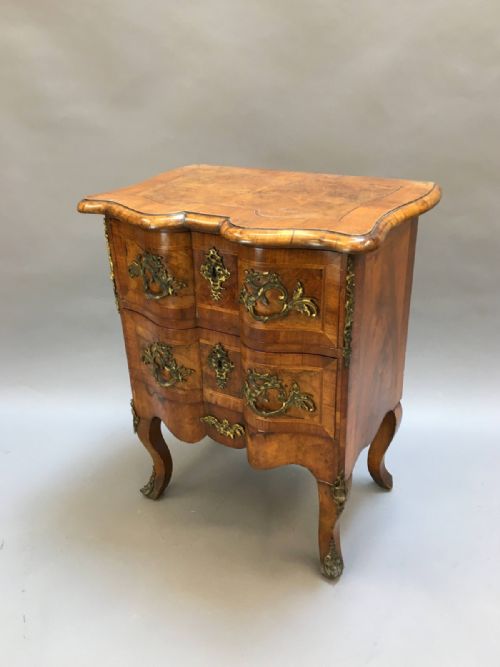
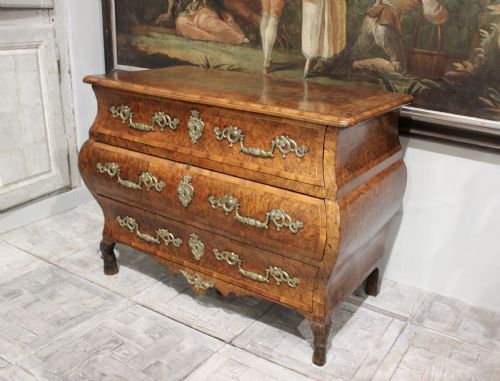
When you search for an ornate antique commode, you encounter low bedroom and salon chests of drawers designed with serpentine or bombe fronts. These pieces span the eighteenth, nineteenth, and early twentieth centuries, drawing heavily on French Louis XV and Rococo design traditions.
The versions most commonly met on this page are walnut, oak, and burr elm examples originating from France, Germany, and Venice. They manifest as both regional provincial pieces and grand revival items featuring rich marquetry or giltwood mounts.
Materials and construction
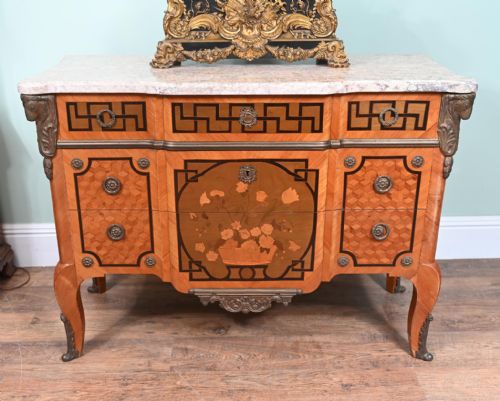
Cabinetmakers constructed these commodes using substantial timber carcasses of walnut, oak, kingwood, and burr elm. Rich veneers and intricate marquetry inlay were applied across serpentine and bombe drawer fronts to create movement and visual depth.
The structural decoration relies on cast or chased brass and ormolu mounts, complemented by polished marble tops fitted closely to the wooden frames.
Listings feature eighteenth and nineteenth-century pieces alongside early twentieth-century examples, using materials including marble, ormolu, walnut, oak, and burr elm.
Variations in quality
The standard of a commode rests on the crispness of its carving and the fluidity of its serpentine or bombe lines. Hand-cut marquetry and thick, well-figured burr walnut or burr elm veneers indicate superior cabinetmaking.
The quality of the finishing hardware distinguishes the range. Heavy, finely detailed ormolu and brass mounts integrated smoothly into the wood signify better workshop production than mass-cast replacements.
The Ornate Commode Glossary
- Bombe
- A bulging or outward-curving chest shape associated with eighteenth-century continental furniture design. This curvaceous profile requires advanced woodworking skill to build successfully.
- Ormolu
- Gilded bronze used for decorative mounts on fine furniture. It provides a bright metallic contrast against dark woods like walnut and kingwood.
- Marquetry
- Decorative patterns formed by fitting small pieces of veneer into wooden panels. Cabinetmakers use contrasting timbers to create floral or geometric designs.
- Serpentine
- A shaped furniture front featuring a concave centre flanked by two convex ends. This undulating contour defines many provincial and revival pieces.
- Giltwood
- Timber that has been coated with gold leaf or gold paint. It appears on carved frames and decorative mounts, particularly on Venetian pieces.
Ornate Commode: Frequently Asked Questions
What is an ornate antique commode?
An ornate antique commode is a low chest of drawers originating from eighteenth, nineteenth, or early twentieth-century continental Europe. These pieces are characterised by serpentine or bombe silhouettes and decorative woodwork.
They function primarily as storage furniture while serving as decorative focal points in sitting rooms, hallways, and bedrooms.
How were commodes used historically?
Historically, commodes served as low storage chests for clothing, linens, and personal valuables in private chambers and reception rooms. Their flat tops also provided a surface for displaying decorative objects, clocks, or candelabra.
Over time, their decorative prominence increased, making them status symbols in grand provincial and urban interiors alike.
How do I live with an antique commode?
Living with one of these chests involves placing it against a sturdy wall where its serpentine or bombe front can be appreciated without obstruction. Use coasters beneath items placed on the marble or wooden top to protect the surface from moisture.
Keep them away from direct heat sources and strong sunlight to protect the aged wood, veneers, and delicate mounts.
How can I tell periods apart?
Eighteenth-century examples typically show hand-carved details, regional provincial timbers like oak or burr elm, and traditional joinery methods. Later nineteenth-century revival pieces often display heavier proportions, machine-cut veneers, and more uniform ormolu mounts.
Stylistic cues such as Louis XV Rococo curves help distinguish earlier forms from later revival interpretations.