



Original Church Watercolour
An original church watercolour captures sacred architecture and local parish life through pigment on paper, offering buyers a genuine piece of historical topography.
Original Church Watercolour
An original church watercolour brings together historic ecclesiastical architecture and fluid pigment applied directly to paper by artists recording British and European landscapes. When searching for an original church watercolour, buyers encounter depictions ranging from humble rural parishes to grand abbeys, produced across the nineteenth and early twentieth centuries.
The works appearing here span distinct artistic movements including the Norwich School, Victorian academic painting, Early 20th Century British art, and Post-Impressionism. Artists frequently documented specific sites such as Whitby Abbey, St Martin in the Fields, and local village churches with precise topographical interest.
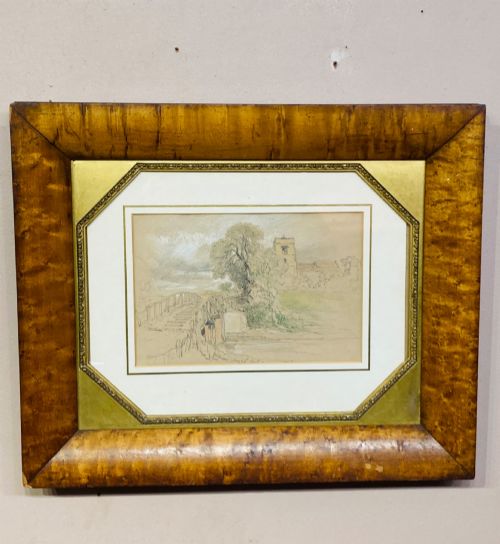
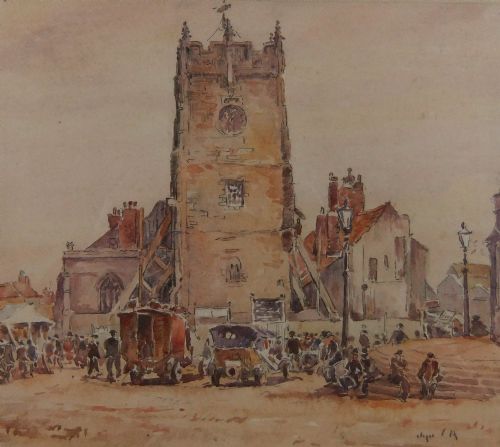
Framed watercolours on paper dominate the selection, often protected by glass and housed within wood or gilt wood frames. These paintings capture both the exterior masonry and surrounding churchyards, occasionally paired as diptychs or paired views to record rural life and changing light.
Materials and execution
Artists typically applied watercolour pigment and ink onto absorbent paper supports, building up translucent washes and fine linear details to define stonework and foliage. Paper quality varied according to the period, while ink provided the initial structural outlines for towers, arches, and gravestones.
Finished sheets were secured behind glass within wooden frames, frequently enhanced with gilt moulding to isolate the delicate pigment from atmospheric moisture and handling. This traditional method of conservation ensures the survival of fugitive water-soluble pigments over successive generations.
Original Church Watercolour Retail Price Guide 2026
Typical asking prices for original church watercolour among the pieces listed under this phrase on Sellingantiques today, from the lower quarter to the upper quarter. They describe what is for sale here now, not the wider market.
Listings feature works executed on paper using watercolour pigment and ink, housed in wood and gilt wood frames.
Differentiating quality in works on paper
The distinction between standard topographical illustration and superior artistic achievement lies in the confidence of the brushwork and the handling of atmospheric light. Stronger compositions demonstrate a sophisticated grasp of perspective when rendering complex ecclesiastical structures like naves, spires, and buttresses.
Condition plays a central role in valuation, as paper is vulnerable to foxing, fading from ultraviolet exposure, and acidic mount burn. Works that retain their original pigment saturation and sit within period gilt wood frames preserve their intended visual impact far better than those affected by damp or improper storage.
Henry Lines·John Smith Atherton·Alfred George Morgan·John Edward Bale·Rowland Henry Hill·Maurice Asselin·David Bates·Fred Lawson·John Thistle
The Original Church Watercolour Glossary
- Watercolour pigment
- Finely ground colour particles suspended in a water-soluble binder, applied in thin layers to create luminous washes.
- Diptych
- A painting comprising two separate hinged or matching panels designed to be viewed together as a single artwork.
- Norwich School
- The first provincial art movement in Britain, noted for its members' dedication to painting local Norfolk landscapes and rural architecture.
- Topography
- The detailed graphic representation of specific geographical locations, buildings, and local landmarks in art.
Original Church Watercolour: Frequently Asked Questions
How do I date an early church watercolour?
Dating relies heavily on costume details of figures in the churchyard, architectural modifications recorded in the masonry, and the specific paper watermarks or framing styles characteristic of the era. Signatures and contemporary pencil inscriptions on the reverse of the paper also provide reliable chronological anchors.
Comparative study with dated works by the same artist helps narrow the window of execution, particularly across the Victorian and Edwardian periods where stylistic shifts are well documented.
Can I hang these paintings in direct sunlight?
Watercolour pigments are notoriously sensitive to ultraviolet light and will fade permanently if exposed to direct sun for prolonged periods. Glazing with UV-filtering glass offers partial protection, but placement on interior walls away from direct windows remains essential for preservation.
Maintaining stable relative humidity in the room prevents the paper support from cockling or developing foxing spots over time.
What distinguishes a study from a finished painting?
Studies often feature visible pencil gridlines, rapid colour swatches, and loose washes intended to capture immediate atmospheric effects rather than complete architectural detail. Finished exhibition pieces display disciplined control, precise perspective, and fully resolved foreground elements.
Both forms hold historical interest, though finished works usually command greater attention from collectors of topographical art.
Why are some church watercolours framed with gilt wood?
Gilt wood frames were selected by Victorian and Edwardian framers to complement the warm tones of the paper and provide a formal boundary for domestic display. The reflective gold leaf added a sense of importance to topographical subjects and harmonised with traditional interior decoration.
Original period frames also contribute historical context, provided the backing boards and glass remain undisturbed.