

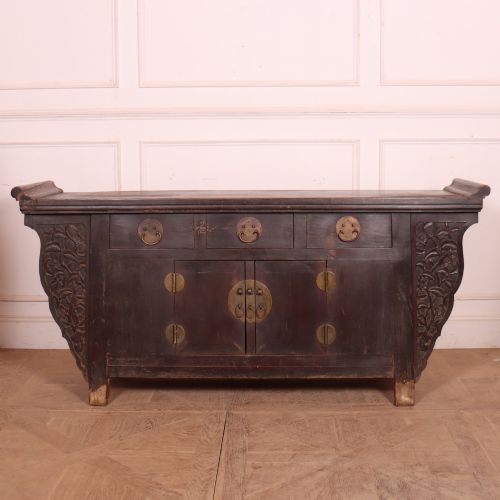


Oriental Wood Credenza
An oriental wood credenza brings substantial storage and distinct regional character to a room, combining practical utility with centuries of traditional craftsmanship.
Oriental Wood Credenza
When you search for an oriental wood credenza, you encounter a selection of sideboards, cabinets, and console tables primarily dating from the nineteenth century. These items serve as functional storage furniture, encompassing Chinese provincial styles alongside Anglo-Indian, Anglo-Egyptian, and Anglo-Burmese designs.
The pieces on this page lean heavily towards Chinese elm sideboards and carved padauk cabinets. You also find specialised forms such as three-drawer console tables and storage cabinets reflecting Qing Dynasty influences.
Originating across different regions, these items blend traditional Asian woodworking techniques with decorative vocabularies that crossed continents during the late nineteenth and early twentieth centuries. Each form offers a distinct silhouette, from low console tables to tall cupboards designed for domestic utility.
How they were made
Makers utilised dense timbers such as padauk wood and elm, selecting each log for its grain pattern and structural resilience. These sturdy woods formed the load-bearing frames and cabinet doors that withstand daily use.
Craftspeople integrated decorative elements using brass hardware, bone inlay, and detailed metal mounts. Relief carving appears frequently on surfaces, notably in Burmese padauk pieces that showcase elaborate sculptural depth.
Oriental Wood Credenza Retail Price Guide 2026
Typical asking prices for oriental wood credenza among the pieces listed under this phrase on Sellingantiques today, from the lower quarter to the upper quarter. They describe what is for sale here now, not the wider market.
Listings feature items from the nineteenth century up to 1920, constructed mainly in elm, padauk wood, and walnut with brass and bone details.
What varies in quality
The standard of carving defines the upper tier of these pieces, distinguishing crisp, deep relief work from flatter, simpler surface decoration. The handling of traditional motifs reveals the artisan's skill and the workshop's standing.
Timber selection and joinery integrity dictate longevity. Denser woods like padauk and well-seasoned elm provide superior structural stability compared to more utilitarian domestic construction.
The Oriental Wood Credenza Glossary
- Padauk
- A dense, heavy tropical hardwood prized for its deep reddish-brown colour and durability in carved furniture. It takes a fine finish and supports intricate detail.
- Elm
- A resilient domestic timber used widely in Chinese provincial cabinet making. It offers good bending strength and a pronounced grain.
- Chinoiserie
- European decorative style reflecting Chinese artistic influences. It appears in furniture adapted for Western tastes during the nineteenth century.
- Qing Dynasty
- The final imperial dynasty of China, spanning from the seventeenth to the early twentieth century. Furniture from this era displays established regional traditions and classical forms.
Oriental Wood Credenza: Frequently Asked Questions
What is an oriental wood credenza?
These pieces function as large sideboards, storage cabinets, and console tables designed to hold household goods while serving as a decorative focal point in a room.
Originating largely from the nineteenth century, they incorporate regional styles from China, India, Egypt, and Burma using native timbers like elm and padauk.
How do I care for padauk furniture?
Keep the wood away from direct heat sources and sudden humidity changes to prevent timber movement. Dust regularly with a soft, dry cloth and avoid harsh chemical polishes.
Applying a traditional wax occasionally helps nourish the dense grain and preserves the natural lustre of the surface.
Where were these cabinets placed?
Households used these sideboards and cupboards in dining rooms, living spaces, and hallways for general storage and display purposes. Console tables functioned as side furniture against walls for decorative objects.
Their robust construction allowed them to hold heavy items while organising daily domestic paraphernalia.
How are different regional styles identified?
Chinese provincial pieces often feature simple elm construction with traditional joinery, whereas Anglo-Indian and Anglo-Burmese items frequently display dense padauk and deep carving.
Stylistic markers include hardware choices, decorative motifs, and the specific density and colour of the timber utilised.