

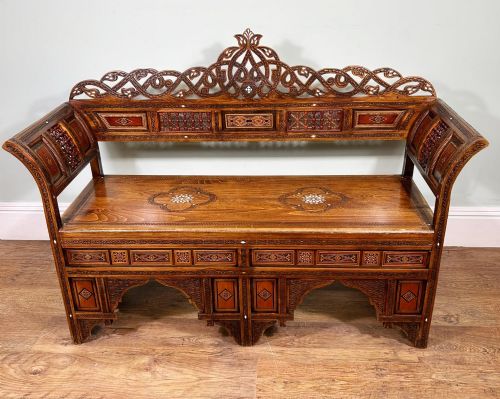


Oriental Style Carved Bench
An oriental style carved bench offers striking seating or surface space, bringing rich wood and intricate detail into any room.
Oriental Style Carved Bench
When searching for an oriental style carved bench, buyers encounter diverse seating options rooted in Chinese Qing Dynasty aesthetics, Moorish Revival design, and Syrian Damascus traditions. These pieces span from the late nineteenth century into the early decades of the twentieth century, reflecting broad geographic influences.
The selections on this page range from grand hall benches and settles to low window seats, daybeds, and companion stools. Hardwoods form the core of these offerings, often accompanied by complementary coffee tables and larger furniture suites.
Chinese Qing Dynasty pieces and Middle Eastern seating show distinct regional carving traditions. Buyers most frequently meet substantial hardwood benches featuring traditional motifs alongside inlaid Syrian Damascus works.
Materials and construction methods
The construction of these pieces relies heavily on dense hardwoods such as huali, huanghuali, and ebonised timber. Elm and walnut also appear in specific regional builds, providing sturdy frames capable of deep carving.
Master artisans embellished these wooden structures using contrasting materials set flush into the grain. Mother of pearl, bone, and marble panels are integrated into complex geometric or figurative patterns across the surfaces.
Oriental Style Carved Bench Retail Price Guide 2026
Typical asking prices for oriental style carved bench among the pieces listed under this phrase on Sellingantiques today, from the lower quarter to the upper quarter. They describe what is for sale here now, not the wider market.
Some nineteenth century benches double as nap stations for opium enthusiasts.
Assessing quality in carved seating
Quality rests primarily on the depth and crispness of the carving work across the hardwood structure. Superior examples display sharply defined motifs without splintering or softening in the grain.
The precision of inlaid elements separates finer pieces from simpler items. When mother of pearl or bone sits completely flush and secure within the timber channels, the standard of craftsmanship remains high.
The Oriental Style Carved Bench Glossary
- Hardwood
- Dense timber derived from broad-leaved trees, used for sturdy furniture construction. It provides the ideal substrate for intricate hand-carving.
- Mother of pearl
- The iridescent inner layer of mollusc shells used for decorative inlay. Artisans cut it into thin sections to form geometric patterns.
- Qing Dynasty
- The final imperial dynasty of China, spanning from sixteen forty-four to nineteen twelve. Pieces from this era often feature elaborate dragon and traditional motifs.
- Moorish Revival
- An architectural and decorative style popular in the nineteenth and twentieth centuries. It incorporates influences from North African and Middle Eastern design.
Oriental Style Carved Bench: Frequently Asked Questions
Where should I place a carved bench?
These benches suit hallways, living spaces, or bedrooms as statement seating. They also function well beneath windows as low seats.
Ensure the piece has adequate clearance from direct heat sources to protect the dense hardwood and any delicate inlay work.
How do I care for inlaid hardwood?
Dust the timber regularly with a soft, dry cloth to prevent dirt accumulation in the carved recesses. Avoid harsh chemical polishes.
Maintain stable humidity levels in the room to prevent the wood from expanding and loosening the mother of pearl or bone inserts.
Are these pieces purely decorative?
While highly decorative due to their intricate carving and inlay, these benches are constructed from durable hardwoods for daily seating. Daybeds and window seats offer functional rest areas.
Their substantial weight and sturdy frames ensure they withstand normal domestic use.