
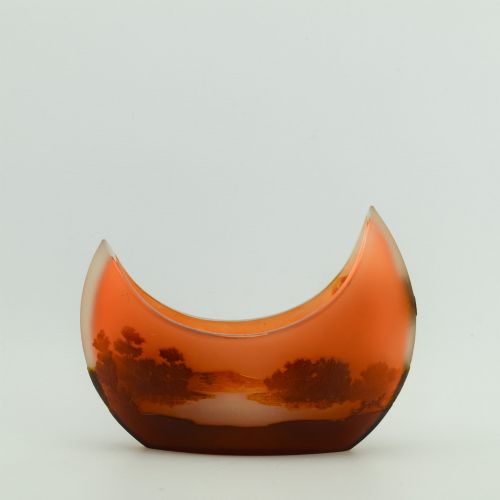
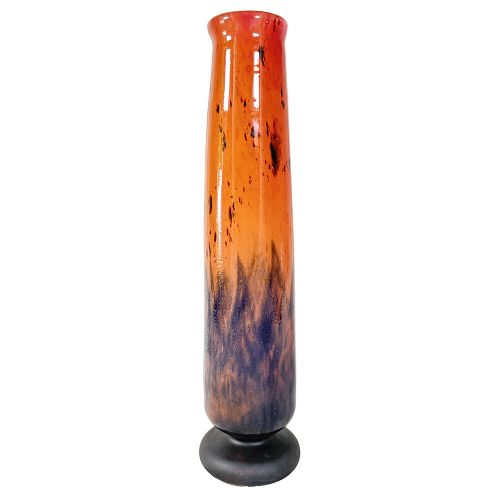
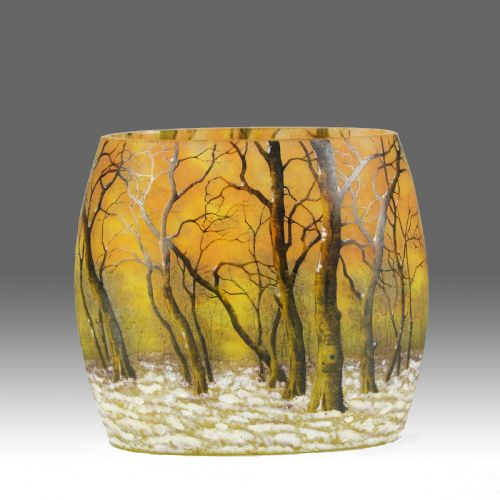


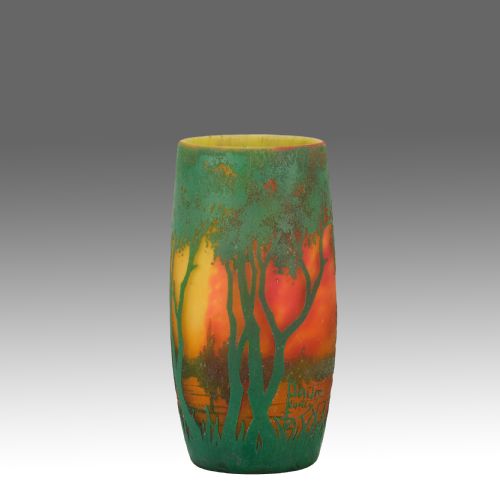

Orange Cameo Vase
An orange cameo vase brings the rich, fiery tones of early twentieth-century glassmaking into a room, offering layered depths that catch the light.
Orange Cameo Vase
An orange cameo vase is a decorative glass vessel created primarily during the early twentieth century, spanning the Art Nouveau and Art Deco periods. These pieces showcase distinctive layered glass designs where vibrant orange hues dominate the background or the raised motifs.
The versions most commonly met on this page originate from esteemed French makers working between nineteen hundred and nineteen twenty. They take forms such as crescent shapes, large oviform bodies, and cylindrical vessels depicting landscapes, aquatic scenes, and floral subjects.
How they were made
Makers utilised blown glass as the foundational base, often incorporating frosted glass, powdered glass, or enamel to build complex visual textures. Molten layers of contrasting colours were fused together before the vessel was shaped.
Acid-etched glass techniques were then applied to carve away the outer layers of glass, revealing the design in relief against the orange background. This precise chemical carving created the characteristic multi-layered cameo effect seen across Art Nouveau and Art Deco examples.
The listings on this page span the early twentieth century, focusing entirely on blown and acid-etched cameo glass vessels from French studios.
What varies in quality
Quality rests upon the depth of the carving and the complexity of the colour transitions within the cameo glass. Superior examples display crisp relief work where the acid-etching defines delicate botanical or landscape details without blurring the boundaries between layers.
The artistic ambition of the subject matter also dictates the tier of the piece, moving from straightforward floral motifs to intricate winter or aquatic scenes. The handling of orange tones, whether mimicking a fiery sunset or a muted autumnal landscape, determines the visual impact.
Gallé·Daum·Daum Frères·Legras·Le Verre Francais·Schneider
The Orange Cameo Vase Glossary
- Cameo Glass
- Glass vessels formed with multiple layers of contrasting colours, where portions of the outer layers are carved away to leave a raised design. This technique requires immense skill to control the depth of the acid or cutting tool.
- Acid-Etched Glass
- A method using acid to eat away exposed portions of glass to create surface decoration or relief carvings. It became a defining technique for early twentieth-century French glassmakers.
- Art Nouveau
- A style prominent around nineteen hundred characterised by flowing, organic lines and floral motifs. Glassware from this movement frequently draws inspiration from natural landscapes and aquatic themes.
- Art Deco
- A later style appearing around nineteen twenty favouring stylised forms and geometric precision. Pieces from this era often pair striking orange tones with deep purples or contrasting backgrounds.
- Powdered Glass
- Finely ground glass fused into or onto the body of a vessel during creation to produce mottled colour effects. It adds subtle texture and depth beneath the cameo layers.
Orange Cameo Vase: Frequently Asked Questions
What periods do these vases come from?
These vases date from the early twentieth century, specifically clustering around nineteen hundred, nineteen ten, and nineteen twenty. They bridge the transition from organic Art Nouveau designs to the bolder structures of Art Deco.
The specific years recorded on the pieces reflect the height of French cameo glass production by master workshops in Nancy and Paris.
How were these vases used originally?
They served primarily as high-end ornamental objects for prosperous Edwardian and interwar interiors. Their striking orange hues and detailed carvings meant they were displayed on mantelpieces and side tables to catch natural light.
Unlike utilitarian kitchenware, they were conceived as pure art glass showcases for wealthy collectors.
How do I distinguish Art Nouveau from Art Deco pieces?
Art Nouveau pieces from nineteen hundred typically feature flowing floral motifs, honeysuckle, or natural landscapes rendered with soft, curving lines. The focus remains closely tied to organic forms and botanical observation.
Art Deco examples from nineteen twenty lean towards bolder, more stylised compositions such as stark winter scenes or geometric colour pairings like orange on purple.
How should I display an orange cameo vase at home?
Place the vase near a natural light source, such as a windowsill or an open shelf, to allow daylight to pass through the layered cameo glass. This reveals the hidden depths of the orange tones and the precision of the acid-etching.
Keep surrounding decor neutral so the vibrant glass remains the focal point of the space.