
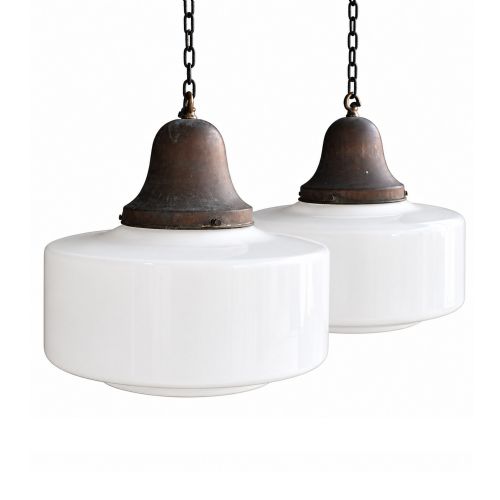
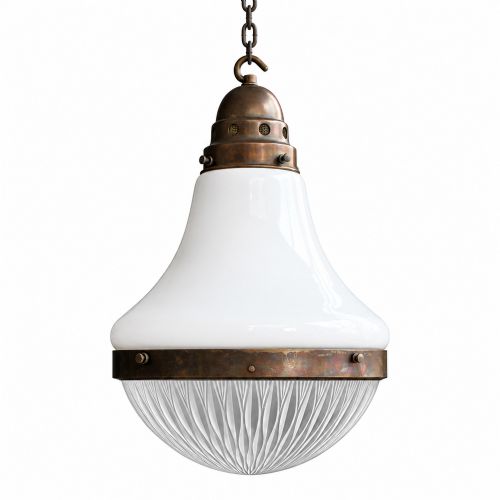
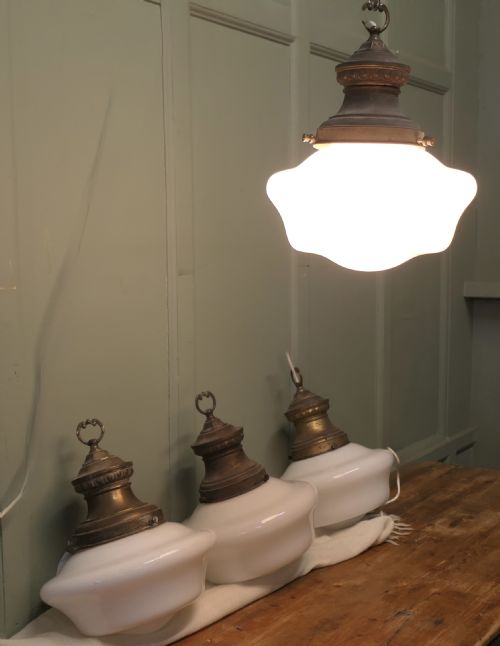
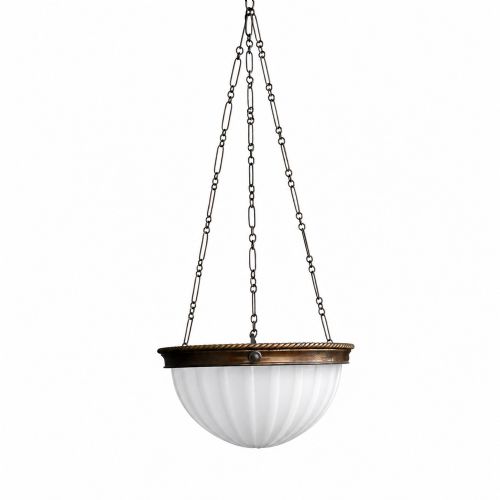
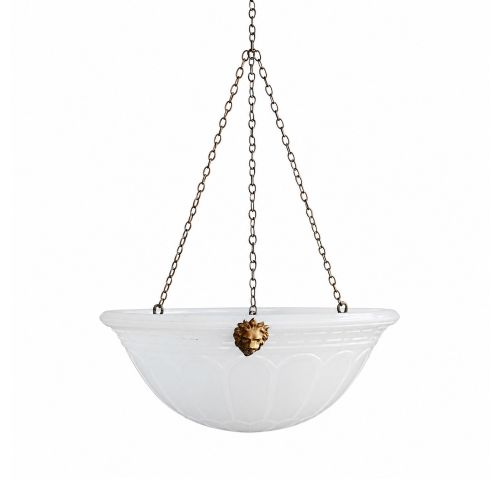


Opal Glass Hanging Shade
An opal glass hanging shade diffuses a soft, even light across a room, bringing both genuine period character and functional illumination to your interior scheme.
Opal Glass Hanging Shade
An opal glass hanging shade encompasses pendant lamps, ceiling bowls, and trade sign lights that suspend from above to cast a diffused, glare-free glow. When you search for this phrase, you find lighting fixtures spanning from the nineteenth century through the Edwardian period and the interwar decades up to the nineteen-forties.
The versions you are most likely to meet on this page lean heavily towards early twentieth-century English examples, often catalogued as moonstone or opaline glass. These pieces frequently combine translucent milky glass shades with simple brass, copper, or enamelled suspension fittings suited to industrial, Arts and Crafts, or mid-century interiors.
How they were made
The shades themselves rely on specialised glass-making techniques that introduce bone ash or metallic oxides into the molten batch to achieve that characteristic milky, opalescent opacity. This ensures the light source is hidden while the maximum amount of illumination diffuses evenly through the body of the shade.
Metal components in brass and copper provide the structural suspension, working alongside enamel finishes and fabric cords to anchor the heavy glass bowls securely to the ceiling. These durable materials reflect the practical demands of Edwardian and industrial workshops where longevity and ease of cleaning mattered most.
Early twentieth-century English glassmakers occasionally added a pinch of arsenic to the molten batch to achieve that mesmerising milky opalescence.
What varies in quality
The weight and consistency of the glass set the better examples apart, with superior pieces showing a dense, rich opacity rather than a thin or streaky finish. Substantial thickness in the shade ensures a deeper, softer diffusion of light.
The refinement of the metal suspension hardware dictates the overall calibre of the fitting. Heavy cast brass or carefully enamelled steel mounts demonstrate a higher standard of manufacture than generic replacement fixings.
The Opal Glass Hanging Shade Glossary
- Opal glass
- A translucent white glass that diffuses light evenly while obscuring the bulb within. It became popular for domestic and commercial lighting from the nineteenth century onwards.
- Moonstone glass
- A specific type of soft, glowing glass with a milky appearance reminiscent of the gemstone. It is frequently found on early twentieth-century English pendants.
- Opaline glass
- A slightly heavier, semi-opaque glass often produced in pastel shades or dense white. It adds a subtle decorative presence to industrial and Edwardian light fixtures.
- Pendant lighting
- A single light fixture that hangs from the ceiling by a cord, chain, or metal rod. These direct illumination downwards into a specific workspace or living area.
- Enamelled ceiling suspension
- A metal mounting fixture coated with a fused vitreous enamel layer for durability and colour. This finish was common in industrial and trade settings.
Opal Glass Hanging Shade: Frequently Asked Questions
How do I clean an opal glass hanging shade safely?
Remove the shade from its suspension fixture if possible and wash it gently in warm, soapy water using a soft cloth. Avoid harsh abrasives that might scratch the surface or dull the milky finish.
Dry the glass thoroughly with a lint-free towel before reattaching it to the brass or copper fitting. Take care when handling older glass bowls as they can be heavier and more delicate than modern equivalents.
How do I date an Edwardian or early twentieth-century pendant?
Examine the construction of the metal fitter, the thickness of the glass, and the type of wiring or cord used for suspension. Edwardian and 1920s pieces often feature heavy brass galleries and specific screw-thread configurations that differ from later mid-century designs.
Look for subtle manufacturing marks or registration numbers stamped onto the metal galleries. Comparing the overall form against documented industrial and domestic lighting catalogues from the period also helps narrow down the decade.
Are these lights suitable for low ceilings?
Some shorter pendant configurations and ceiling bowls sit relatively close to the mounting point, making them suitable for rooms with restricted vertical clearance. Adjusting the fabric cord or suspension chain can also help tailor the drop to your specific space.
Ensure that the bottom of the shade hangs high enough to maintain a clear walkway beneath it. Bowl-style fixtures often provide a better solution for compact spaces than long, multi-component hanging assemblies.