
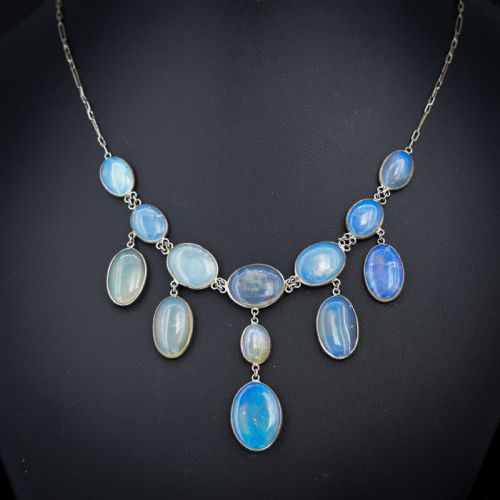
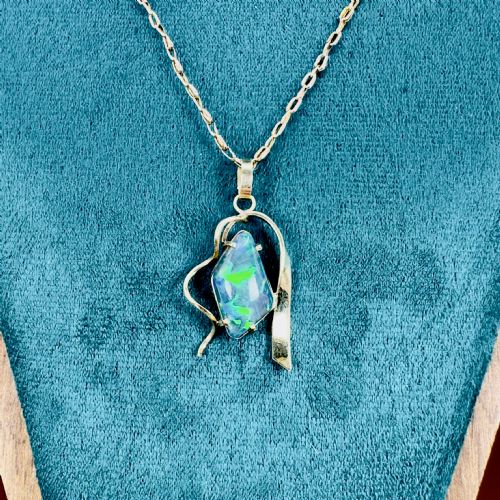


Opal Gemstone Pendant
An opal gemstone pendant catches the light with shifting fires, offering a distinct flash of colour that draws the eye across a room.
Opal Gemstone Pendant
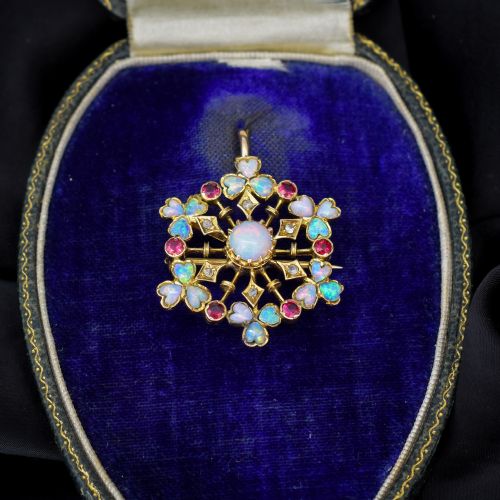
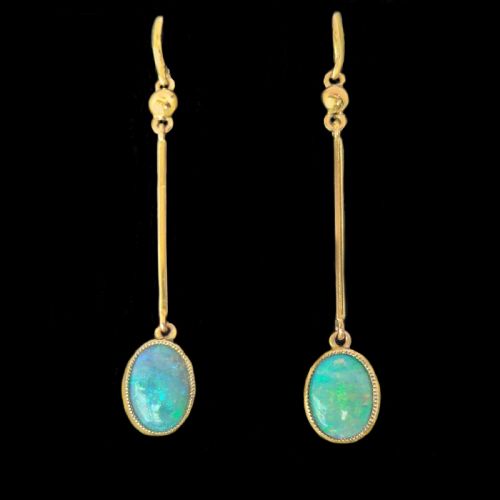
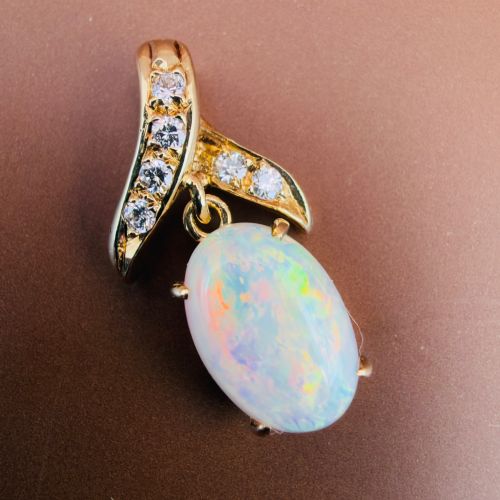
An opal gemstone pendant is a suspended ornament centred around an opal, often accompanied by supporting stones or intricate metalwork. When you search for this phrase, you find pieces spanning the Victorian, Edwardian, Art Deco, and Mid-Century periods.
The selections include simple solitary drops alongside elaborate cluster arrangements and convertible brooch pendants. Most examples you meet here date from the mid-twentieth century or the nineteenth century, reflecting classic historical tastes.
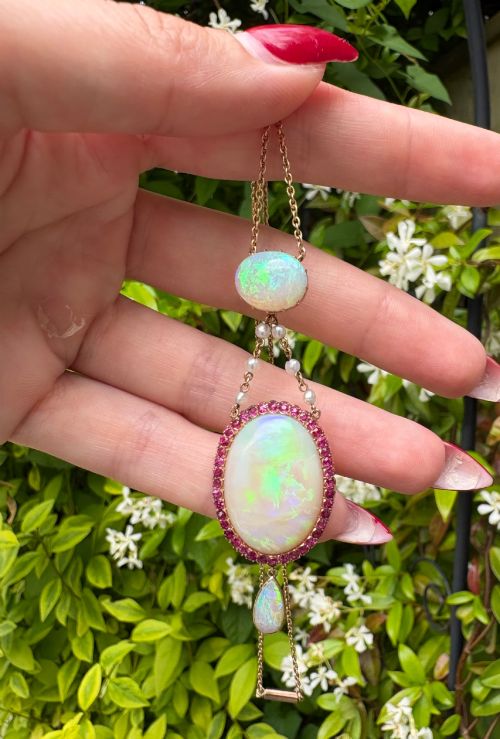
Forms vary from delicate fringe festoon necklaces to bold cabochon centerpieces set in yellow or white gold. The stones themselves range from milky Australian varieties to dark black opals and fiery orange tones.
Materials and Construction
Gold forms the primary metal structure, appearing in nine-carat, fifteen-carat, and eighteen-carat purity levels, alongside occasional silver settings. Stones are secured in claw mounts, closed-back bezels, or fine filigree wirework.
Gems are shaped as smooth cabochons to display their internal play of colour, sometimes paired with cut diamonds, rubies, or seed pearls. Doublets also appear, layering natural opal with a supportive backing to enhance durability and visual depth.
Listings feature items spanning the Victorian era through the mid-twentieth century, employing gold, silver, diamonds, and rubies.
Judging Quality and Execution
Quality rests primarily on the optical performance of the opal and the integrity of its setting. Stones displaying vibrant, multi-coloured flashes across the entire surface command greater attention than those with dull or static patches.
Execution shows in the delicacy of the metalwork, whether hand-twisted wire in Edwardian fringes or heavy cast clusters from the mid-century. The harmonious balance between the central gem and surrounding diamonds or gold defines the overall success of the piece.
The Opal Gemstone Pendant Glossary
- Cabochon
- A gemstone cut with a smooth, rounded, convex top rather than faceted edges. This style suits opals by showcasing their internal play of colour.
- Doublet
- A composite stone made by joining a thin slice of natural opal to a dark backing material. This method strengthens the gem and deepens the perceived body tone.
- Fringe
- A necklace design featuring hanging drops or tassels suspended along the lower edge of the chain or collar. Edwardian makers favoured this layout for delicate pearl and opal arrangements.
- Cluster
- An arrangement of smaller stones set closely around a larger central gem. This configuration maximises sparkle and visual impact.
- Play of colour
- The shifting flashes of spectral hues seen within an opal as it moves under light. This optical phenomenon arises from the diffraction of light through microscopic silica spheres.
Opal Gemstone Pendant: Frequently Asked Questions
What makes an opal pendant antique?
An opal pendant gains antique status when its age reaches roughly one hundred years or more, typically placing Victorian and Edwardian examples in this category.
Hand-wrought metal details and specific gem-cutting traits help confirm these historical origins.
How do I care for my opal pendant?
Opals contain water within their structure, requiring gentle treatment and avoidance of harsh chemicals, ultrasonic cleaners, and extreme temperature shifts.
Storing the piece separately from harder gemstones prevents surface scratching on the softer stone.
Are all opals solid stones?
Not every opal is a solid natural stone, as some historic and mid-century examples utilise doublets to add strength and depth.
Examination of the side profile usually reveals the distinct junction line where the opal meets its backing.
How do I date an opal pendant?
Dating relies on metal purity marks, stone cuts, clasp styles, and overall design motifs associated with periods like Art Deco or the Victorian era.
Assay stamps and professional testing provide further clarity on the exact period of manufacture.