

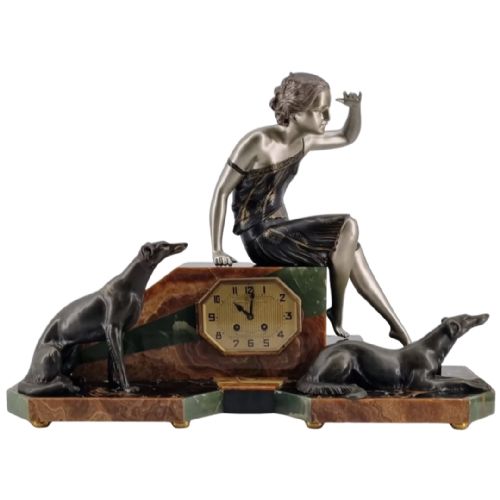


Onyx Clock Garniture
An onyx clock garniture brings a striking focal point to a mantelpiece, combining a central timepiece with matching decorative side urns or figurative sculptures.
Onyx Clock Garniture
An onyx clock garniture consists of a central mantel clock accompanied by a matching pair of side pieces, such as urns or figurative sculptures, designed to sit together harmoniously on a surface. When searching for an onyx clock garniture, you encounter sets ranging from ornate Victorian and Louis XVI Revival designs to streamlined Art Deco compositions.
The pieces on this page originate predominantly from French makers across the nineteenth and twentieth centuries. These sets span periods from the Victorian era and 1860s through to the 1920s and 1930s Art Deco movement.
Forms include complete three-piece clock garniture sets and mantel clock sets featuring sculptural elements like greyhounds and German Shepherd dogs by artists such as Michel Decoux. The materials combine natural stone with metal mountings and enamel dials to create a balanced decorative display.
How they were made
The primary structure relies on carved onyx or marble combined with metal components such as brass, bronze, gilt metal, or ormolu. Artisans shaped the stone into architectural cases and matching garniture bodies while casting and gilding the metal mounts.
Surface decoration incorporates champleve enamel detailing on dials and panels, alongside cast spelter or bronze sculptural figures. The integration of glass covers protects the delicate clock faces and enamel work.
Onyx Clock Garniture Retail Price Guide 2026
Typical asking prices for onyx clock garniture among the pieces listed under this phrase on Sellingantiques today, from the lower quarter to the upper quarter. They describe what is for sale here now, not the wider market.
German Shepherd dogs and greyhounds occasionally stand guard over the clock faces in Art Deco garnitures.
What varies in quality
Quality differences appear in the crispness of the metal casting and the richness of the gilding applied to the bronze, ormolu, or gilt metal mounts. Finer sets display detailed chasing on the metalwork and precise carving of the onyx or marble bodies.
The integration of the garniture components also dictates the caliber of a set, where matching materials and balanced proportions between the central clock and the side pieces demonstrate superior craftsmanship.
Michel Decoux
The Onyx Clock Garniture Glossary
- Garniture
- A set of matching decorative objects, typically comprising a central clock and two flanking urns or figures designed to display together.
- Onyx
- A banded variety of chalcedony used extensively for the polished stone cases of these clocks and garnitures.
- Ormolu
- Gilt bronze ornamentation applied to furniture and clock cases, created through a mercury gilding process or modern electroplating.
- Champleve
- An enamelling technique where troughs are carved into the metal surface and filled with vitreous enamel before firing.
- Spelter
- A zinc alloy frequently used as a base metal for cast figures and decorative mounts, often given a bronze or gilt finish.
Onyx Clock Garniture: Frequently Asked Questions
What is an onyx clock garniture set?
An onyx clock garniture set is a matched ensemble comprising a central mantel clock and two coordinating side pieces, such as urns or flanking sculptures.
These sets were designed during the nineteenth and twentieth centuries to provide a unified decorative display on mantelpieces or console tables.
How do I date a French clock garniture?
Dating relies on stylistic clues, ranging from the elaborate classical motifs of Victorian and Louis XVI Revival pieces to the geometric lines of Art Deco designs.
Materials like champleve enamel and the presence of specific sculptural subjects also help place a set within periods from the 1860s to the 1930s.
Where should I place a clock garniture?
A clock garniture requires a wide, stable surface like a mantelpiece, sideboard, or large table to accommodate all three matching components together.
Arranging the central clock between the two flanking urns or sculptures creates the balanced focal point intended by the maker.
What materials are used in these clock sets?
These pieces combine polished green onyx or marble bodies with metal elements such as brass, bronze, ormolu, and gilt metal.
Enamel dials, glass bezels, and cast spelter sculptural figures frequently complete the construction of the clock and its matching garnitures.