

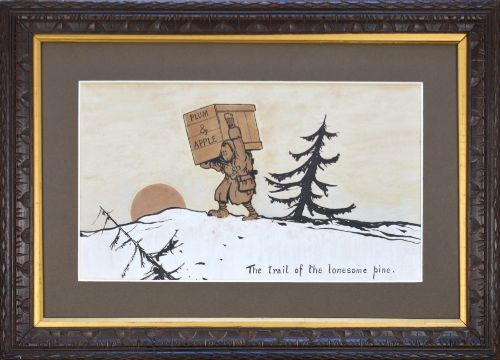
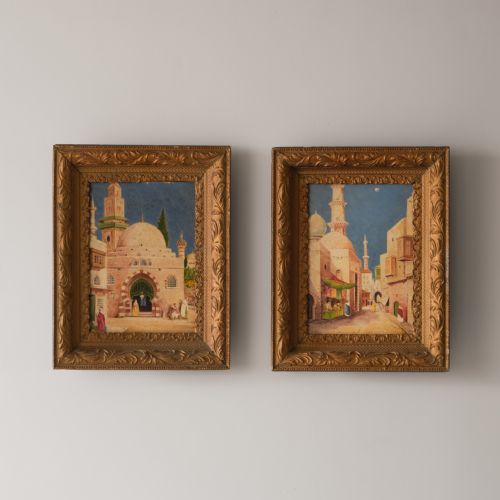


Old Watercolour Artwork
Old watercolour artwork brings traditional paper paintings into a room, capturing landscapes and rustic scenes across centuries.
Old Watercolour Artwork
When you search for old watercolour artwork, you encounter original paintings and drawings on paper dating from the eighteenth century through to the mid-twentieth century. These pieces record historical views, marine settings, and naive compositions preserved behind glass in wooden frames.
The selections available here range from Regency naive portraits and early nineteenth-century scenes to Edwardian garden views and First World War illustrations. Most examples lean towards Victorian and early twentieth-century British subjects, including local mills, country inns, and coastal piers.
How they were made
The foundation of these works is paper, upon which artists applied water-soluble pigments, often alongside ink for definition and structural detail. These pigments sink into the paper fibres, creating translucent washes and layered tones that dry with a matte finish.
Protection comes from traditional framing methods, typically combining glass and wooden surrounds, sometimes finished in gilt wood to highlight the subject within.
Old Watercolour Artwork Retail Price Guide 2026
Typical asking prices for old watercolour artwork among the pieces listed under this phrase on Sellingantiques today, from the lower quarter to the upper quarter. They describe what is for sale here now, not the wider market.
The current listings span periods from the early eighteenth century through to 1940, utilising paper, ink, and watercolour within wooden frames.
What varies in quality
Quality rests upon the confidence of the brushwork and the clarity of the composition, distinguishing accomplished academic output from simpler naive pieces. Skilled draughtsmanship brings depth to architectural elements and natural landscapes alike.
Condition also plays a part, as paper and pigments are sensitive to light and moisture over the decades. Stronger works retain their original colour saturation and paper tone without heavy fading or excessive foxing.
Bruce Bairnsfather·Arthur Wilde Parsons·Henry John Kinnaird·John R Houston·Johan Noah Bemmel·Lilian Stannard·Fred Lawson
The Old Watercolour Artwork Glossary
- Naïve art
- A style of visual art created by a person without formal training, often characterised by a childlike perspective and simplified proportions.
- Regency
- The period in British history from 1811 to 1820, marked by distinct architectural and artistic elegance.
- Edwardian
- The period covering the reign of King Edward VII from 1901 to 1910, though often used broadly to describe the style of the early twentieth century.
- Gilt wood
- Wood that has been coated with a thin layer of gold leaf or gold-coloured paint, commonly used in traditional picture framing.
- Foxing
- The age-related brown spots and patches that appear on old paper due to chemical reactions within the material.
Old Watercolour Artwork: Frequently Asked Questions
What is old watercolour artwork?
These pieces are original painted or drawn compositions executed on paper using water-based pigments and inks, preserved behind glass in traditional frames.
They span multiple historical eras, including the eighteenth, nineteenth, and early twentieth centuries, recording landscapes, architecture, and figural subjects.
How should I hang old watercolours?
Watercolour pigments on paper are sensitive to direct sunlight and high humidity, which can cause fading and deterioration over time.
Position your framed paintings on interior walls away from direct windows and maintain a stable room temperature to protect the paper.
How do I identify the period?
Dating relies on stylistic clues, subject matter, and framing techniques characteristic of eras such as the Regency, Victorian, or Edwardian periods.
Signatures, inscriptions on the reverse, and the type of paper or framing materials also offer reliable indicators of age.
What subjects are most common?
The selections frequently feature architectural landmarks, country mills, coastal piers, and rural gardens across Britain.
Portraiture and military subjects also appear, alongside naive interpretations of distant locations and historical events.