


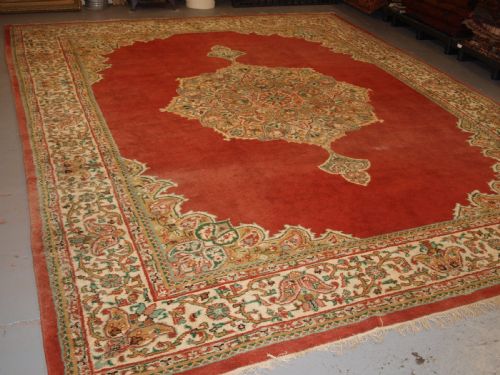
Old Turkish Carpet
An old turkish carpet brings warmth and deep regional character to a room through traditional hand-knotted designs.
Old Turkish Carpet
An old turkish carpet encompasses village rugs, large carpets, and flat-woven kilims originating from Anatolia and surrounding regions during the early twentieth century. Buyers seeking an old turkish carpet will frequently encounter specific regional village weaves and traditional styles such as Anatolian Tribal, Melas, Yahyali, and Ushak.
These floor coverings arrive in various formats including smaller area rugs, prayer rugs, and expansive carpets measuring over four metres. Formats range from the village-made runner or compact mat to substantial reception-size carpets suitable for principal living spaces.
Design vocabulary spans star medallions, Caucasian patterns, banded layouts, and classical floral or geometric motifs executed in soft red, ivory, and pastel grounds. Each piece reflects the specific weaving traditions of centres like Bergama, Dosemealti, Isparta, and Sharkoy.
How they were made
The construction relies fundamentally on natural fibres, combining wool pile with cotton foundations in the majority of knotted examples, alongside flat-woven wool and cotton structures found in kilims. Weavers utilised hand-spun materials and traditional village looms to build dense, durable textile structures.
Dyes and patterns were derived from local regional traditions, producing soft reds, light red grounds, ivory fields, and banded colour arrangements. The weaving techniques encompass both pile knotting and flat-weave kilim construction across the different Anatolian and Balkan influenced pieces.
Old Turkish Carpet Retail Price Guide 2026
Typical asking prices for old turkish carpet among the pieces listed under this phrase on Sellingantiques today, from the lower quarter to the upper quarter. They describe what is for sale here now, not the wider market.
Carpets travel from quiet Anatolian villages to modern hardwood floors, bringing centuries of nomadic geometry right beside the sofa.
What varies in quality
Quality differences emerge in the fineness of the knotting, the precision of geometric or medallion layout execution, and the depth of regional character. Finer village and town pieces demonstrate tighter structural foundations and carefully balanced colour palettes.
The integrity of the wool, the retention of original dimensions, and the preservation of secondary borders or banded designs separate standard examples from finer collector pieces. Condition ranges from robust village utility to remarkably preserved classical formats.
Maples Ushak
The Old Turkish Carpet Glossary
- Kilim
- A flat-woven carpet or rug produced without a pile by tightly interweaving warp and weft strands. These textiles often feature sharp geometric patterns and lighter overall weights than knotted pile carpets.
- Prayer rug
- A rug featuring a central mihrab or niche design historically oriented towards Mecca during prayer. These pieces typically display specific architectural motifs in the upper field.
- Medallion
- A central ornamental design motif placed in the middle of the carpet field. Star and classical medallion patterns dominate many Anatolian room-size carpets.
- Warp
- The vertical foundation threads stretched tightly on the loom before weaving begins. Cotton is commonly used for these structural support lines.
- Weft
- The horizontal threads passed through the warp strands to lock knots and structural rows in place. Together with the warp, they form the sturdy grid of the carpet.
Old Turkish Carpet: Frequently Asked Questions
How do I care for a wool rug?
Vacuum gently without a rotating brush to protect the vintage wool pile.
Keep the textile out of direct sunlight to prevent fading of soft red and pastel dyes.
Where were these carpets woven?
Production centres include traditional villages and towns across Anatolia, such as Bergama, Melas, and Ushak.
Certain styles also extend into Balkan and regional weaving traditions associated with Sharkoy.
What is a village rug?
Village rugs are independent domestic weaves rather than commercial factory productions.
They display spontaneous regional designs, such as star medallions and tribal motifs, reflecting local maker traditions.
How do I identify a prayer rug?
Prayer rugs feature a distinct pointed arch or niche design at one end of the field.
This architectural motif directs the visual layout of the rug for devotional use.