

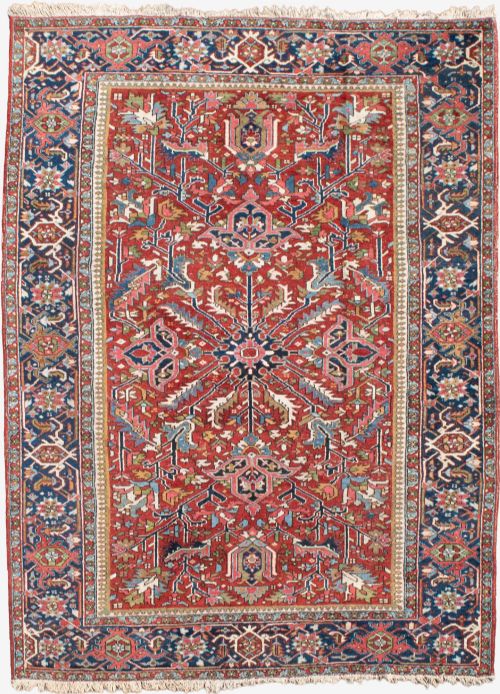


Old Oriental Rug
An old oriental rug brings tangible warmth and dense pattern into a room, grounded in centuries of nomadic and urban weaving traditions.
Old Oriental Rug
An old oriental rug encompasses hand-knotted and woven floor coverings originating from Persia, Anatolia, Central Asia, India, and China, dating from the nineteenth century into the early twentieth century. When searching for an old oriental rug, a buyer encounters diverse regional formats ranging from room-size carpets to long runner rugs and small prayer rugs.
The selections span city workshops, village looms, and tribal encampments, yielding everything from grand room-size Heriz and Tabriz carpets to geometric Baluch, Yomut Turkmen, and Qashqai tribal pieces. Buyers meet these variations across different scales, from substantial Persian room-size carpets down to compact Nepalese and Tibetan formats.
Village and tribal examples display spontaneous geometric medallions and repeating lattice designs, whereas urban workshops produce intricate floral room-size carpets and medallion formats. Architectural formats like runner rugs and prayer rugs also appear frequently among the listings.
How they were made
These textiles rely primarily on wool, cotton, and silk foundations and piles, often incorporating hand-spun wool and natural dyes to achieve rich, enduring palettes. Weavers tied pile knots onto warp and weft threads or created flat-woven kilim structures, depending on the regional tradition.
Nomadic and village weavers utilised local sheep's wool, frequently hand-spinning the fibre and applying natural dyestuffs for village and tribal pieces such as Baluch, Bergama, and Qashqai rugs. Urban workshops in centres like Qum, Nain, Kashan, and Tabriz employed finer wools, cotton foundations, and occasionally silk highlights to delineate complex medallion and floral designs.
Old Oriental Rug Retail Price Guide 2026
Typical asking prices for old oriental rug among the pieces listed under this phrase on Sellingantiques today, from the lower quarter to the upper quarter. They describe what is for sale here now, not the wider market.
Origins represented include Persian, Anatolian, Afghan, Caucasian, Indian, Chinese, Nepalese, and Tibetan traditions.
What varies in quality
Quality rests upon knot density, the integrity of the materials, and the precision of the design execution across the field and border. Tighter knotting on a cotton or wool foundation permits intricate curves in urban carpets, whereas village and tribal pieces achieve distinction through robust hand-spun wool and saturated natural dyes.
The refinement of the drawing and the consistency of the natural dye palette separate standard production from exceptional examples. Finer urban pieces demonstrate meticulous curvilinear planning, while superior tribal and village rugs exhibit vibrant chromatic balance and strong wool quality.
Maples Ushak
The Old Oriental Rug Glossary
- Medallion
- A central ornamental motif dominating the field of the rug. This symmetrical design element frequently anchors the surrounding patterns of Persian and Anatolian carpets.
- Prayer rug
- A small format rug featuring a mihrab or niche design at one end, historically oriented toward Mecca during daily prayers. These pieces often originate from Turkish, Baluch, or Turkmen weavers.
- Kilim
- A flat-woven carpet or runner produced without a pile by tightly interweaving warp and weft strands. These textiles serve as versatile floor coverings and wall hangings.
- Warp
- The vertical foundation threads stretched lengthwise on the loom before weaving begins. The exposed ends of these threads often form the fringe of the rug.
- Weft
- The horizontal threads passed alternately over and under the warp threads to bind the knots in place. Together with the warp, they form the stable grid of the textile.
Old Oriental Rug: Frequently Asked Questions
How do I identify a tribal rug?
Tribal rugs display geometric motifs, latch-hooked polygons, and asymmetrical elements that reflect nomadic heritage rather than rigid urban workshop planning. Their designs are passed down through generations within specific tribal groups.
These pieces typically utilise hand-spun wool and saturated natural dyes, resulting in rustic textures and robust structures well-suited to heavy daily use.
Where were these carpets woven?
Production spans traditional weaving centres across Persia, Anatolia, Central Asia, and parts of East Asia, including India and Tibet. Each region developed distinct colour palettes, knotting techniques, and iconography.
City workshops produced refined floral room-size carpets, while village and nomadic groups created geometric runners and smaller utility rugs.
Can I use a runner in a hallway?
Long narrow proportions make runner rugs well-suited for hallways, corridors, and narrow passageways. Their durable wool piles cushion foot traffic while introducing colour and pattern to transitional spaces.
Underlay helps keep these elongated formats stable on smooth wooden or tiled hallway floors.
What is a prayer rug used for?
Prayer rugs feature a distinct architectural niche or mihrab design indicating the direction of prayer. Historically, users placed them on the floor for ritual daily prayers.
Today, collectors appreciate their compact proportions, symbolic iconography, and focused regional designs as decorative accents in smaller spaces.