



Occasional Tables Set of 3
An occasional tables set of 3 offers multiple surfaces that slide neatly together, combining practical utility with space-saving elegance.
Occasional Tables Set of 3
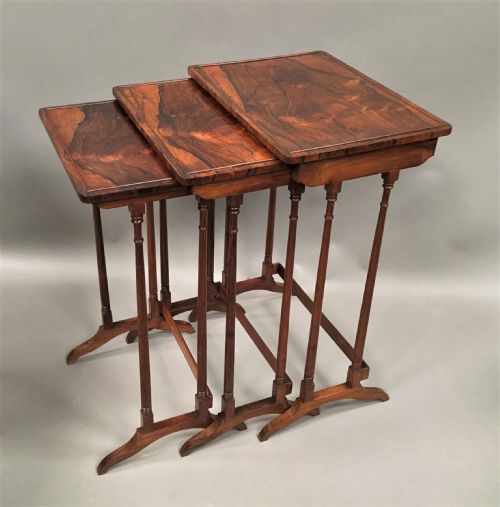
An occasional tables set of 3 comprises graduated surfaces designed to slide inside one another when floor space is at a premium. Buyers encounter these pieces across diverse eras, from Georgian and Regency designs to Edwardian and Art Deco iterations.
The materials span traditional timbers such as mahogany, walnut, and rosewood, alongside decorative finishes like satinwood crossbanding and Chinoiserie decoration. Formats vary from classic nests of three to larger quartetto sets of four or five tables.
Materials and construction techniques
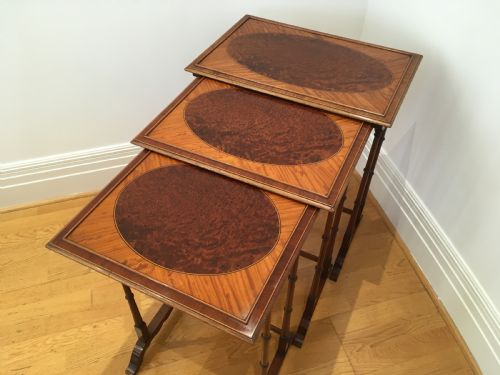
Cabinet makers utilised dense hardwoods including mahogany, walnut, oak, and rosewood to ensure structural stability across slender frames. Grain selection played a vital role, with burr walnut and satinwood veneers applied to create striking visual contrast on tabletops.
Joinery techniques such as square tapered legs, delicate inlays, and precise graduated sizing allowed individual surfaces to nest flush. Specialised decoration like hand-painted floral motifs and mother of pearl inlay further distinguished finer workshop productions.
Listings feature occasional tables spanning the nineteenth century through the Art Deco period, constructed in mahogany, walnut, and rosewood.
Distinctions in craftsmanship
Quality rests in the precision of the graduated fit and the integrity of the timber selection across all surfaces. Superior examples display seamless nesting where each table slides without friction while maintaining rigid, well-balanced frames.
The refinement of secondary details such as crossbanding, string inlay, and hand-carved elements separates standard production from exceptional maker output. Timber matching across the nested surfaces indicates deliberate design by skilled hands.
Harry and Lou Epstein·Heal's
The Occasional Tables Set of 3 Glossary
- Quartetto
- A matched set of four occasional tables designed to nest together. These pieces typically date from the nineteenth and early twentieth centuries.
- Crossbanding
- A decorative border of veneer laid perpendicular to the grain of the main surface. This technique frames the tabletop and highlights the principal timber.
- Inlay
- Pieces of contrasting wood, shell, or metal fitted into depressions in the wood surface to form a design. Edwardian and Georgian makers frequently utilised satinwood for this purpose.
- Nesting tables
- A set of graduated tables constructed so each smaller piece fits beneath the preceding one. They provide flexible surface space while occupying the footprint of a single table.
Occasional Tables Set of 3: Frequently Asked Questions
What is a quartetto table set?
A quartetto set consists of four tables graduated in size to nest together compactly.
Cabinet makers of the nineteenth and early twentieth centuries favoured this format for drawing rooms.
How were nesting tables used historically?
They provided temporary surfaces for tea, writing, or needlework without cluttering the room.
Servants moved the individual tables around the interior as needed before sliding them back together.
How do I date an occasional table set?
Stylistic markers such as Edwardian inlay, Art Deco geometric lines, or Regency rosewood help establish the period.
Construction methods and timber choice further confirm the era of manufacture.
Can these tables support everyday use?
Solid hardwood construction ensures these pieces handle standard daily placement of lamps and decorative objects.
Care should be taken with older veneered surfaces to avoid moisture and excessive weight.