




Oak Floral Armchairs
These oak floral armchairs bring centuries of heavy timber and patterned textiles together for any room.
Oak Floral Armchairs
When you search for oak floral armchairs, you are looking at substantial wooden seating upholstered in patterned fabrics, varying from Victorian Gothic revival pieces to 1930s occasional chairs. These items range across periods including 17th century, Victorian, Edwardian, and the early twentieth century.
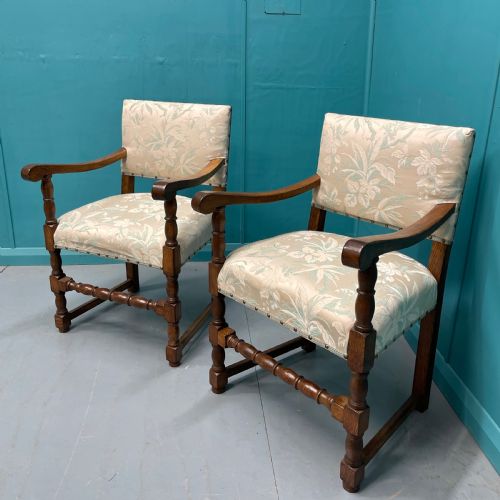
You are most likely to meet pairs on this page, as many of these sturdy seats survive alongside a matching partner. Forms encompass large throne chairs with carved details, open armchairs, and occasional seating.
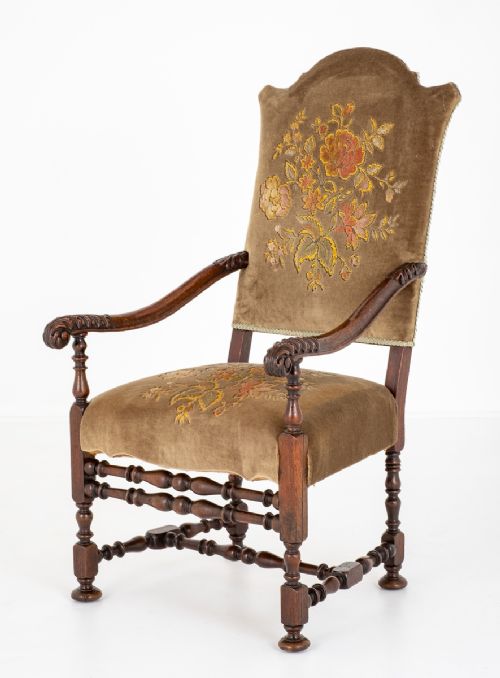
The frames rely on solid timber foundations while the seats and backs carry textiles such as tapestry, velvet, and upholstered fabric. Regional variations span English designs, French styles, and Jacobean revivals.
Materials and construction methods
Makers constructed these frames predominantly from solid oak, though walnut also appears alongside brass hardware. Timber sections were shaped by hand, often featuring deep relief carving such as green man motifs.
Upholstery techniques combined sturdy internal webbing with sprung or stuffed pads, covered in heavy woven cane, tapestry fabric, or plush velvet. Frames frequently display revivalist styles like Carolean and Charles II influences.
Several heavy oak chairs feature glaring green men, watching over the sitting room with leafy expressions.
Assessing quality in construction
Quality separates pieces by the depth and sharpness of the timber carving and the weight of the underlying oak frame. Superior examples display tight joinery and well-preserved structural integrity despite decades of use.
The textile choice also dictates standard, with heavy tapestries and thick velvets holding greater visual presence than basic woven fabrics. Original surfaces and patinated wood mark the difference between standard production and exceptional craftsmanship.
The Oak Floral Armchairs Glossary
- Bergere suite
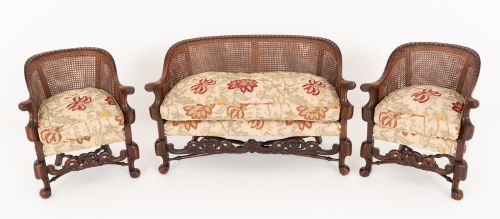
- A matching set of seating featuring woven cane panels set within wooden frames. This style appears frequently in nineteenth-century revival groups.
- Carolean style
- A decorative design movement reflecting the late seventeenth-century English court aesthetic. Pieces in this style typically show rich carving and turned supports.
- Green man carved
- A sculptural architectural motif depicting a human face surrounded by foliage. It signifies rebirth and appears in prominent Victorian throne chairs.
- Jacobean revival
- A nineteenth-century historicist style copying early seventeenth-century English furniture forms. It uses dark oak and heavy geometric turnings.
- Tapestry fabric
- A heavy, hand-woven or jacquard-woven textile displaying pictorial or floral patterns. It provides a durable and decorative surface for heavy armchairs.
Oak Floral Armchairs: Frequently Asked Questions
What periods do these armchairs span?
The selection covers items from the seventeenth century through to the interwar period of the twentieth century. Victorian and Edwardian examples sit alongside earlier revivals.
Each era brings distinct carving styles and upholstery choices, ranging from dark Gothic revival frames to lighter 1930s occasional seating.
Are these chairs sold as pairs?
Many listings feature matching pairs or larger seating suites rather than solitary items. This makes them suitable for balancing a room.
Pairs often share identical carved wooden motifs and matching fabric upholstery.
What types of wood are used?
Oak forms the primary structural timber across the selection, providing heavy and durable frames. Walnut also appears in select seventeenth-century pieces.
The timber is often left with a dark patina or enriched with extensive hand carving.
How do I identify a revival style?
Revival pieces copy the heavy turned legs, scroll arms, and deep carvings of earlier centuries while utilising nineteenth- or twentieth-century construction methods. Look closely at the joinery and timber condition.
Styles such as Jacobean, Carolean, and Gothic revival deliberately echo historic periods.