




Oak Convertible Table Bench
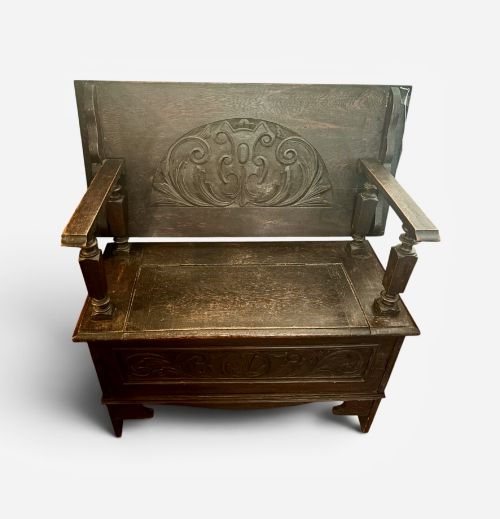
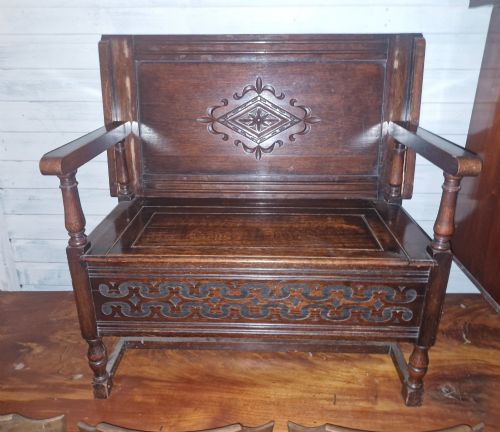
When you search for an oak convertible table bench, you are looking at dual-purpose seating that shifts from a panelled chair or settle to a flat-topped table.
Oak Convertible Table Bench
An oak convertible table bench operates as a multi-functional piece of furniture designed to serve as both a seat and a table within domestic interiors. These items frequently appear as monk's benches, hall seats, settle benches, and chair tables.
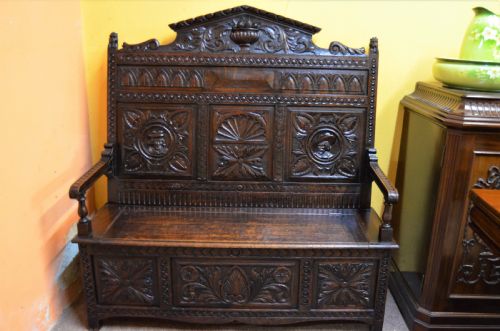
The versions most commonly met on this page span from the seventeenth century through the Victorian era and into the early twentieth century, including revivalist styles. Buyers encounter both compact hall seats and larger carved examples featuring lift-up storage compartments beneath the seat.
Originating to maximise space in smaller rooms, these items combine a high panelled back with a hinged top that folds flat over the arms. They function practically in hallways and living spaces while displaying traditional woodworking forms.
How they were made
Makers constructed these convertible seats primarily using solid timber, predominantly oak, chosen for its strength and durability. Iron and metal components, such as hinges, pins, and fixings, allowed the top to pivot safely between the vertical chair position and the horizontal table surface.
Carpenters employed traditional joinery techniques, including panel construction and mortise and tenon joints, to build the framework. Many examples feature decorative hand-carving along the back panels and arms, executed in styles ranging from Jacobean Revival to Art Nouveau and Gothic Revival.
Some models moonlighted as multi-tasking household guardians, doubling as a hallway seat for muddy boots and a makeshift table for impromptu tea.
What varies in quality
The calibre of an oak convertible table bench rests on the crispness and depth of the carved ornamentation on the panels and backrest. Finer examples display proportional balance, well-executed joinery, and timber with an attractive grain and rich colour developed through age.
The integrity of the conversion mechanism marks another distinction between pieces, where smooth pivoting action and sturdy original metal fixings preserve the dual function. Subtle differences in the thickness of the timber and the refinement of the moulding separate standard utilitarian pieces from more ambitious workshop productions.
The Oak Convertible Table Bench Glossary
- Monk's bench
- A multi-functional piece of furniture featuring a hinged top that converts a high-backed chair or settle into a small table. This form gained popularity for its space-saving utility in smaller domestic rooms.
- Chair-table
- An early form of dual-purpose seating where the wide backrest folds down over the arms to form a flat table surface. These sturdy timber items date back to the seventeenth century and earlier.
- Settle
- A wooden bench with a high solid back, solid arms, and often a storage box beneath the seat. It was designed to keep draughts away from the sitter in communal halls.
- Jacobean Revival
- A nineteenth-century and twentieth-century design style that copies the heavy, carved oak forms and geometric panelling of the early seventeenth century. Furniture in this style often utilises dark finishes to emulate age.
- Panelling
- A method of constructing furniture frames using thin sheets of timber fitted within grooved uprights and rails to allow for natural wood movement. This technique prevents warping in large flat surfaces like chair backs.
Oak Convertible Table Bench: Frequently Asked Questions
How does the table top convert?
The upper backrest pivots on wooden pegs or metal pins situated near the arms. Lifting and tilting the back forward rests it horizontally across the arms to form a table.
In reverse, lifting the top back to the vertical position transforms the piece into a high-backed chair or settle.
Where were these benches used?
Historically, these items stood in hallways, parlours, and living rooms where floor space was at a premium. They provided a seat by the entrance and a quick surface for dining or working.
Today, buyers place them in entrance halls, studies, and dining rooms as practical statement pieces.
How do I date an oak convertible table bench?
Dating relies on examining the construction methods, type of timber preparation, and stylistic carving details. Seventeenth-century examples display hand-split timber, pegged joints, and simple geometric panels.
Later Victorian and twentieth-century versions often feature machine-sawn components, heavier carved motifs, and revivalist styling characteristics.
Do these benches include storage?
Many examples incorporate a lift-up seat lid that opens to a compartment beneath. This box section provided historical storage for blankets, gloves, or household items.
Not every variant includes storage, as some chair tables rely entirely on the folding top mechanism without a hollow base.