
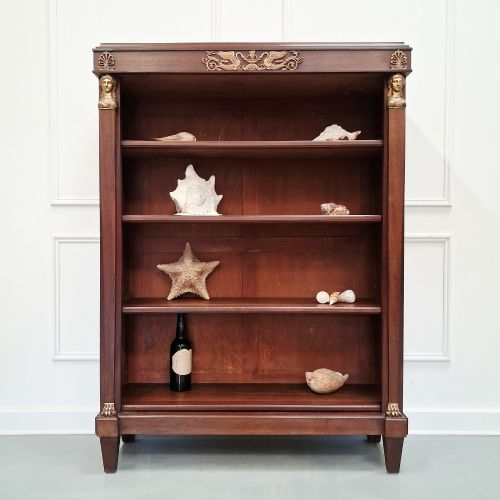
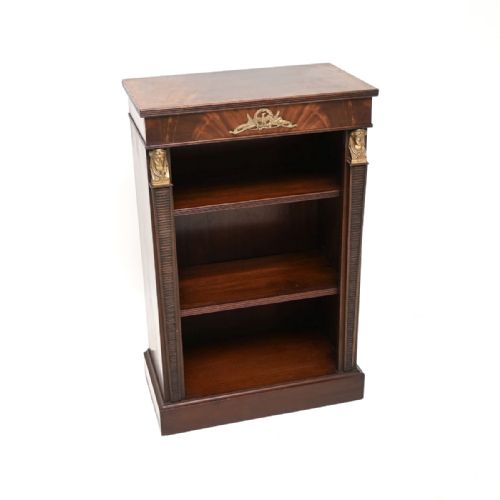
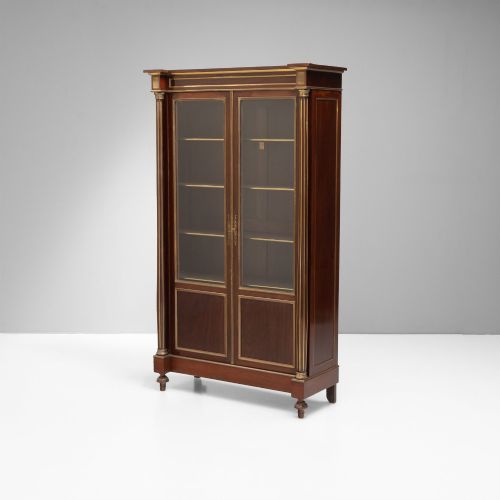


Neoclassical Mahogany Bookcase
A neoclassical mahogany bookcase brings architectural order and rich timber grain to a room, uniting classical proportion with practical storage.
Neoclassical Mahogany Bookcase
A neoclassical mahogany bookcase unites classical architectural lines with practical timber storage, taking forms such as open shelves, display cabinets, corner units, and bookcases on stands.
The versions met most frequently on this page span the nineteenth century into the Edwardian era and 1930, reflecting revivalist movements like Sheraton Revival, French Empire, and Adams.
Makers and designers working in these styles utilised rich timbers and classical motifs to create disciplined furniture that functioned equally as a bookcase or a glazed display cabinet for prized volumes.
How they were made
Makers built these pieces primarily from solid and veneered mahogany, frequently lifting the dark grain with delicate satinwood inlay or marquetry details.
Many examples incorporate cast brass mounts and ormolu details to accent the classical symmetry, alongside glazed glass doors for display cabinets and vitrines.
Some nineteenth-century cabinetmakers hid delicate marquetry secrets inside serpentine corners that only open fully when the light catches the grain just right.
What varies in quality
Quality rests in the crispness of the architectural carving, the precision of the satinwood inlay, and the weight of the brass or ormolu mounts fitted to the timber.
The selection of the mahogany veneer, the integration of glazed doors, and the balance of revivalist proportions separate everyday production from exceptional workshop output.
Jewell of Holborn·Waring & Gillow·Edwards & Roberts·C Hindley & Sons
The Neoclassical Mahogany Bookcase Glossary
- Neoclassical
- A style drawing on the classical art and architecture of ancient Greece and Rome. It prioritises symmetry, straight lines, and restrained classical ornamentation.
- Ormolu
- Gilded bronze used for decorative mounts on furniture. It provides a bright metallic contrast against dark mahogany surfaces.
- Vitrine
- A glass-fronted cabinet designed for displaying porcelain, curiosities, or fine books. These pieces often feature glazed doors on multiple sides.
- Marquetry
- Decorative patterns formed by fitting together thin slices of various veneers. Craftsmen used contrasting timbers to create floral or geometric motifs.
Neoclassical Mahogany Bookcase: Frequently Asked Questions
How do I date a neoclassical mahogany bookcase?
Dating relies on combining the construction methods, timber choice, and stylistic revival cues visible in the piece. Pieces span from the nineteenth century through the Edwardian period to the 1930s.
Cabinetmakers of different decades interpreted neoclassical and empire styles with varying hardware, glass types, and secondary timbers. Comparing these structural details against known workshop timelines helps establish the era of manufacture.
Are these bookcases suitable for everyday book storage?
These bookcases accommodate standard book collections, though glass-fronted vitrines and open shelves offer different levels of protection. Adjustable shelving appears in many surviving examples.
Placing the cabinet away from direct sunlight and excessive heat fluctuations protects the mahogany veneer and delicate satinwood inlay from drying out over time.
How do I recognise Sheraton Revival influence?
Sheraton Revival pieces show lighter proportions, straight tapered legs, and contrasting satinwood inlays. The decoration remains geometric and restrained rather than heavily carved.
This style emerged strongly during the late nineteenth and Edwardian periods, reinterpreting eighteenth-century classical furniture forms for modern Victorian and Edwardian drawing rooms.