


Neoclassical Folding Table
These neoclassical folding table pieces offer clever engineering and classic symmetry, making them a practical choice for period interiors.
Neoclassical Folding Table
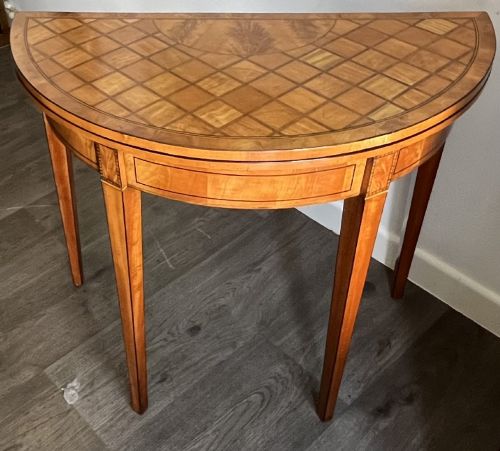
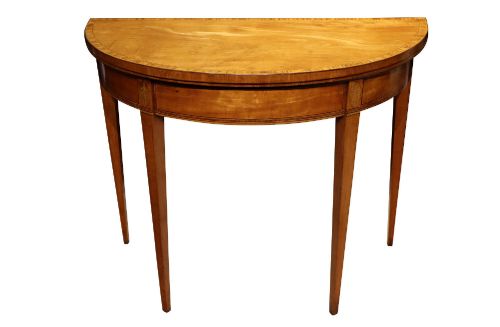
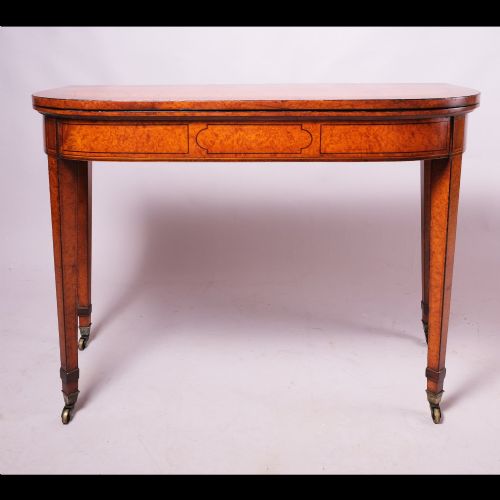
A neoclassical folding table combines formal architectural lines with space-saving mechanisms designed for dining, tea, or card playing. You will find these pieces appearing frequently as demi-lune, D-shaped, or fold-over card and games tables originating from the eighteenth century onwards.
The inventory on this page shows a strong presence of George III and Sheraton period pieces alongside later revival examples. These tables typically feature hinged leaves that open to reveal baize-lined surfaces or polished timber tops.
Makers utilised various formats including console, tea, and occasional tables designed to sit flush against a wall when closed. Such versatility explains their enduring appeal in both compact rooms and larger reception spaces.
Materials and construction methods
Cabinet makers relied heavily on dense tropical hardwoods like mahogany and rosewood for structural stability and rich natural grain. These timbers were often paired with lighter contrasting veneers such as satinwood, boxwood, and kingwood to create intricate geometric borders.
Surface decoration frequently incorporated marquetry inlay and painted finishes depicting classical motifs. Brass mounts and hinges provided both functional support and subtle decorative contrast against the polished timber surfaces.
Some tables hide secret compartments beneath the folding top for stabling stray playing cards.
Distinguishing quality across the range
Quality rests primarily in the precision of the timber selection and the crispness of the inlay work. Finer examples display harmonious grain matching across the fold-over leaves and tightly executed crossbanding.
The integrity of the folding mechanism and the alignment of the legs when open dictate the standard of execution. Superior pieces maintain absolute stability and smooth operation without relying on loose joints.
The Neoclassical Folding Table Glossary
- Demi-lune
- A half-moon shape popular for console and card tables designed to stand flat against a wall. This profile allows the table to occupy minimal floor space when closed.
- Crossbanding
- A strip of veneer applied to the border of a table top with the grain running perpendicular to the centre panel. This technique frames the primary timber and adds visual depth.
- Marquetry
- Decorative patterns formed by fitting together thin slices of various woods and other materials onto a structural surface. It defines the more elaborate neoclassical decorative schemes.
- Baize
- A coarse woolen fabric traditionally used to line the playing surfaces of card and games tables. It provides a durable and tactile texture for board games.
- Fold-over
- A hinged tabletop construction that doubles the surface area when opened out. This mechanism is central to the function of space-saving tables.
Neoclassical Folding Table: Frequently Asked Questions
How do I use a folding table daily?
These tables function well as console or side tables against a wall when closed. Opening the leaf provides a sudden surface for dining, writing, or card games.
Ensure the folding leaf is properly supported by its swing leg or gateleg frame before placing heavy objects on top.
How do I date a mahogany table?
Dating relies on examining the timber species, construction joints, and decorative vocabulary such as inlay styles. Eighteenth-century pieces often display hand-cut dovetails and older growth timber grain.
Later revival pieces from the twentieth century utilise machine tooling and different secondary woods hidden beneath the structure.
Can I play cards on these tables?
Many of these pieces were specifically built as card and games tables with lined folding tops. The baize or polished surface accommodated pastimes like whist and chess.
Check the stability of the folding hinges and swing legs to ensure the playing surface remains level.