

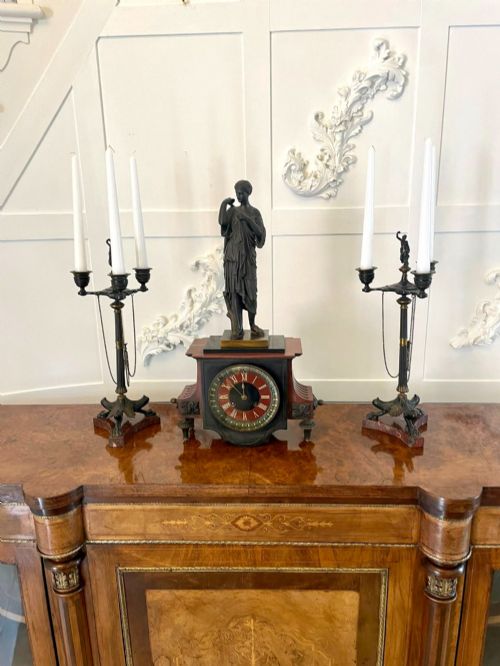


Neoclassical Bronze Garniture Clock
A neoclassical bronze garniture clock commands a room with architectural dignity, matching symmetrical candelabras to a central dial.
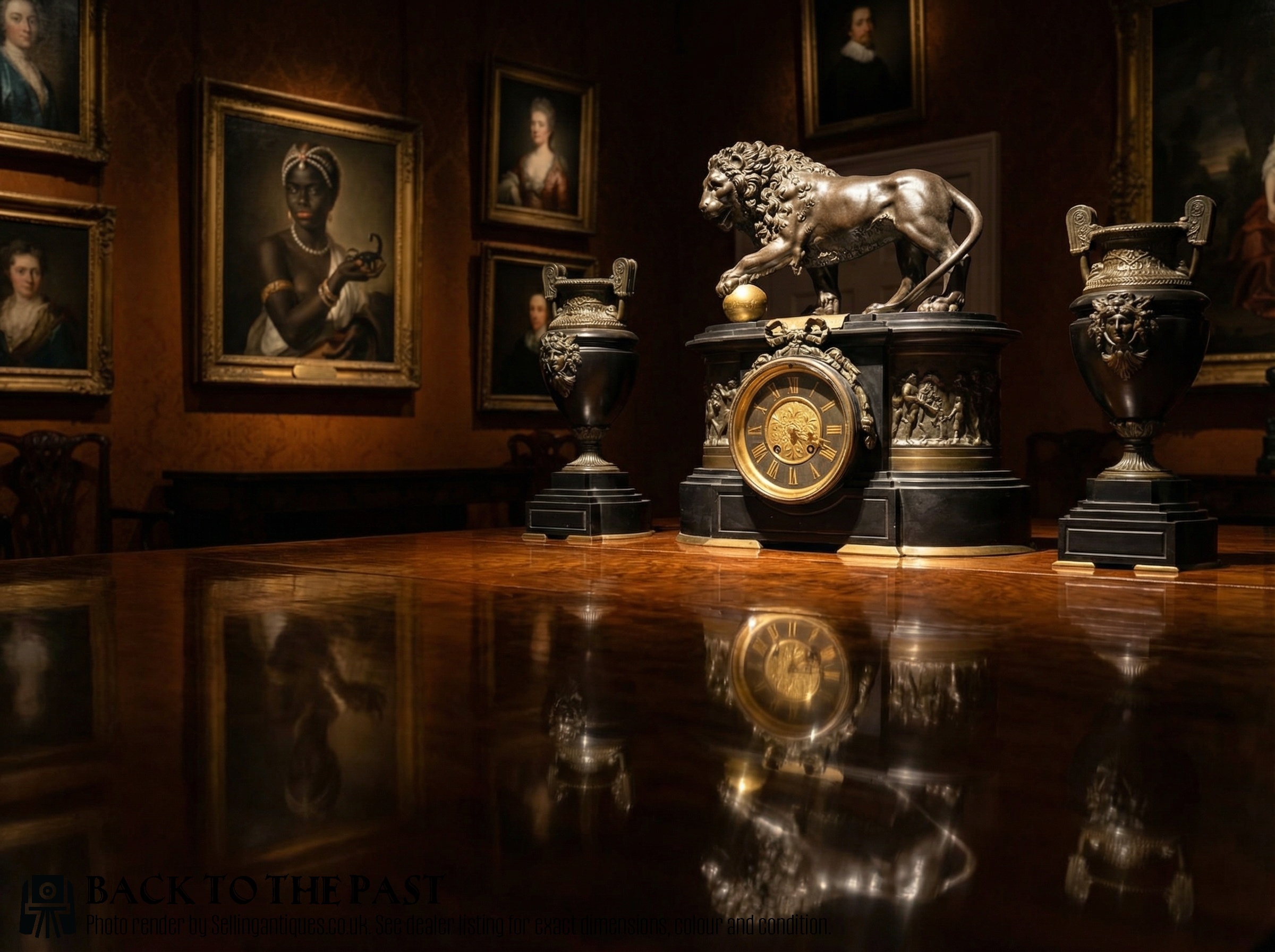
Neoclassical Bronze Garniture Clock
A neoclassical bronze garniture clock combines a central mantel timepiece with matching side pieces such as candelabras or urns, forming a coordinated three-piece or multi-piece set. These ensembles draw upon classical architectural motifs, symmetry, and formal proportion derived from ancient Greece and Rome.
The versions most commonly met on this page date from the Victorian era and the late nineteenth century, frequently adopting Louis XVI Revival styles. Makers combined patinated or gilt bronze with contrasting stones to produce grand mantel centrepieces designed for formal domestic interiors.
How they were made
Craftsmen cast figures and mounts in bronze, often applying a mercury gilt or ormolu finish alongside darker patinated surfaces. These metal elements were then paired with carved bodies of white or coloured marble.
Clock movements typically employed eight-day mechanical systems, occasionally signed by prominent French makers like AD Mougin. Dials incorporated vitreous enamel numerical chapters fitted behind protective glass bezels.
Neoclassical Bronze Garniture Clock Retail Price Guide 2026
Typical asking prices for neoclassical bronze garniture clock among the pieces listed under this phrase on Sellingantiques today, from the lower quarter to the upper quarter. They describe what is for sale here now, not the wider market.
Listings span periods from the eighteenth century to the mid-twentieth century, dominated by nineteenth-century French and Victorian interpretations.
What varies in quality
The crispness of the bronze chasing and the depth of the mercurial gilding separate standard production from superior examples. Sharp details in the acanthus leaves, figures, and architectural mounts indicate skilled hand-finishing after casting.
The selection and density of the marble body also dictate standing. Dense, finely veined stone paired with heavy, substantial cast mounts represents the higher echelon of these garniture sets.
AD Mougin Paris·Ferdinand Berthoud
The Neoclassical Bronze Garniture Clock Glossary
- Garniture
- A set of ornamental objects designed to match and be displayed together on a mantelpiece or sideboard.
- Ormolu
- Finely ground high-carat gold mercury-gilded to a bronze object, giving a rich yellow metallic lustre.
- Patinated bronze
- Bronze treated with chemicals or heat to produce a stable surface colour ranging from deep brown to dark green.
- Enamel dial
- A metal dial face fused with powdered glass fired at high temperatures to create a smooth, durable white surface for painted numerals.
- Candelabra
- A branched candlestick designed to hold multiple taper candles, forming the matching side pieces in a clock set.
Neoclassical Bronze Garniture Clock: Frequently Asked Questions
What is a garniture clock?
A garniture clock is a central mantel timepiece accompanied by matching decorative side pieces, such as a pair of candelabras or urns. Together they create a balanced, symmetrical display traditionally placed on a fireplace mantel.
These sets were designed as unified decorative schemes for formal rooms. The central clock anchor the arrangement while the side pieces echo its materials and stylistic motifs.
How do I wind the clock?
Most of these clocks use mechanical eight-day movements requiring a winding key inserted into holes on the enamel dial. Turning the key winds the mainspring barrels.
Care should be taken not to overwind the movement. Regular maintenance by a horologist ensures the brass gears and escapement function smoothly.
How do I date a neoclassical set?
Dating relies on stylistic clues, movement signatures, and the combination of materials like marble and ormolu. Late nineteenth-century pieces often revive Louis XVI aesthetics with machine-assisted casting alongside hand-chasing.
Examining the backplate of the movement can reveal maker stamps or serial numbers. These marks help place the piece within specific nineteenth-century French or Victorian production periods.
Where should I place a heavy marble clock?
Because these clocks combine dense stone bodies with heavy bronze mounts, they require a sturdy, level surface capable of supporting considerable weight. A deep mantelpiece or a dedicated console table works best.
Ensuring the support is level also helps the pendulum swing evenly. A balanced platform keeps the mechanical beat regular and prevents the clock from losing time.