

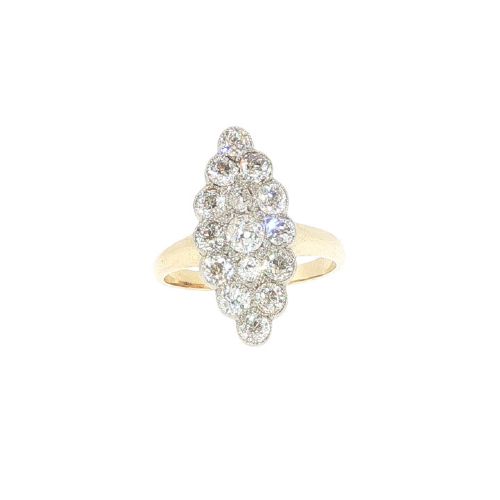
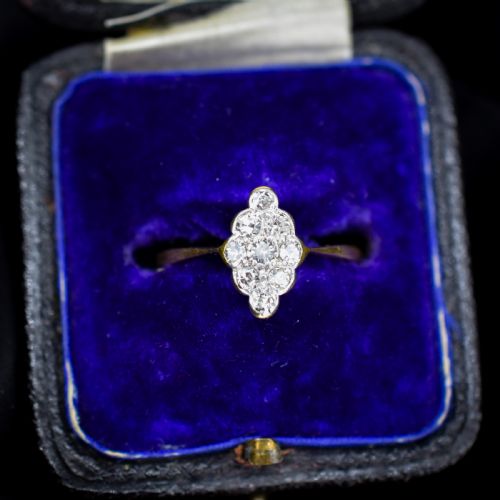


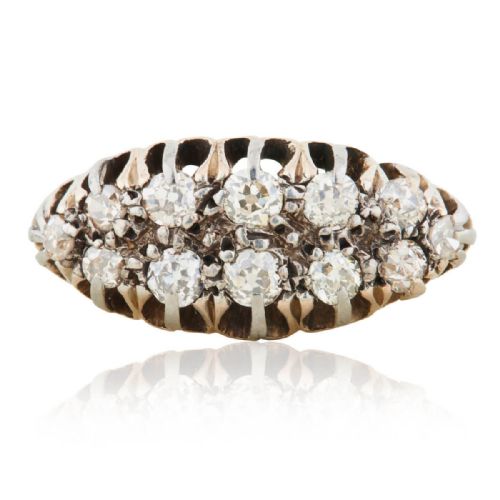


Navette Shape Ring
Navette shape rings bring an elongated, boat-like silhouette to the finger that makes any hand look graceful and slender.
Navette Shape Ring
A navette shape ring offers an elongated cluster design that stretches along the finger, taking its name from the French word for a small boat. When you search for a navette shape ring, you encounter pieces primarily spanning from the Victorian and Edwardian eras into the Art Deco period.
The selections on this page showcase cluster configurations where diamonds, rubies, and sapphires are set to emphasise this distinct pointed oval outline. Examples range from nineteenth-century gold mountings to platinum settings of the early twentieth century.
The form naturally commands attention due to its substantial finger coverage without relying on a single massive stone. Buyers find both traditional Victorian diamond designs and geometric Art Deco interpretations among the current selection.
Materials and construction
Master jewellers constructed these pieces utilising combinations of 18ct gold, yellow gold, and platinum. Platinum frequently appears in twentieth-century mountings to securely hold old cut diamonds within delicate geometric frameworks.
Gems such as diamonds, Burmese rubies, and sapphires are closely clustered to form the characteristic boat profile. Goldsmiths utilised traditional claw and bezel settings to anchor the stones firmly while maintaining maximum light reflection.
Navette Shape Ring Retail Price Guide 2026
Typical asking prices for navette shape ring among the pieces listed under this phrase on Sellingantiques today, from the lower quarter to the upper quarter. They describe what is for sale here now, not the wider market.
Materials documented across the collection include platinum, yellow gold, diamonds, sapphires, and rubies.
Assessing quality in navette rings
The distinction between standard examples and the finest pieces lies in the precision of the cluster geometry and the matching of the central stones. Superior workshops achieved a seamless flow along the pointed tips without visible gaps in the metalwork.
The choice of materials also dictates the calibre of the piece, with heavier platinum and gold mountings providing greater structural integrity over decades of wear. Old cut diamonds with lively scintillation elevate the overall presence compared to more muted stones.
The Navette Shape Ring Glossary
- Navette
- A pointed oval gemstone or ring shape resembling a little boat, also known as a marquise shape. This silhouette creates maximum visual length on the hand.
- Cluster ring
- A ring featuring a central stone surrounded by a group of smaller gems. This layout maximises sparkle and presence.
- Old cut
- A diamond facet style hand-cut before modern machinery, characterised by a smaller table, higher crown, and open culet. These stones display a softer, candlelit glow.
- Platinum
- A dense, strong, and highly durable white metal utilised in jewellery manufacture from the Edwardian period onward. It permits extremely fine claw work without sacrificing strength.
- Chester hallmark
- An official mark stamped on precious metals indicating the item was tested and assayed in the English city of Chester. This stamp helps date British pieces accurately.
Navette Shape Ring: Frequently Asked Questions
What is a navette ring?
A navette ring is a piece of jewellery featuring a long, pointed oval shape that stretches horizontally along the finger. The design resembles a small boat and typically houses a cluster of diamonds or coloured gemstones.
This specific silhouette became popular during the Victorian era and evolved through the Edwardian and Art Deco periods. The geometry flatters the hand by creating an illusion of length.
How do I care for antique rings?
Caring for antique jewellery requires mindful handling, particularly with older claw settings that secure delicate stones. Regular checks by a professional jeweller ensure the platinum or gold mountings remain secure.
Remove your ring before engaging in heavy manual work, gardening, or swimming to protect the metal and gems from unnecessary trauma. Clean them gently with warm soapy water and a soft brush rather than harsh ultrasonic machines.
Are these rings comfortable to wear?
Despite their elongated appearance, most navette rings sit smoothly against the finger due to gently curved under-bezels. The pointed ends are designed to follow the natural line of the digit.
Buyers with shorter fingers may wish to consider the specific length of the navette face to ensure it does not interfere with the knuckle movement. Most pieces balance well once settled on the hand.
How do I date an antique ring?
Dating relies on a combination of stylistic clues, gemstone cutting techniques, and official hallmarks stamped inside the band. Georgian and Victorian pieces often feature yellow gold backs and closed settings, while Edwardian and Art Deco examples favour platinum.
Maker's marks and town assay stamps provide precise clues to the year of manufacture. Comparing the overall design grammar to documented periods confirms the era of creation.