

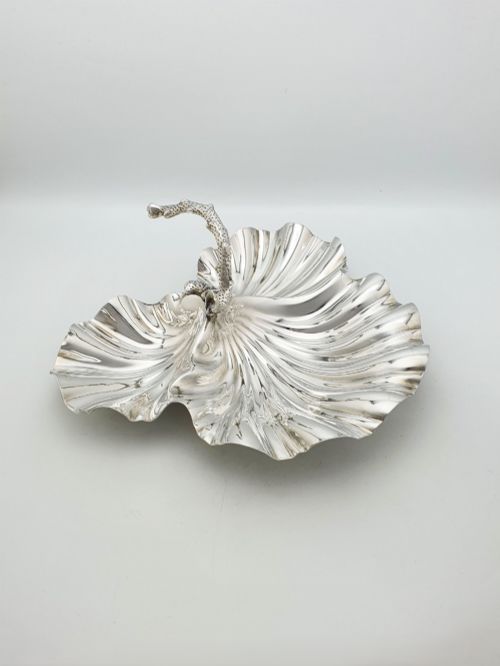


Naturalistic Silver
Naturalistic silver brings flora and fauna to the table, taking the form of hollowware and small accessories modelled on shells, flowers and fruit.
Naturalistic Silver
When you search for naturalistic silver, you encounter functional dining implements and decorative items shaped to mimic organic forms such as shells, leaves, fruit and insects. These objects emerge principally from the Victorian era and the Georgian period, spanning the nineteenth century.
The most common examples on this page are dining table accessories, notably sauce boats with acorn designs, salt cellars featuring flower motifs, and chambersticks. You also find novelty desk items like inkstands shaped as apples, pears and pomegranate, alongside smaller personal ornaments like brooches.
Makers drew heavily on the shapes found in nature during the Victorian naturalism and Aesthetic Movement phases. Solid sterling silver sits alongside silver plate and electroplated nickel silver, often enriched with vermeil or silver gilt finishes.
How they were made
Silversmiths utilised solid sterling silver and silver plate over base metals, shaping the material by hand to capture the irregular contours of foliage and marine life. Casting and chasing allowed artisans to render realistic textures like coral handles and foliate stems with precision.
Gilding techniques such as vermeil and silver gilt were applied to interior surfaces, particularly on hollowware and desk pieces, to protect the metal and provide a rich golden contrast against the silver exterior.
Naturalistic Silver Retail Price Guide 2026
Typical asking prices for naturalistic silver among the pieces listed under this phrase on Sellingantiques today, from the lower quarter to the upper quarter. They describe what is for sale here now, not the wider market.
Some nineteenth-century artisans could not resist adding tiny, realistic beetles onto the rims of silver fruit dishes.
What varies in quality
The degree of realism in the organic modelling separates standard production from superior work. Master silversmiths achieved fluid, convincing representations of fruit and leaves rather than stiff, stylised approximations.
The weight and gauge of the sterling silver or the durability of the silver plate dictate the substance of the piece. Maker marks and clear hallmarks from established workshops anchor the provenance and skill level behind each item.
William Bateman·Robert Hennell·Francis Higgins
The Naturalistic Silver Glossary
- Sterling silver
- A silver alloy containing ninety-two point five percent pure silver by mass, with the remainder consisting of copper. This standard alloy provides the durability required for functional tableware.
- Silver gilt
- Sterling silver that has been coated with a thin layer of gold on its surface. It provides the appearance of solid gold while maintaining structural strength.
- Vermeil
- Sterling silver coated with gold, differing from silver gilt primarily by requiring a heavier deposition of gold over the base metal.
- Chamberstick
- A small, portable candlestick fitted with a saucer base and a handle, designed for carrying through a house at night. Nineteenth-century examples often incorporated foliate drip pans.
- Saucer base
- The wide, flat circular pan beneath a chamberstick or inkstand that catches dripping wax or ink. It offered makers ample surface area for organic ornamentation.
Naturalistic Silver: Frequently Asked Questions
What is naturalistic silver?
Naturalistic silver comprises items modelled directly on organic shapes found in nature, such as flowers, fruit, shells, and insects. These pieces range from dining table accessories to personal jewellery.
Craftsmen during the nineteenth century used these motifs to break away from rigid geometric forms, embracing the asymmetries and textures of the natural world.
How were salt cellars used?
Salt cellars held loose salt on the dining table before the invention of the salt shaker. Guests would take a pinch using small spoons or their fingers.
In naturalistic designs, the vessel itself often took the form of a flower, shell, or leaf to complement the dining arrangement.
How do I identify a Victorian piece?
Victorian pieces often carry hallmarks indicating the assay office, date letter, and maker's mark. Stylistically, they reflect the historicism and nature-inspired ornamentation popular during the nineteenth century.
Documentation and registry marks can narrow down the production year to specific decades of the era.
What is an inkstand?
An inkstand is a desk accessory designed to hold inkwells, quill pens, and sanders for writing. Elaborate examples often incorporated naturalistic themes like fruit and foliage.
They served as functional desk furniture and decorative status symbols in nineteenth-century studies and offices.