

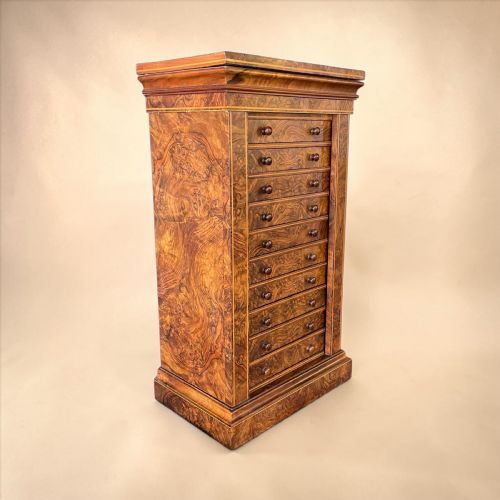


Narrow Timber Cabinet
These narrow timber cabinet pieces bring compact vertical storage and display to any room, offering traditional craftsmanship in mahogany, oak, burr walnut, and hardwood.
Narrow Timber Cabinet
When you search for narrow timber cabinet, you encounter tall and compact storage items including Wellington chests, display cabinets, bookcases, armoires, and cupboards. These pieces provide functional vertical storage without demanding extensive floor space in a room.
The selection on this page spans from the nineteenth century into the twentieth century, taking in Victorian, Edwardian, and 1920s eras. You find formal mahogany library pieces alongside painted panels, Dutch neoclassical forms, and North African designs.
Mahogany and hardwood dominate the forms, supplemented by burr walnut, oak, brass handles, and glass panels. The assortment ranges from tall chests of drawers to single armoires and open bookcases.
How they were made
Cabinet makers utilised dense timbers like mahogany and hardwood, often selecting highly figured veneers such as burr walnut for visual depth. Structural integrity relies on solid timber construction, sometimes enhanced with painted finishes or glass door panels.
Narrow Timber Cabinet Retail Price Guide 2026
Typical asking prices for narrow timber cabinet among the pieces listed under this phrase on Sellingantiques today, from the lower quarter to the upper quarter. They describe what is for sale here now, not the wider market.
Materials span mahogany, burr walnut, oak, hardwood, brass, glass, and paint.
What varies in quality
The calibre of timber figuring marks the distinction between standard examples and superior work, particularly in highly figured Wellington chests. Exceptional pieces exhibit deliberate grain matching and maker attribution, such as work by Gillows of Lancaster.
The refinement of decorative elements, from carved claw feet to painted Dutch panels and brass hardware, separates simpler utility pieces from high-status library and display furniture.
Gillows of Lancaster
The Narrow Timber Cabinet Glossary
- Wellington chest
- A tall, narrow chest of drawers secured by a hinged locking stile that fastens with a key.
- Hardwood
- Dense timber derived from broad-leaved trees, encompassing mahogany, oak, and walnut used in these cabinets.
- Burr walnut
- Wood taken from a walnut tree growth featuring intricate, swirling grain patterns highly prized for veneer work.
- Armoire
- A tall wardrobe or cupboard enclosed by doors, utilised for hanging or shelved garment storage.
Narrow Timber Cabinet: Frequently Asked Questions
What is a Wellington chest?
A Wellington chest is a tall, narrow set of drawers featuring a locking side pilaster or stile. This architectural locking bar secures all drawers simultaneously when closed and locked with a key.
Originally designed for secure storage of documents or personal items in nineteenth-century libraries and studies, these pieces remain popular for their compact footprint.
Where should I place a narrow timber cabinet?
These compact cabinets suit hallways, alcoves, bedrooms, and studies where floor space is limited. Their vertical proportions maximise storage capacity without dominating the room.
Keep them away from direct sunlight and heat sources to protect timber veneers and polished finishes from drying out over time.
How do I identify Victorian pieces?
Victorian cabinets often utilise dense mahogany or walnut timbers, sometimes featuring heavy mouldings, locking mechanisms, and carved details like claw feet. Construction methods from this era involve solid secondary woods and hand-cut dovetailing in the drawers.
Comparing the specific hardware style, timber selection, and overall proportions helps distinguish Victorian examples from Edwardian or later twentieth-century reproductions.
What maintenance do timber cabinets require?
Timber cabinets benefit from occasional treatment with appropriate wax polish to nourish the wood and maintain the surface sheen. Avoid silicone-based sprays, which can build up and damage antique polished finishes.
Maintaining stable indoor humidity levels prevents the timber and veneers from warping or cracking across seasonal changes.