
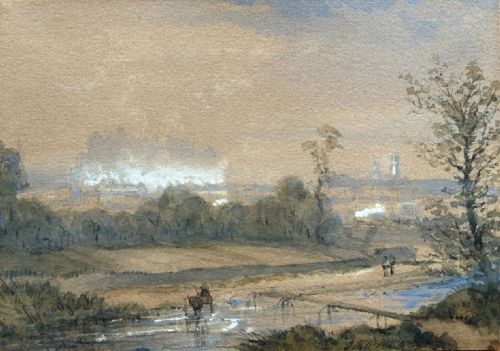
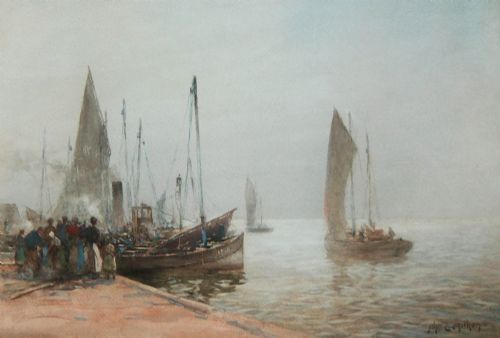


Muted Brown Watercolour Landscape
A muted brown watercolour landscape captures quiet topography and subdued earth tones through delicate pigment washes on paper.
Muted Brown Watercolour Landscape
A muted brown watercolour landscape represents topographical and rural views executed primarily in earthy monochrome or restrained pigments. Buyers exploring a muted brown watercolour landscape encounter original paintings spanning the nineteenth century through the mid-twentieth century.
The selections on this page encompass British school works, regional dockyards, and pastoral scenes framed under glass. Artists working within British impressionism and realism frequently favoured these subdued palettes to render winter light and overcast skies.
Materials and technique
These works utilise watercolour pigment and paint applied directly onto paper supports. The application relies on transparent washes to build depth within the landscape.
Many examples are preserved behind glass and housed within wooden frames. The combination of water-soluble pigment and paper requires careful environmental control to protect the delicate media.
Materials seen across the site include paper, wood, glass, and watercolour paint.
What varies in quality
The strength of the composition and the confidence of the brushwork separate standard topographical records from superior artistic achievements. Master dilution of pigment creates atmospheric perspective without muddying the paper.
Condition of the paper support and stability of the watercolour pigment influence the desirability of each piece. Tonal balance across the restrained brown palette dictates the visual impact of the final landscape.
John R Prentice·James E Aitken·Alfred George Morgan·Fred Lawson·Sir Thomas Newenham Dean·Ernest Pile Bucknall·Tom Clough·James Orrock·Louie Stanley Maurice Prince·Henry Charles Fox·Edmund Morris Wimperis·John D Walker·Harold Swanwick·Fred Mayor·Edward Killingworth Johnson·George Graham·Robert Lesley Howey·William Collins·Arthur Netherwood·Maurice Asselin·William A Macdonald·William Stephen Coleman·Cuthbert Crossley·Matthew Hale·Angus Rands
The Muted Brown Watercolour Landscape Glossary
- Watercolour pigment
- Finely ground colour matter mixed with a binder for painting on paper. This medium allows for luminous washes and subtle tonal gradations.
- British Impressionism
- A late nineteenth and early twentieth-century painting movement focusing on light and everyday subjects. Practitioners often adopted restrained palettes to capture atmospheric British weather.
- Gouache
- An opaque watercolour paint containing added white pigment to increase reflectivity. Artists occasionally combined this with transparent watercolour to highlight specific areas.
- Support
- The physical material upon which the artwork is painted. In these instances, the foundation consists exclusively of historic paper.
Muted Brown Watercolour Landscape: Frequently Asked Questions
What is a muted brown watercolour landscape?
A muted brown watercolour landscape is an original painting on paper that employs earthy, restrained tones to depict rural scenery, rivers, and architecture.
These artworks rely on monochrome or subdued palettes to convey atmospheric weather conditions like winter frost or overcast skies.
How should I frame and display these watercolours?
These works on paper require conservation mounting behind glass to protect the delicate watercolour pigment from airborne pollutants and physical damage.
Keep them away from direct sunlight to prevent the subtle brown washes from fading over time.
How do I identify the age of a watercolour landscape?
Dating relies on stylistic markers associated with specific periods such as the Victorian era, Edwardian period, and mid-century British realism.
Signatures, framing remnants, and the specific composition of the paper can also offer clues to the creation date.
What subjects appear in these historic watercolours?
The subjects range from rural pastures and snowy valleys to coastal harbours, docks, and continental street scenes.
Artists frequently documented specific British and European locations during the nineteenth and twentieth centuries.