
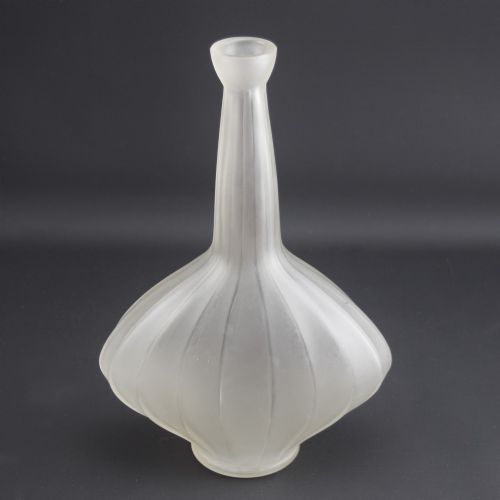


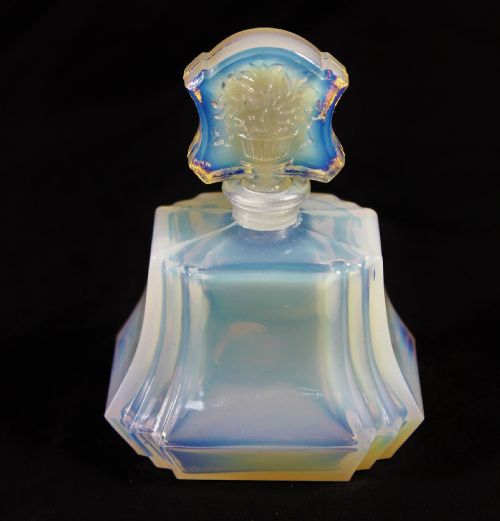
Moulded Glass Bottle
A moulded glass bottle brings tactile relief and sculptural form to a dressing table, combining utility with decorative art.
Moulded Glass Bottle
Every moulded glass bottle on this page is a vessel shaped by press or mould techniques, appearing in forms such as perfume bottles, atomisers, scent bottles, decanters, and flasks. These pieces span the Victorian period through to the 1920s and 1930s, capturing functional containers transformed into display objects.
The most frequent examples you will encounter here belong to the Art Deco era, particularly French pieces from makers working in opalescent and frosted glass. Alongside these, earlier Victorian and Georgian styles surface as decanters and flasks, showing simpler utilitarian roots before decorative moulding gained dominance.
The function of these vessels ranges from holding scent and cosmetics to serving liquids at table. Their survival often depends on whether stoppers or atomiser hardware remain intact alongside the main body.
Materials and methods of production
Moulded glass production relies on gathering molten material and pressing it into a metal or wooden matrix to form raised patterns and contours. The process allows for consistent replication of intricate botanical or geometric motifs across multiple items.
Materials span clear, frosted, opalescent, and patinated glass, sometimes enhanced with enamel or paper labels. Opalescent glass uses chemical additives that catch light differently across the moulded reliefs, shifting in tone depending on the angle of illumination.
Post-moulding work often involves acid-etching, staining, or hand-polishing specific details to accentuate the contrast between the recessed background and the raised design elements.
Listings feature periods spanning from the Victorian era through the 1920s and 1930s, using clear, opalescent, and frosted glass.
Factors that define quality
Quality rests primarily on the crispness of the moulded detail and the finish applied to the surface. Sharp, well-defined reliefs indicate a fresh mould and careful execution, whereas soft or blurred contours suggest worn tooling during production.
The treatment of the glass surface further separates standard utility pieces from fine decorative examples. Sophisticated use of frosting, staining, or opalescence creates depth that flat, uniform glass lacks.
The presence of matching original stoppers and legible signatures or maker marks elevates a piece. When the maker's vision extends to every integrated element, the object achieves its intended artistic unity.
Rene Lalique·Sabino
The Moulded Glass Bottle Glossary
- Opalescent glass
- Glass that displays a milky, bluish haze when viewed by transmitted light and a warm amber tone by reflected light. This optical effect is achieved through the inclusion of bone ash or arsenic during melting.
- Frosted glass
- Glass treated to achieve a matte, non-reflective surface, usually through acid-etching or sandblasting. It highlights sculptural mouldings by muting reflections.
- Patinated glass
- Glass enhanced with coloured pigments rubbed into the recessed areas of a moulded design. This technique heightens contrast and readability of the pattern.
- Quilt moulded
- A pattern of raised diamond or lozenge shapes formed in glass by blowing the gather into a patterned dip mould. It is commonly found on 19th-century flasks.
- Atomiser
- A device fitted to a perfume bottle that turns liquid fragrance into a fine spray using a bulb or pump. The metal and rubber hardware often dates the mechanism.
Moulded Glass Bottle: Frequently Asked Questions
What is a moulded glass bottle?
A moulded glass bottle is a vessel shaped in a rigid form rather than blown freehand, allowing for repeatable decorative patterns and sculptural reliefs.
These pieces were produced for vanity use, as scent bottles and atomisers, or for domestic service as decanters and flasks.
How do I date a glass scent bottle?
Dating relies on stylistic clues such as Art Deco geometry or Victorian ornamentation, alongside manufacturing methods and signature styles.
Makers often marked their work with moulded signatures, providing a direct link to specific periods of production.
Why is opalescent glass used?
Opalescent glass diffuses light across raised surfaces, accentuating the three-dimensional quality of moulded floral or abstract motifs.
The chemical composition creates shifting colour tones that change depending on the viewing angle and ambient light.
How should I clean my perfume bottle?
Cleaning requires gentle warm water and mild soap, avoiding harsh abrasives that can damage frosted or stained surfaces.
Care must be taken around paper labels, enamel work, and delicate atomiser hardware to preserve the original condition.